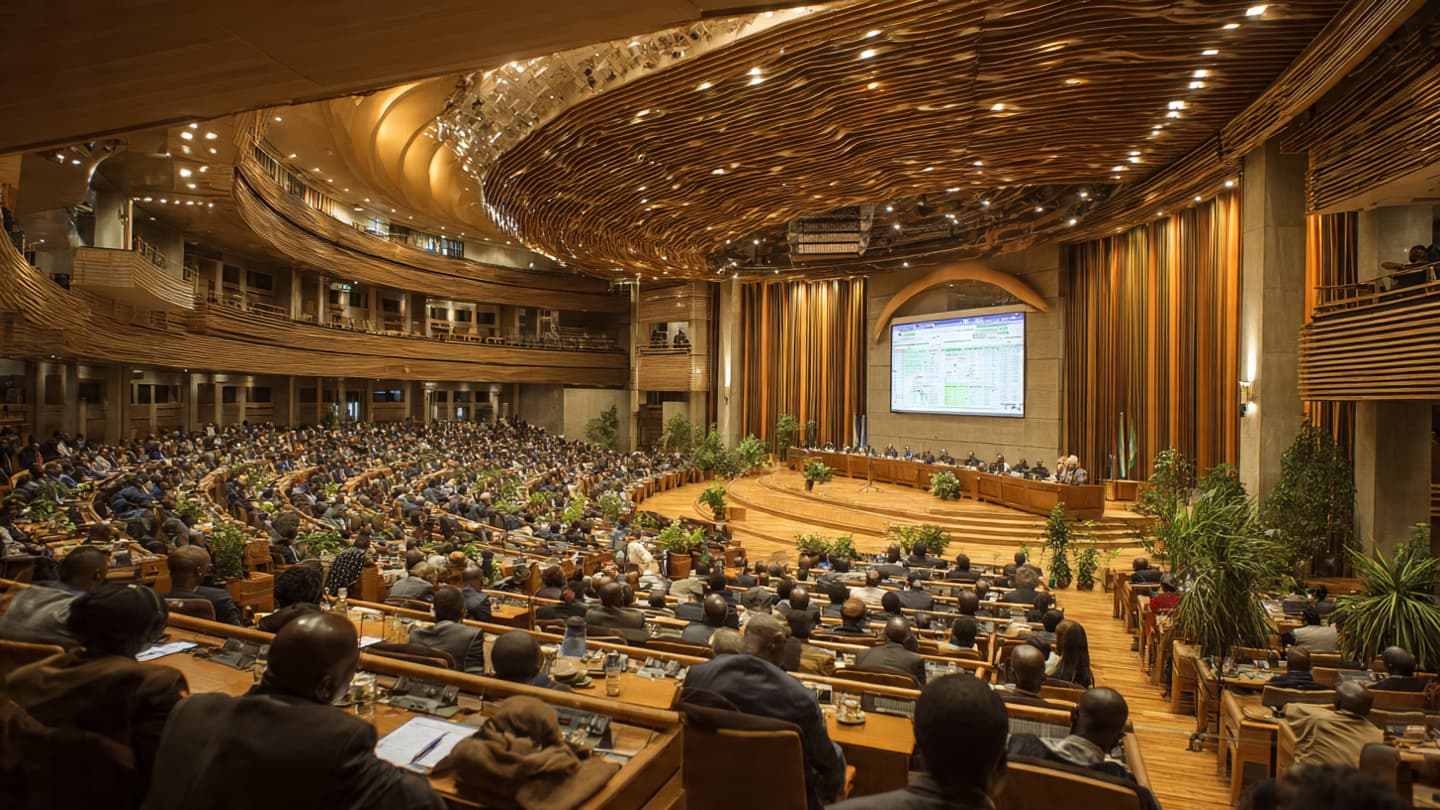
Across the wide corridors of Addis Ababa, where diplomatic conversations often move like measured footsteps across polished stone, a different kind of anticipation has been building. It is not the urgency of crisis that fills the air, but the slower, layered expectation of transformation — the kind that gathers around long-term visions of energy, infrastructure, and the quiet reshaping of economies.
At the AM 2026 African Development Bank Presidential Dialogue, leaders from across the continent have gathered to present and refine proposals that place energy access and green investment at the center of Africa’s development narrative. The conversations, while formal in structure, carry an undercurrent of urgency shaped by both climate realities and economic necessity.
Electricity, in many parts of the continent, remains a story still in progress — uneven grids stretching across borders, rural communities still waiting for reliable connections, and rapidly growing cities straining under demand that outpaces infrastructure. Within this context, energy is not only a technical challenge but a foundational question of equity and opportunity. It shapes education after sunset, industrial capacity, digital access, and even the rhythm of daily life.
Against this backdrop, the proposals presented at the dialogue have leaned heavily toward renewable solutions: solar corridors that follow the continent’s vast sunlight potential, wind projects along coastal and highland regions, and hydropower systems that seek to balance environmental limits with rising demand. Alongside these are discussions of financing mechanisms — public-private partnerships, regional investment frameworks, and expanded roles for multilateral development banks.
The African Development Bank has positioned itself at the center of these conversations, acting as both facilitator and financial anchor. Its leadership has emphasized that the transition to green energy is not simply an environmental imperative but also a strategic economic opportunity, one that could redefine Africa’s position in global supply chains and technological innovation.
Yet the tone of the dialogue remains carefully grounded. For all the optimism surrounding renewable expansion, participants are aware of the structural constraints that shape implementation. Financing gaps remain significant, and infrastructure development often moves at a pace that struggles to match policy ambition. In some regions, energy projects must contend not only with technical limitations but also with political instability, regulatory fragmentation, and climate volatility.
Still, there is a noticeable shift in framing. Where earlier development conversations often separated growth from sustainability, the discussions at AM 2026 increasingly treat them as intertwined. Economic expansion is now frequently discussed in the same breath as emissions reduction, energy efficiency, and climate resilience. This convergence reflects a broader global trend, but one that carries particular weight in a region where development needs are immediate and climate vulnerability is acute.
Throughout the dialogue, references to green industrialization have been especially prominent. Leaders and financial experts alike have pointed to the potential for Africa to move beyond resource extraction models toward manufacturing and value-added production powered by renewable energy systems. In this vision, solar farms are not isolated projects but nodes within broader industrial ecosystems; transmission lines are not only infrastructure but pathways of economic integration.
The conversations have also highlighted regional cooperation as a central requirement. Energy markets, many participants noted, do not stop at national borders. Power pools, cross-border grids, and shared regulatory frameworks are increasingly seen as essential to scaling up renewable capacity and ensuring stability in supply.
Beneath the policy language, however, lies a quieter human dimension. Energy access determines whether a child studies under a lamp or in darkness, whether a hospital maintains life-saving equipment during outages, whether small businesses expand or remain constrained by generator costs. These everyday realities give weight to the technical discussions unfolding in conference halls.
As the AM 2026 dialogue continues, the question that lingers is not only how Africa will finance its green transition, but how quickly and equitably that transition can be realized. The answers, still unfolding, depend on the alignment of vision, investment, and execution — a complex choreography that extends far beyond any single meeting.
For now, the conversations remain open, shaped by both ambition and constraint. Yet within them is a sense that the continent’s energy story is entering a new chapter — one written not only in policy documents and investment pledges, but in the gradual reimagining of what growth itself can mean in a warming world.
AI Image Disclaimer Visual materials are AI-generated and intended as conceptual illustrations of policy and energy development themes.
Sources African Development Bank (AfDB) Reuters Bloomberg World Bank African Union
Published by Banx Network. This article is part of the Banx decentralized media programme, powered by the BXE token on the XRP Ledger.