There are moments in science that feel less like calculated steps and more like stumbling upon a secret in an old attic—a photograph half-forgotten, yet capable of reframing an entire story. In the vast cosmic attic of space science, the young worlds orbiting the star V1298 Tau are exactly such a find. These planets, swollen with light gases and drifting in the glow of a star barely a fraction of the Sun’s age, seem almost like celestial infants freshly swaddled in their atmospheres, offering a glimpse of a cosmic childhood we’ve long sought but rarely seen.
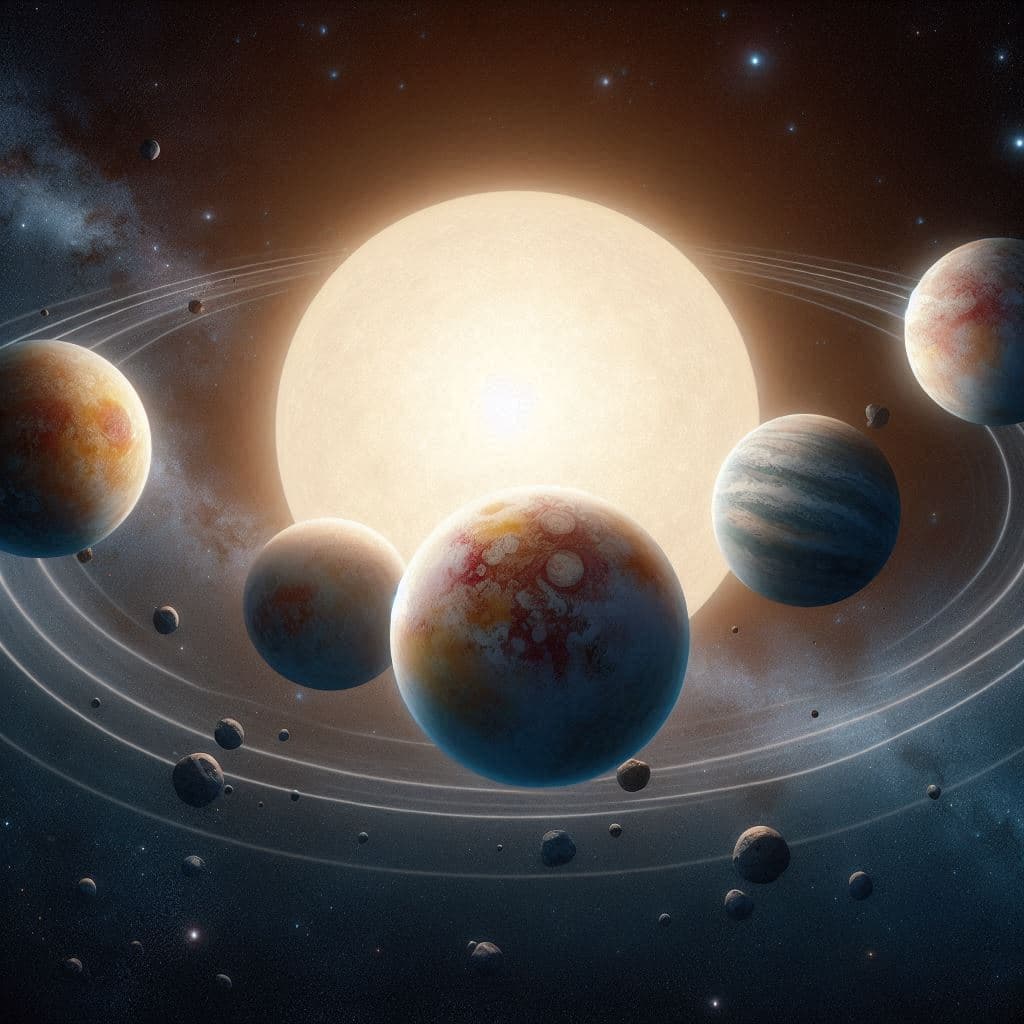
In a distant stellar nursery roughly 350 light-years away, an international team of astronomers has watched four planets in what can only be described as their formative stretch marks—expanded, low-density worlds that resemble cosmic cotton candy more than the rocky or dense gas giants we’re accustomed to cataloging. Their youthful size belies their true mass: although they are several times larger than Earth, they weigh only a modest handful of Earth-masses. This unusual combination makes them far puffier than what traditional planet formation theories would predict.
For decades, astronomers have puzzled over the origins of the galaxy’s most common planets—those between Earth and Neptune in size, orbiting close to their stars. These super-Earths and sub-Neptunes are abundant; yet, until now, a clear picture of their early evolution remained elusive. Observations of V1298 Tau provide a long-sought snapshot of this missing phase, capturing planets not as finished products but in the midst of growing up.
Using a decade’s worth of high-precision monitoring from a fleet of telescopes on the ground and in space, researchers were able to measure subtle variations in the timing of each planet’s transit across the face of the star. These tiny wobbles, caused by gravitational tugs among the siblings themselves, revealed their masses—circumventing the usual methods that struggle with the noisy activity of young stars.
The result was striking: planets that are physically large yet surprisingly light. Such low densities imply that these worlds possess voluminous, tenuous atmospheres that are already beginning to escape under the influence of their star’s intense radiation. Over time—millions of years, but quickly in cosmic terms—these “puffy babies” are expected to shed much of their gaseous envelopes and shrink into more compact super-Earths or sub-Neptunes, the kinds of planets scattered throughout the Milky Way.
In this sense, V1298 Tau is like a Rosetta Stone for planetary evolution: a rare key that helps decode the lifecycle of worlds that don’t exist in our own solar system but abound elsewhere in the galaxy. It reminds us that planetary birth is not a single moment but a process—a slow unfurling of shape and substance that leaves traces long after the cosmic cradle has faded.
As this research deepens, astronomers hope to witness even finer details of these transformations, shedding light on the complex interplay between young stars, nascent planets, and the ghostly gases that bind them together. For now, these cotton-candy worlds teach a humble lesson: that understanding our cosmic neighborhood often means observing not just where things are, but how they become.
In an ever-expanding universe of discoveries, the story of these puffy young planets stands as a reminder that the cosmos still holds chapters we have yet to read—pages that may rewrite the biographies of worlds beyond our own.
AI Image Disclaimer “Visuals are created with AI tools and are not real photographs, meant to serve conceptual illustration purposes.”
Credible sources found (mainstream & niche):
National Institutes of Natural Sciences Live Science ScienceDaily NAOJ (National Astronomical Observatory of Japan) Phys.org
Published by Banx Network. This article is part of the Banx decentralized media programme, powered by the BXE token on the XRP Ledger.