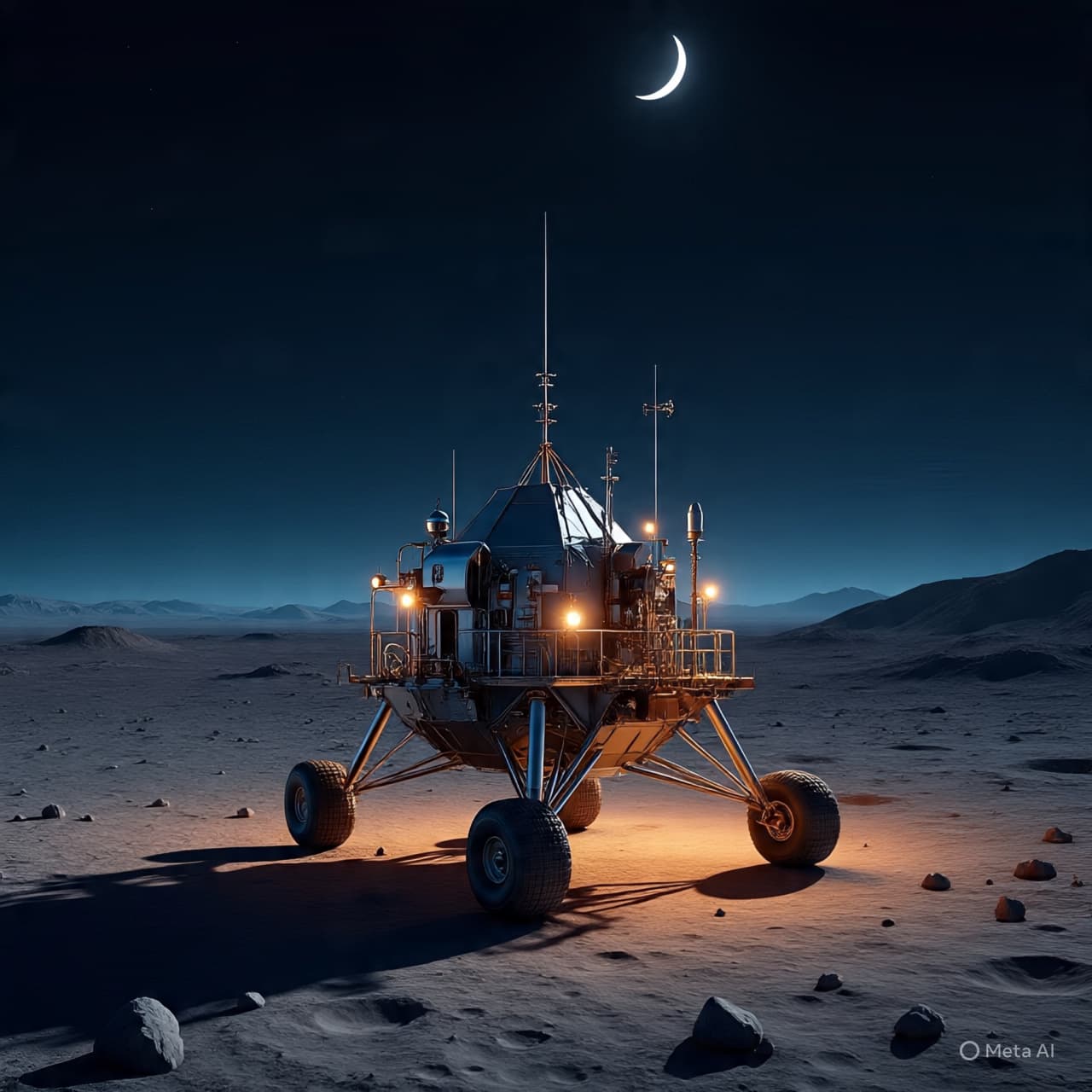
In the long shadow of the Moon’s night, where sunlight disappears for nearly two weeks at a time, survival becomes less about ambition and more about endurance. Machines sent there must learn patience. They must wait through darkness that stretches beyond ordinary imagination, holding their warmth and their purpose in silence.
It is in this quiet challenge that Europe’s work on radionuclide batteries begins to take shape. Backed by the European Space Agency and developed in collaboration with industrial partners such as Airbus Defence and Space, these compact power systems are designed to provide steady heat and electricity for lunar missions. Unlike solar panels, which depend on continuous sunlight, radionuclide batteries draw energy from the natural decay of radioactive materials, offering a constant and predictable source of power.
The concept is not new in space exploration. Radioisotope power systems have long supported missions venturing far from the Sun. Yet Europe’s renewed investment signals a strategic step toward sustaining lunar exploration under the Artemis era and beyond. As lunar ambitions expand — from robotic landers to potential habitats — the ability to endure the Moon’s frigid nights becomes essential.
The technology under development focuses on so-called Radioisotope Heater Units (RHUs) and potentially larger radioisotope power systems. These devices convert the heat released by decaying isotopes into usable thermal or electrical energy. In the Moon’s environment, where temperatures can plunge below minus 280 degrees Fahrenheit during the lunar night, such warmth is not a luxury; it is protection for delicate instruments and electronics.
Institutions including DLR are contributing research and engineering expertise. The effort reflects a broader European strategy to strengthen independent capabilities in deep-space technologies. Reliable energy systems are foundational, not only for surface missions but also for long-term scientific operations in permanently shadowed regions near the lunar poles.
There is a measured pragmatism in this approach. Solar arrays remain vital and efficient during daylight, but redundancy matters in exploration. A lander operating near the Moon’s south pole, where sunlight can be intermittent and low on the horizon, may depend on radionuclide-based systems to survive extended darkness. In that context, the battery becomes a quiet companion, emitting steady warmth while the landscape freezes around it.
Safety and regulatory oversight remain central to development. Handling and launching radioactive materials requires strict protocols and international compliance. European agencies emphasize that these systems are engineered with containment and shielding designed to withstand launch and landing contingencies.
The broader significance lies in resilience. As Europe positions itself within international lunar partnerships, dependable power systems expand the range of possible missions — from autonomous science stations to infrastructure supporting future crewed activity. Energy, in space, defines possibility.
In closing, the European Space Agency continues advancing research and testing of radionuclide battery technologies as part of its lunar exploration roadmap. While timelines for deployment will depend on mission planning and regulatory approvals, the development reflects Europe’s commitment to sustainable operations on the Moon. In the stillness of lunar night, these batteries may one day provide the steady pulse that keeps exploration alive.
AI Image Disclaimer Visuals are created with AI tools and are not real photographs.
Source Check
Credible mainstream and scientific sources covering this topic include:
European Space Agency Airbus Defence and Space DLR SpaceNews Reuters
Published by Banx Network. This article is part of the Banx decentralized media programme, powered by the BXE token on the XRP Ledger.