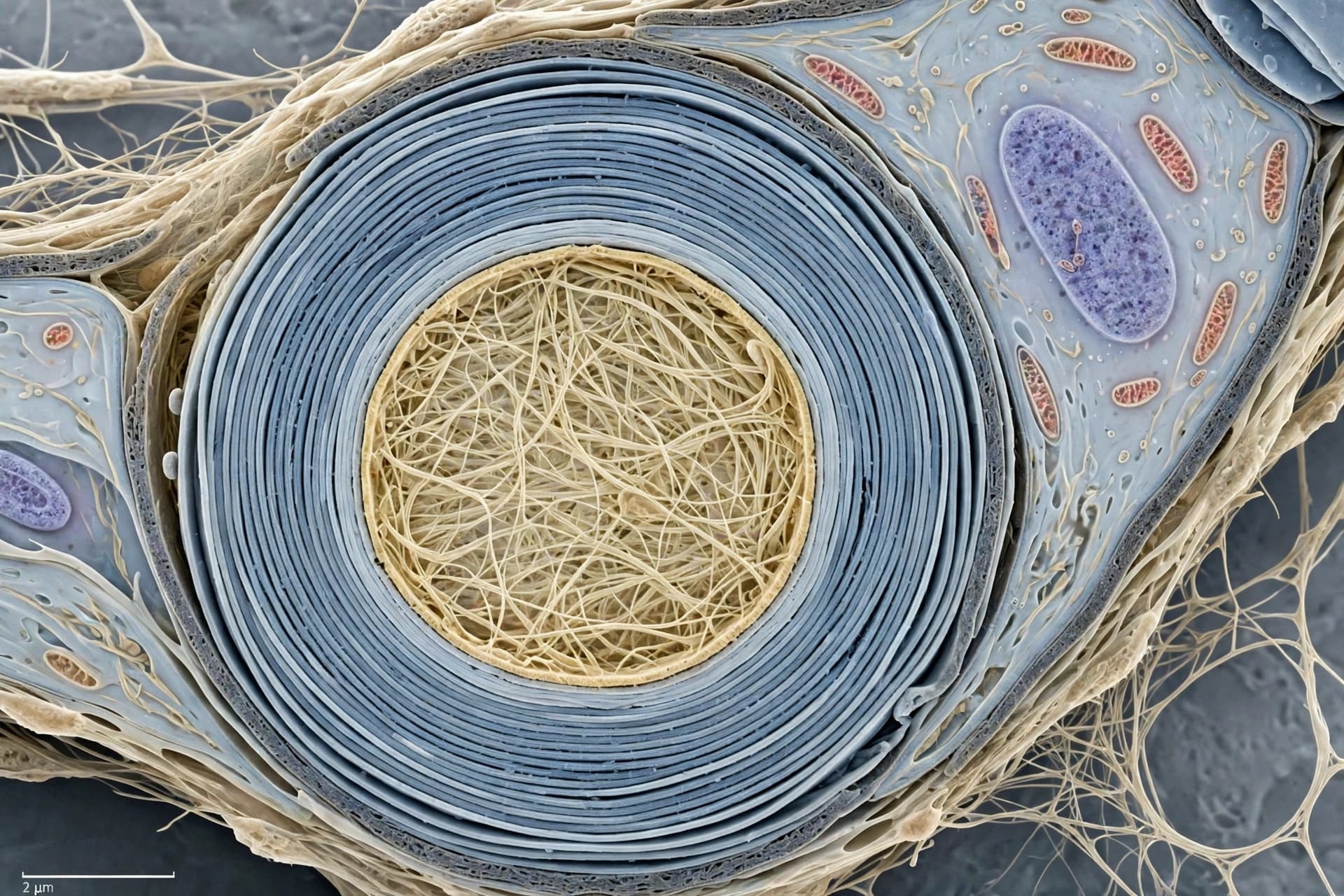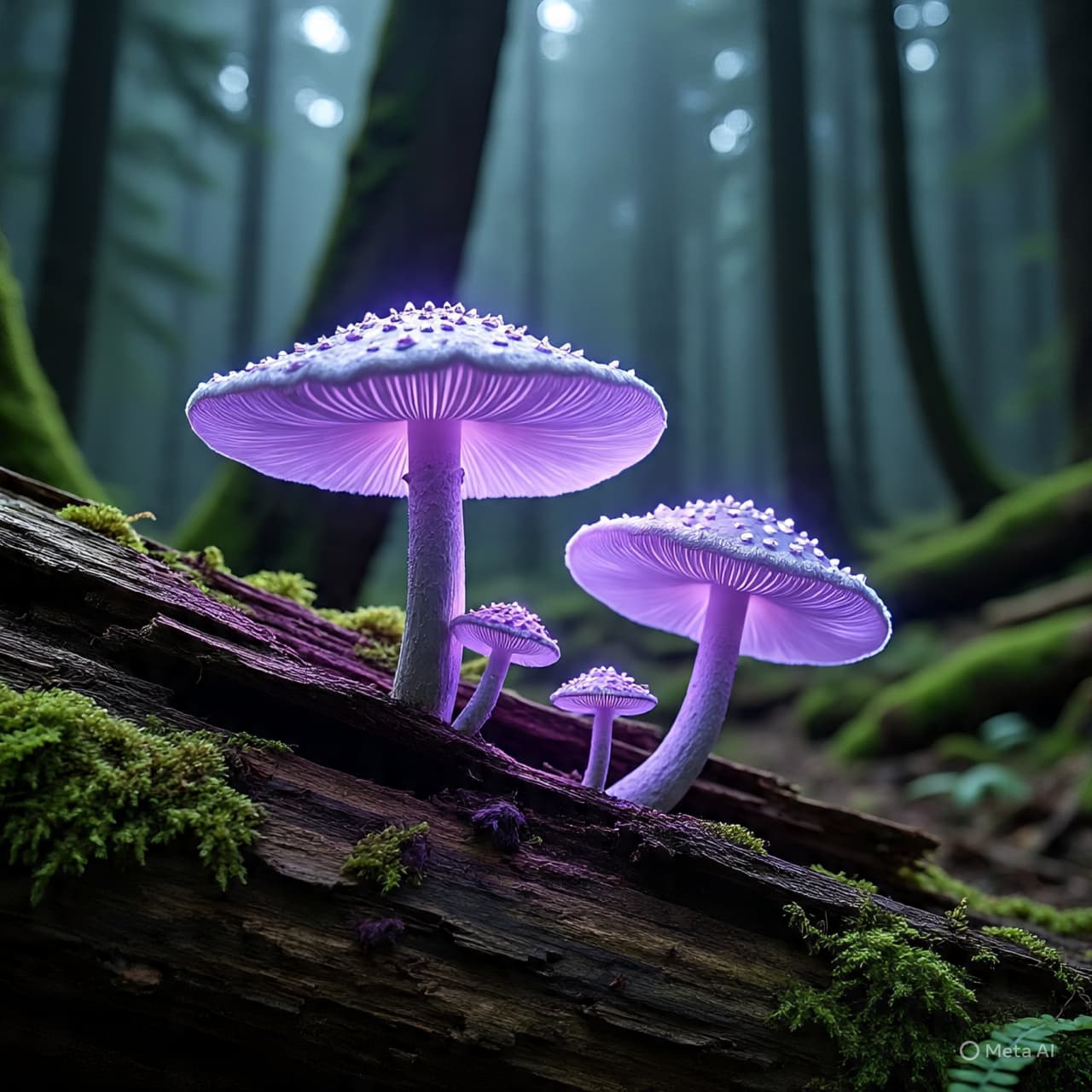
Just after the last birdcall dissolves into evening, when the air cools and the forest floor exhales the day’s stored warmth, something almost imperceptible begins to gather beneath the leaves. It is not the sharp flare of lightning nor the steady beam of a lantern. It is softer than that — a hush of color, a violet breath rising from bark and fallen wood, as though the earth itself remembers an older language of light.
To walk through a nearby woodland and discover it faintly aglow can feel like stepping sideways in time. The purple shimmer does not command attention. It asks for patience. Eyes must adjust; steps must slow. Only then does the undergrowth begin to reveal thin ribbons of radiance tracing along rotting logs, small caps of fungi emitting a subdued, otherworldly glow. The light seems less like illumination and more like a pulse — a quiet persistence in the dark.
Scientists have long documented bioluminescence in forests around the world, a phenomenon most often associated with certain species of fungi. While many emit a greenish glow commonly known as “foxfire,” researchers have also recorded variations in hue depending on species, chemical composition, and the way human eyes interpret faint light in darkness. Under specific conditions — moisture, temperature, and the deep absence of competing artificial light — these organisms can cast what appears to be a subtle purple wash across bark and soil.
The glow originates from a chemical reaction within the fungal cells. Compounds known as luciferins react with oxygen in the presence of enzymes called luciferases, releasing energy in the form of light. It is a process remarkably efficient, producing little heat — light without flame, brightness without burn. For the fungi, scientists believe the glow may help attract insects that aid in spore dispersal, ensuring survival through quiet collaboration with the forest’s smallest travelers.
Reports of luminous woods are not new. Naturalists centuries ago described walking through forests that shimmered faintly at night, their observations often dismissed as imagination or folklore. In recent years, however, photographers and researchers have captured clearer evidence, documenting glowing mushrooms across parts of Asia, Australia, and the Americas. What once sounded mythical has become measurable, though no less wondrous.
The sense of closeness matters. One does not need to journey to distant rainforests to encounter such phenomena. In temperate woodlands, especially after sustained rainfall, clusters of bioluminescent fungi may emerge on decaying hardwood. Their presence is seasonal and fleeting. A log that glows tonight may appear ordinary by morning, its secret visible only to those who arrive at the right hour.
Yet the purple impression is not solely a matter of biology. Human perception in near darkness relies heavily on rod cells in the retina, which are more sensitive to low light but less precise in color detection. Under such conditions, faint green emissions can appear bluish or violet to the eye. What feels like a forest bathed in amethyst may be, in part, the collaboration between organism and observer — chemistry meeting consciousness.
There is something humbling in that partnership. The glow does not dominate the night; it coexists with it. Overhead, the canopy remains black against the stars. Around it, crickets maintain their rhythm. The illuminated fungi do not banish darkness. They soften it, suggesting that obscurity is rarely absolute.
In an era when artificial light spills into nearly every horizon, the rediscovery of natural luminescence carries a quiet resonance. Researchers continue to study the ecological role of glowing fungi, as well as their potential applications in sustainable lighting and biological research. For now, their presence remains largely an ecological curiosity — delicate, intermittent, and deeply dependent on undisturbed habitats.
Forestry experts note that preserving decaying wood and maintaining healthy forest ecosystems are essential for sustaining fungal biodiversity, including bioluminescent species. Observers are encouraged to avoid disturbing specimens and to experience the phenomenon without removing or damaging it.
The forest’s hidden purple glow is neither spectacle nor spectacle-seeker. It is a small, persistent reminder that light can emerge where least expected — not as conquest over darkness, but as accompaniment.
AI Image Disclaimer
Visuals are AI-generated and serve as conceptual representations.
Source Check
BBC National Geographic Smithsonian Magazine The Guardian The New York Times
Published by Banx Network. This article is part of the Banx decentralized media programme, powered by the BXE token on the XRP Ledger.