There are lights in the night sky that do not belong entirely to the present. They arrive delayed, softened by distance, carrying with them a record of time that has already passed. To look upward is, in some quiet way, to look backward—into moments that unfolded long before the Earth had taken its current form.
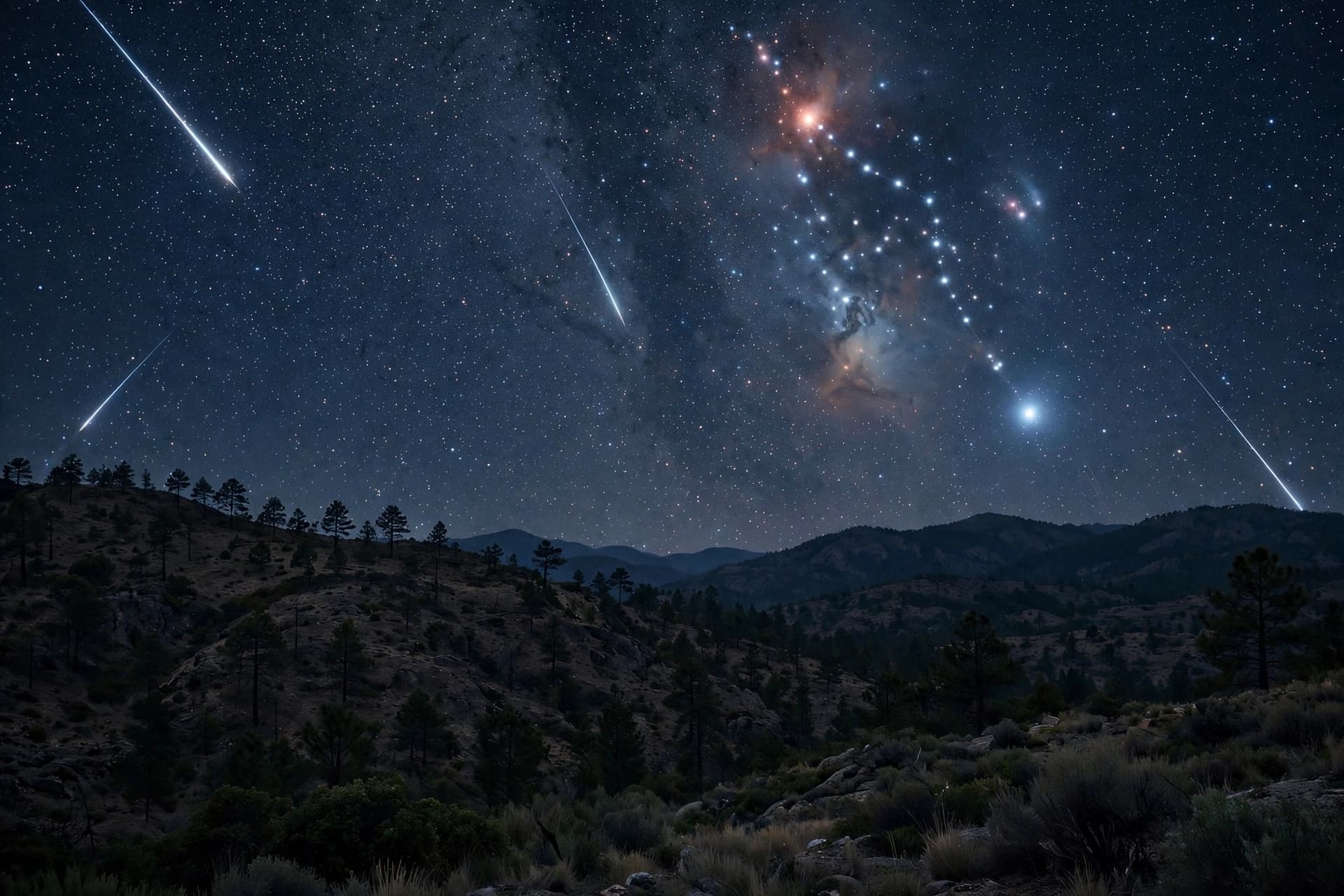
It is within this layered sky that astronomers continue their patient work, tracing faint signals across immense distances. Using the Dark Energy Camera, known as DECam, mounted on a telescope in Chile, researchers have captured the image of a star whose origins reach deep into the early history of the universe. It is not the brightness of this star that draws attention, but its age—its light suggesting a formation not long after the first generations of stars began to emerge.
DECam, designed to observe wide fields of the sky with exceptional sensitivity, allows scientists to detect objects that would otherwise remain hidden within the background of countless points of light. Through its lens, the sky becomes less crowded and more legible, revealing differences that are not immediately visible to the eye alone.
The star identified in these observations is considered one of the oldest known, a relic of an earlier cosmic era. Its composition holds particular significance. In the early universe, only the simplest elements—primarily hydrogen and helium—were abundant. Heavier elements, such as carbon, iron, and oxygen, were forged later within stars and distributed through supernova explosions. A star with extremely low levels of these heavier elements suggests it formed before such processes had become widespread.
In this sense, the star becomes more than an object; it becomes a record. Its chemical makeup preserves conditions that no longer exist in the same form, offering a glimpse into a time when the universe was simpler, less enriched, and still in the process of building complexity.
Finding such stars is not straightforward. Over billions of years, galaxies evolve, stars are born and die, and the materials that make up new generations become increasingly mixed. Ancient stars, especially those that have remained relatively unchanged, are rare and often difficult to distinguish from the vast population that surrounds them. It requires careful measurement, the analysis of light spectra, and the ability to isolate subtle differences in composition.
The use of DECam in this context reflects a broader movement in astronomy—one that combines wide-field imaging with detailed follow-up analysis, allowing scientists to both locate and understand objects that might otherwise remain unnoticed. Each discovery adds a small but meaningful piece to a much larger narrative: the story of how the universe moved from simplicity toward the complexity observed today.
There is, perhaps, a quiet resonance in observing such an object. A star that has endured across billions of years does not announce itself. It remains, steady and distant, its light continuing to travel, carrying with it the conditions of its origin.
Astronomers using the Dark Energy Camera have photographed one of the oldest known stars, identified by its extremely low abundance of heavy elements. The finding provides insight into the early universe, offering evidence of stellar formation shortly after the first generations of stars emerged.
AI Image Disclaimer
Visuals are AI-generated and serve as conceptual representations.
Source Check NOIRLab NASA Science Nature BBC
Published by Banx Network. This article is part of the Banx decentralized media programme, powered by the BXE token on the XRP Ledger.