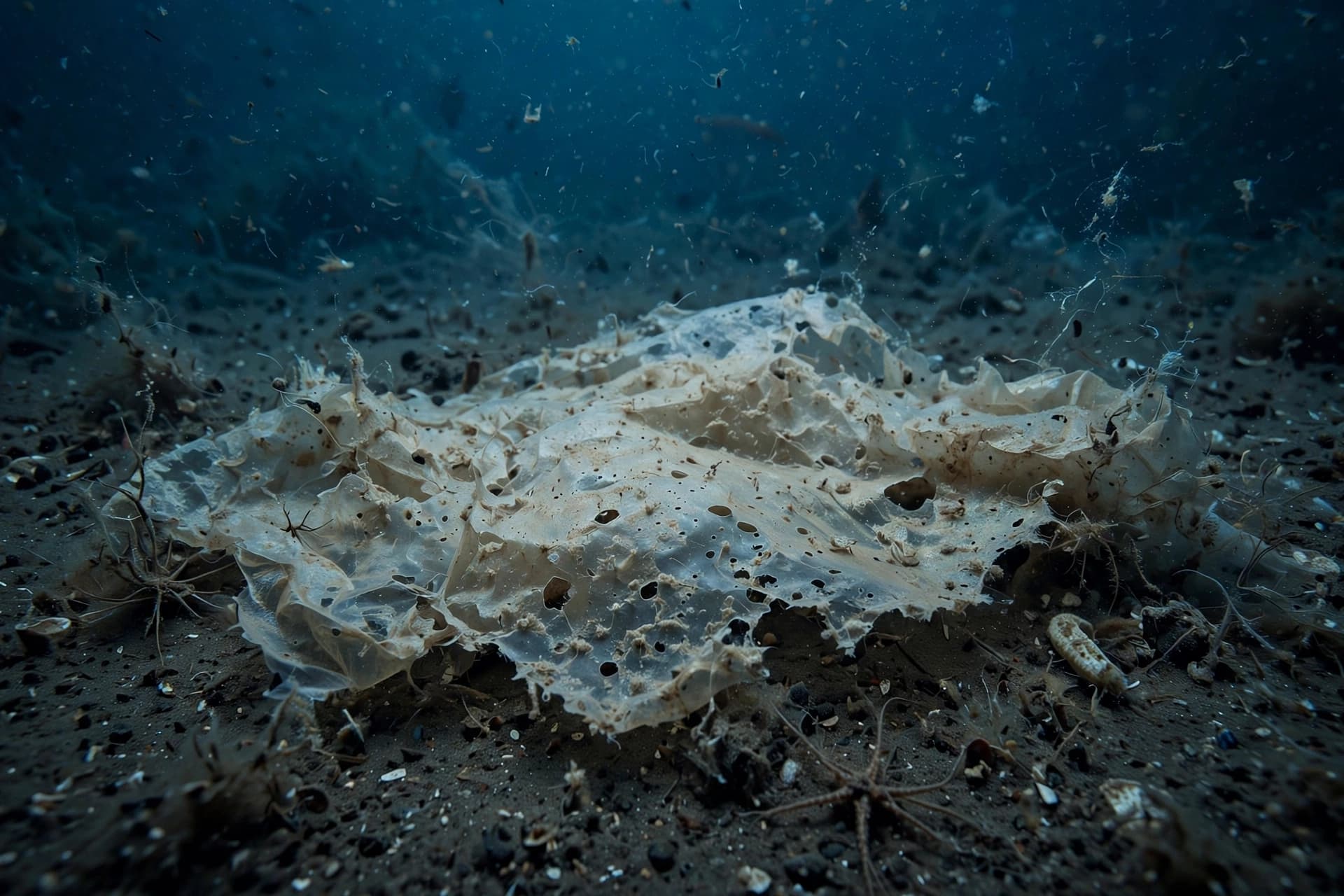
The deep sea is a place of patience. Cold, dark, and vast, it receives what the surface sends down—organic matter, minerals, and, increasingly, plastic—and breaks it down at a pace measured in years, sometimes decades. Microbes are scarce there. The conditions that make life possible on the ocean floor are the same conditions that make biodegradation slow. A compostable bag that disappears in weeks on land might linger for years in the abyss, a ghost of human convenience settled into the sediment.
A new material, developed by researchers at the University of Tokyo and collaborating institutions, offers a way to accelerate that timeline. By embedding natural degradation enzymes directly into biodegradable polyester during heat molding, the team created plastics that break down rapidly even in the deep sea, where microbial populations are sparse and temperatures are low . The findings were published in Nature.
The mechanism is elegant in its simplicity. The enzymes—cutinase or lipase, among others—are mixed into the plastic at temperatures above its softening point, preserving their activity while dispersing them throughout the material. In dry conditions, the enzymes remain dormant. When the plastic enters water and begins to wear or fragment, the enzymes contact water and initiate degradation . In experiments, enzyme-embedded poly(butylene succinate-co-adipate) and polycaprolactone films achieved substantial mass losses after eighteen months on deep-sea floors. At a site 757 meters deep, PBSA lost 57.3 percent of its mass and PCL lost 99.0 percent, while enzyme-free controls showed negligible degradation . At a coastal site, complete degradation occurred within one month; at 750 meters depth, within five months .
The enzyme-embedded plastics degraded roughly thirty times faster than their enzyme-free counterparts . Even at 5,503 meters depth, where pressure is immense and temperatures near freezing, the embedded enzymes retained activity. Laboratory pressure-vessel experiments confirmed that enzymatic hydrolysis continued at pressures equivalent to 2,500 meters, though degradation rates slowed somewhat at the greatest depths . The enzymes themselves do not depend on the presence of specific microbial communities—they carry their own capacity for breakdown, a kind of内置 mechanism that travels with the material wherever it goes.
The implications extend beyond the deep sea. "As the plastic can be decomposed by enzymes in a harsh environment on the seabed, the findings can also be used in other environments such as mountains and rivers," said Professor Iwata Tadahisa of the University of Tokyo . The technology maintains the strength and flexibility of the original plastic and can be thermomolded into products. The enzymes do not degrade during use because they require water to activate .
The problem the work addresses is not abstract. An estimated eight million tons of plastic waste enter the ocean each year, much of it in forms that resist degradation for centuries . Biodegradable plastics have offered a partial answer, but their performance in the deep sea has been disappointing outside of a few specialized materials like PHAs . By embedding enzymes that work independently of microbial abundance, the Tokyo team has extended the reach of biodegradable plastics into environments where they previously fell short.
What remains is the question of scale, cost, and adoption. The enzymes add complexity to manufacturing. The plastics must still be collected and disposed of in conditions that allow degradation. But the material itself now carries a capacity it did not have before—a capacity to break down in the places where human waste accumulates and time moves slowly, and where, until now, the plastic simply waited.
The images in this article are AI-generated and are not photographs of the experiments or researchers described.
Sources: Nature, NEDO, NHK World-Japan, University of Tokyo
Published by Banx Network. This article is part of the Banx decentralized media programme, powered by the BXE token on the XRP Ledger.