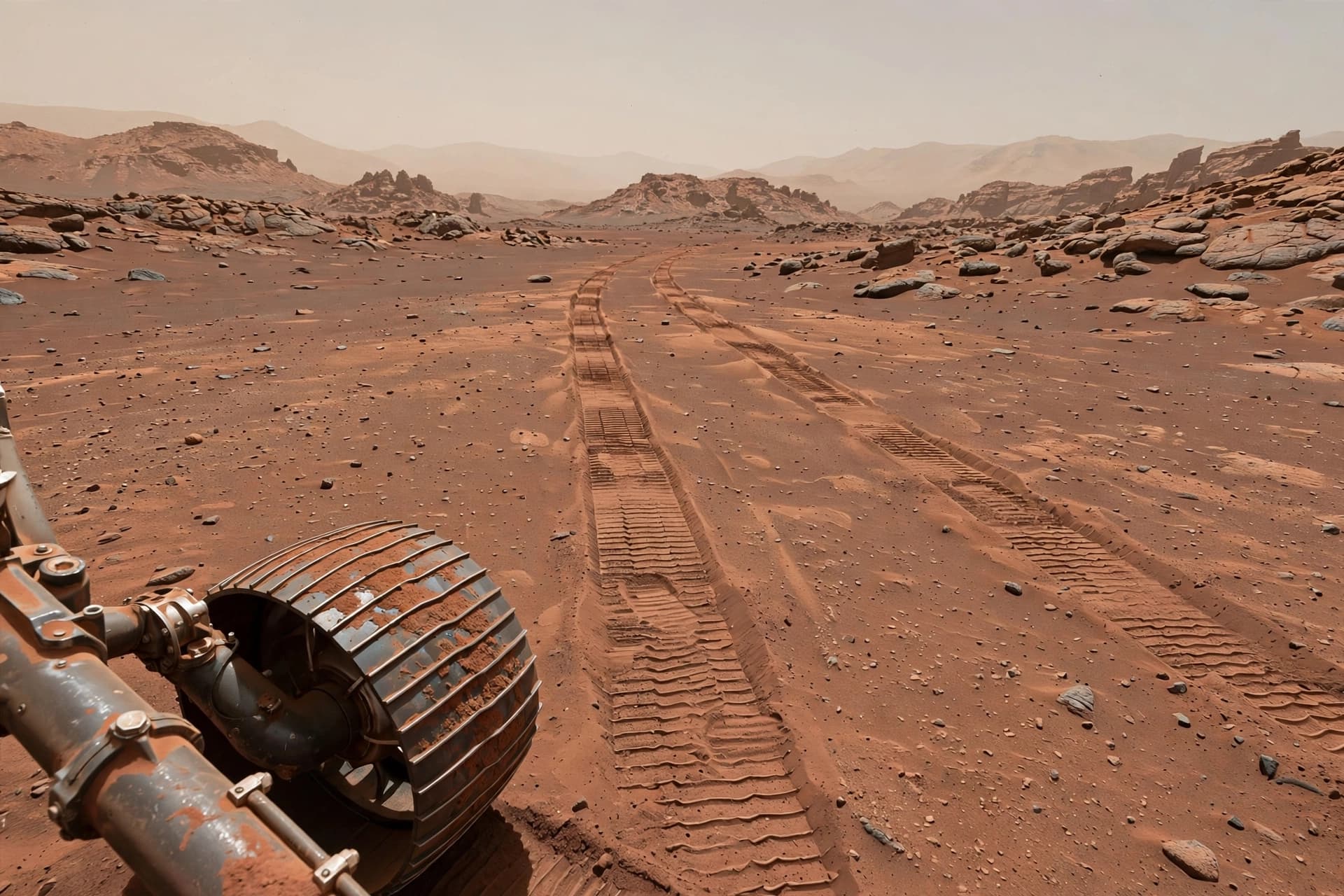
There is something quietly moving about a machine looking back at where it has been. On a planet where no human has walked, where the dust rises and settles without witness, a rover turned its cameras toward its own wake and captured a line pressed into the Martian surface—a trail that represents more distance than anything has ever traveled on another world.
On October 11, NASA's Perseverance rover surpassed 28.10 miles (45.22 kilometers) driven on Mars, earning the interplanetary driving record . The previous record belonged to Opportunity, which took roughly fourteen years to cover that distance. Perseverance did it in just over five years . The image, released as Space.com's photo of the day for October 27, shows the rover's own tracks stretching behind it, a simple mark in the dust that carries the weight of years.
The record is not the whole story. Since landing in 2021, Perseverance has observed, sampled, and studied rocks, boulder fields, and slopes across the Red Planet . Recently, observations made using the rover provided the strongest evidence yet of possible biosignatures on Mars—chemical traces that might, just might, suggest something once lived there . The driving record is a metric of distance. The science is a measure of something harder to quantify: how close we have come to answering a question that has followed humanity for as long as we have looked up at the red dot in the sky.
The rover's journey has also pushed the boundaries of autonomous driving on other worlds. Vandi Verma, chief engineer for robotic operations at NASA's Jet Propulsion Laboratory, has described the team's ongoing efforts to explore new and better ways to drive rovers remotely from another planet . Each mile logged is not only a mile of Martian terrain but a mile of experience in operating a machine across the vast distance between Earth and its neighbor.
What the image captures, beyond the tracks themselves, is a moment of reflection—literal and figurative. Perseverance looked back at its progress, and in doing so, allowed those of us on Earth to look with it . The trail in the dust is a line drawn by human curiosity, executed by a robotic hand, on a world that has no memory of either.
The record will eventually be broken. Another rover, perhaps a human mission, will travel farther. But the tracks in this photograph belong to a specific moment in time, a specific machine, and a specific effort to understand a place that remains, in so many ways, beyond our reach.
The images in this article are AI-generated and are not actual photographs from Mars.
Sources: Space.com, Yahoo, NASA/JPL-Caltech
Published by Banx Network. This article is part of the Banx decentralized media programme, powered by the BXE token on the XRP Ledger.