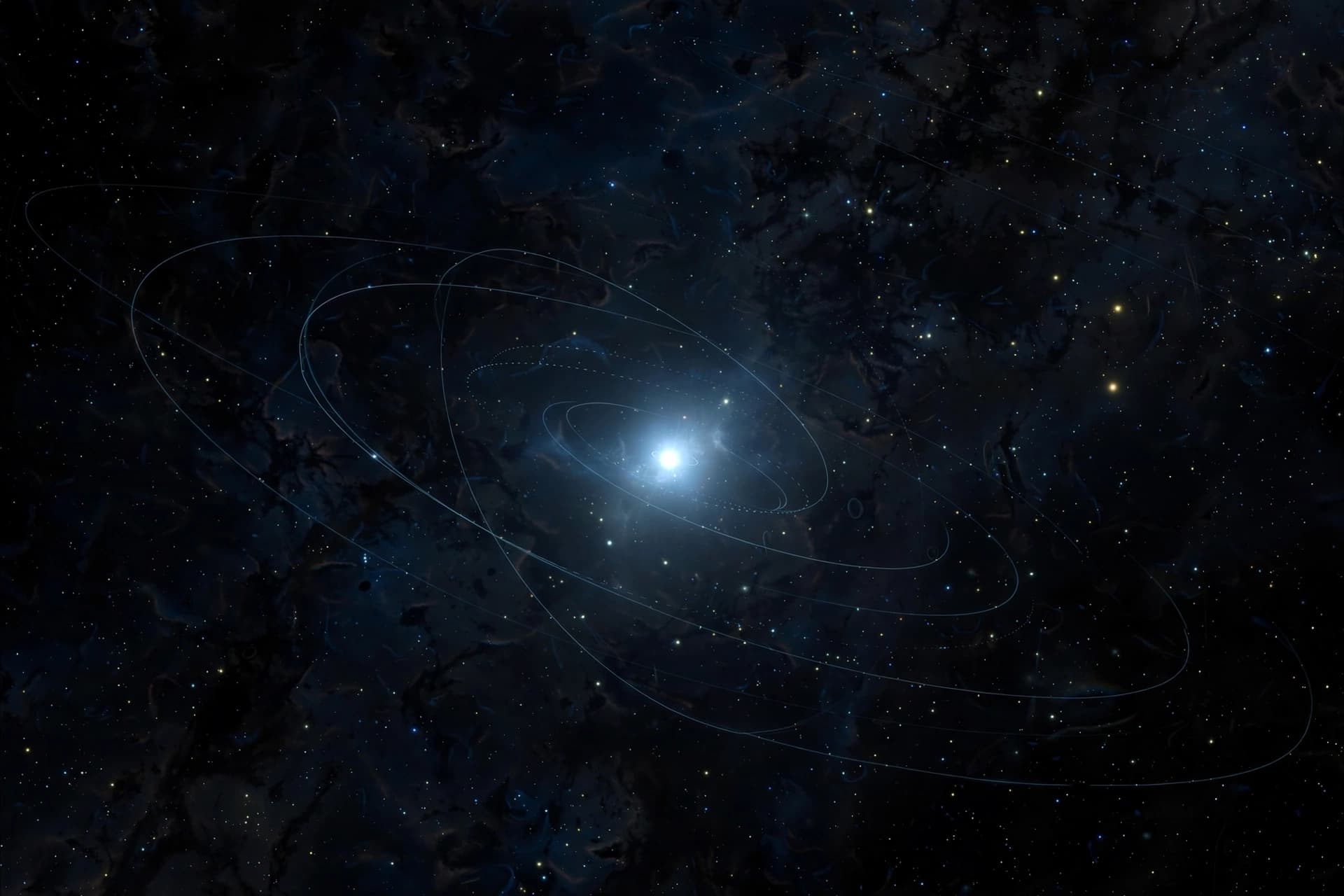
There are places in the universe where time seems to gather itself at the beginning—where matter has not yet settled into permanence, and form is still an unfolding possibility. Around certain young stars, light filters through vast disks of gas and dust, and within those quiet շրջան of motion, something gradual and deliberate begins to take shape.
Astronomers have now reported direct confirmation of two forming planets orbiting a young, Sun-like star, offering a rare glimpse into a stage of planetary birth that is often inferred but seldom observed so clearly. These worlds, still in their earliest phases, are embedded within a protoplanetary disk—a broad, rotating field of material that both feeds and reveals their emergence.
The observation draws from advances in astronomy and astrophysics, where increasingly sensitive instruments allow scientists to resolve fine structures within these distant systems. In this case, the presence of the planets is not suggested solely by indirect signals, but by visible features within the disk itself—gaps, spirals, and localized disturbances that align with theoretical predictions of planet formation.
As a young planet gathers material, it exerts gravitational influence on its surroundings, carving subtle paths through the disk. Dust and gas shift in response, creating patterns that can be detected across vast distances. These newly confirmed planets appear to be shaping their environment in precisely this way, their presence marked by distinct separations in the disk’s structure.
What makes this observation particularly significant is its clarity. While astronomers have long identified candidate forming planets, direct confirmation—where both the planetary bodies and their effects are observable—remains uncommon. It offers a more complete picture, allowing researchers to compare theory with observation in a more immediate way.
The host star, similar in mass and character to our own Sun, provides an additional point of reflection. Systems like this are often considered analogs to the early solar system, offering a window into processes that may have once unfolded closer to home. In the shifting dust and emerging orbits, there is a distant echo of origins—of how planets, including Earth, may have first taken shape.
Yet even here, the process resists simplicity. Planet formation is not a uniform sequence, but a dynamic interplay of accumulation, collision, and migration. The two forming planets may continue to evolve, altering their paths, gathering mass, or interacting with one another over time. What is observed now is only a moment within a much longer arc.
There is a certain quiet in these early stages. No sudden brightness announces the birth of a planet, no singular event marks its arrival. Instead, it emerges gradually, its presence written into the structure of the disk, its future carried forward by gravity and motion.
Astronomers confirm that two protoplanets have been directly observed forming within a disk around a young Sun-like star. The findings provide strong evidence of early-stage planet formation, with visible disk structures corresponding to the planets’ positions. Researchers continue to study the system to better understand how such planets evolve over time.
AI Image Disclaimer
Illustrations were created using AI tools and are not real photographs.
Sources
Nature Science ESO NASA The Astrophysical Journal
Published by Banx Network. This article is part of the Banx decentralized media programme, powered by the BXE token on the XRP Ledger.