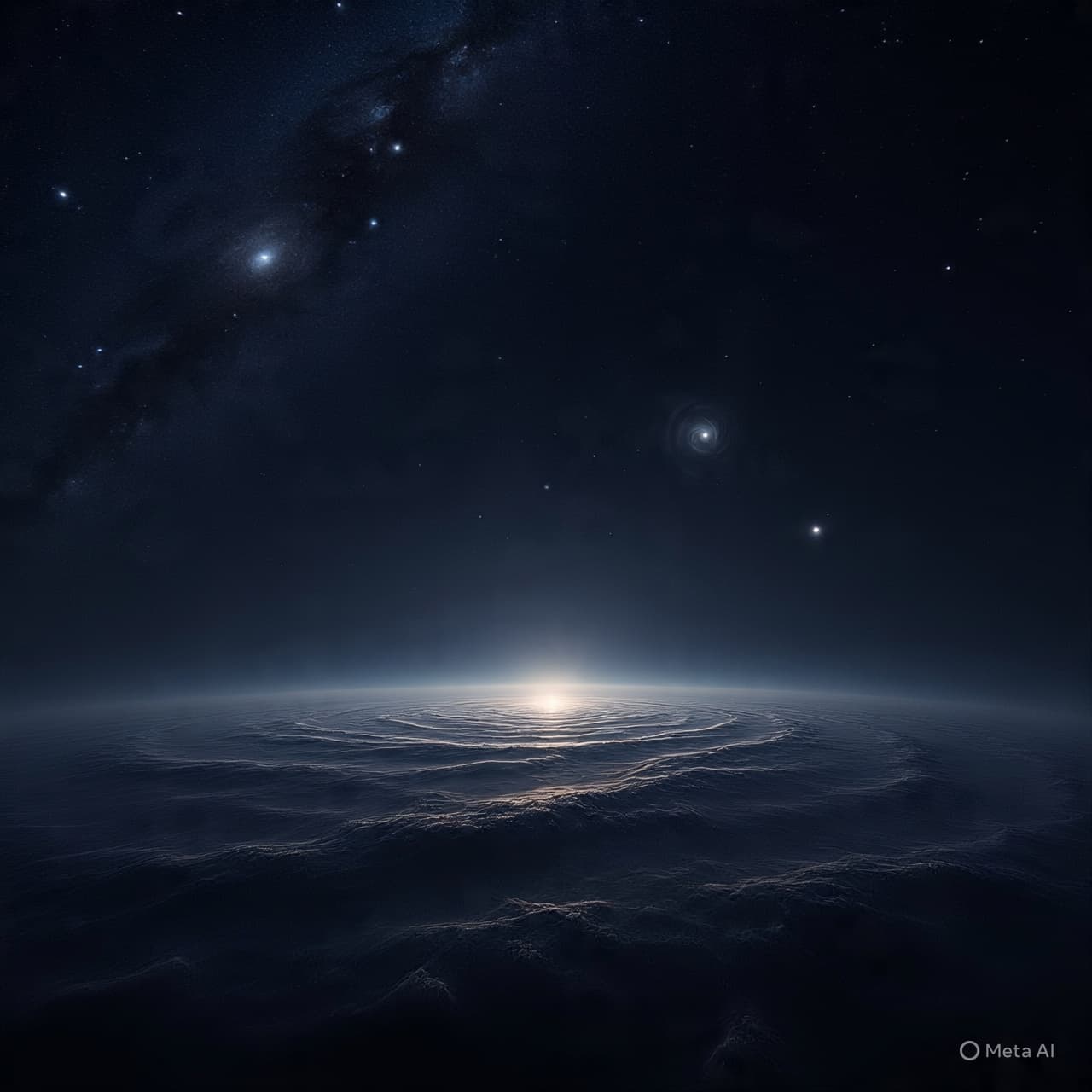
Long before galaxies learned their shapes and stars found their steady rhythms, the universe lingered in a deep and patient dusk. It was an age without light as we know it, a cosmic pause where matter gathered itself quietly, like breath held before a first word. In that silence, darkness was not an absence but a presence, dense with possibility. And within it, astronomers now believe, strange stars may have flickered—not with brightness, but with influence.
These hypothetical objects, often called dark stars, are thought to have formed in the universe’s earliest chapters. Unlike familiar stars that shine by nuclear fusion, dark stars may have been powered by dark matter annihilation, a process invisible yet energetic. In this idea, darkness does not merely surround the stars; it feeds them, sustaining vast, swollen forms that glow softly, if at all.
Dark matter, which outweighs ordinary matter five to one, does not interact with light. Yet gravity binds it closely to the architecture of the cosmos. In the young universe, dense halos of dark matter may have cradled the first clouds of hydrogen and helium. Where gravity pulled hardest, something unusual could have occurred: dark matter particles colliding and annihilating, releasing energy just enough to prevent collapse, but not enough to ignite fusion.
The result, theorists suggest, would be stars unlike any we know—enormous, cool by stellar standards, and long-lived. Their surfaces may have glowed faintly red, while their interiors were governed by physics still being tested in equations and simulations. These objects, if they existed, would have delayed the birth of conventional stars, subtly reshaping the timeline of cosmic dawn.
Yet illumination does not always mean light. Dark stars may have illuminated the early universe by structure rather than shine. Their mass could have seeded early black holes, explaining how supermassive black holes appeared so quickly after the Big Bang. Their gravity may have guided the assembly of the first galaxies, tracing invisible paths later filled with light.
Modern telescopes are beginning to peer far enough back to test these ideas. Observatories like the James Webb Space Telescope are revealing objects that appear too massive, too early, challenging familiar models. Some astronomers wonder whether these are echoes of dark stars, or whether the universe is simply reminding us how much remains unlearned.
Dark stars remain theoretical, balanced carefully between mathematics and imagination. But their appeal lies in what they suggest: that darkness itself may have played a creative role. In the universe’s earliest moments, before starlight defined time and distance, it may have been the unseen that quietly set the stage.
As observations sharpen and theories mature, the question is no longer whether darkness mattered, but how deeply it shaped the cosmos we now observe.
In astronomy, progress often comes not from banishing darkness, but from listening to what it implies.
AI Image Disclaimer
Illustrations were produced with AI and serve as conceptual depictions rather than real astronomical photographs.
Sources
NASA European Space Agency (ESA) Nature Science Scientific American
Published by Banx Network. This article is part of the Banx decentralized media programme, powered by the BXE token on the XRP Ledger.