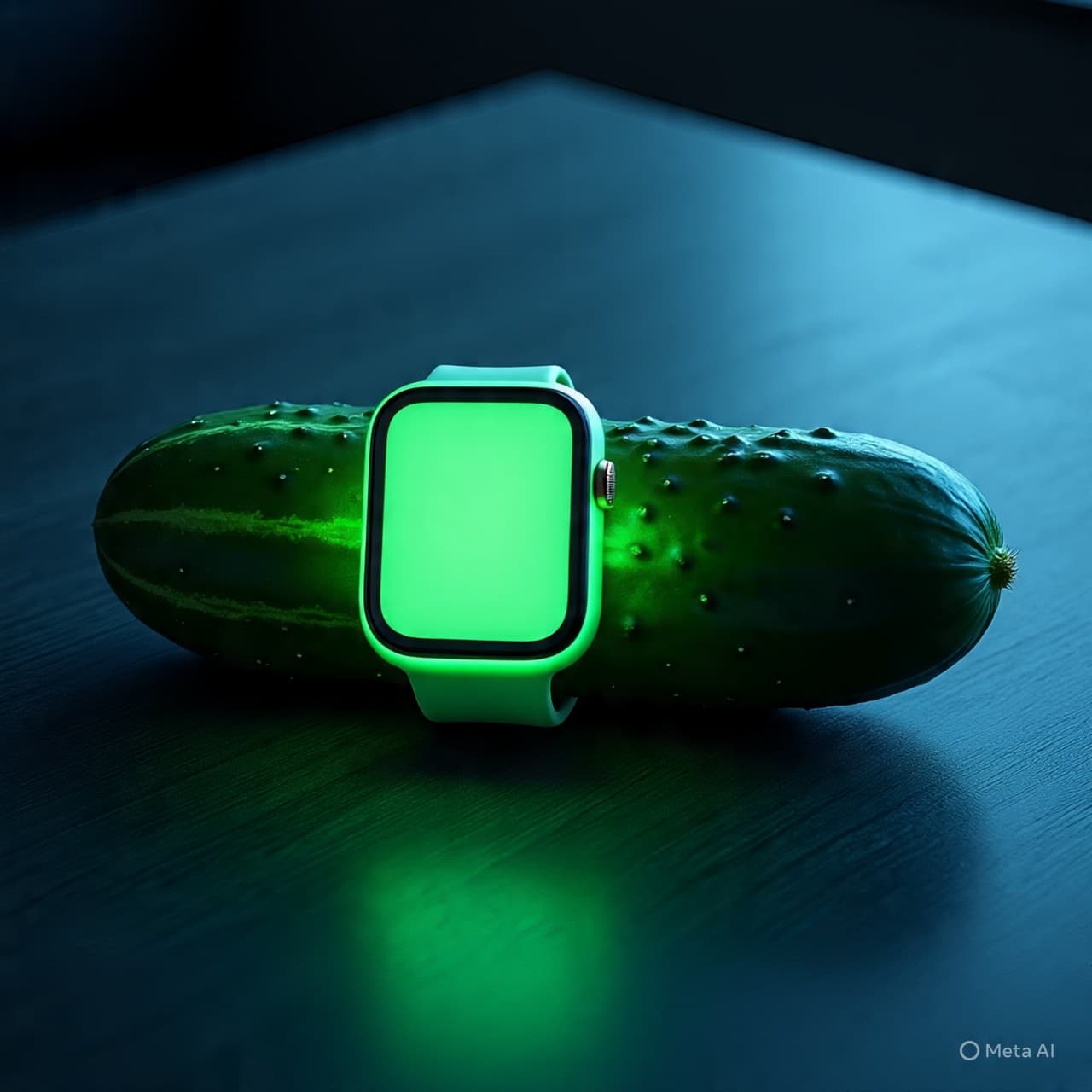
There are stories in the tech world that sound almost too absurd to carry meaning. A smartwatch detecting a heartbeat on a cucumber is one of them — a headline that feels like a punchline. But its absurdity is precisely what makes it revealing. Beneath the humor lies a reminder of how easily consumers can be misled in an era when even the simplest metrics carry the weight of health, fitness, and daily reassurance.
The demonstration, shared by researchers and consumer advocates, shows counterfeit smartwatches displaying pulse readings when strapped to inanimate objects. No skin, no blood flow, no biological signal — just the steady, unwavering quiet of a vegetable. And yet, the watch reports life where there is none.
The trick is rooted in oversimplified sensor design. Many imitation models do not measure biometrics at all; instead, they generate numbers that mimic plausible readings. They are programmed to reassure rather than detect, to simulate precision rather than achieve it. Real wearable sensors rely on complex optical patterns, algorithms, calibration, and error correction. Fake devices bypass all of that, producing a kind of health theater that looks convincing but collapses under scrutiny.
For consumers, the implications are larger than a viral video. Wearables have become proxies for personal well-being — tools for monitoring sleep, stress, heart health, and daily rhythm. When these devices fail, they don’t just present bad data; they erode confidence in the technology meant to empower us. And when counterfeit models proliferate across online marketplaces, the line between reliable and deceptive blurs in ways that can be risky.
There is also a deeper cultural shift beneath this moment. People increasingly live alongside metrics — steps counted, calories inferred, heartbeats graphed into colored arcs. Numbers become narratives, shaping how individuals interpret their bodies. If those numbers are fiction, the narrative becomes one too.
Yet the solution is not fear but clarity. Trusted manufacturers are investing heavily in sensor accuracy, regulatory compliance, and transparent testing. Health agencies warn regularly about the dangers of imitation devices. And consumers are growing more cautious, learning to read the signals behind the packaging — certification labels, ecosystem compatibility, safety testing, and price points that reflect real engineering.
The cucumber with a heartbeat will linger as a joke, but it also functions as a warning. In a world overflowing with quantification, not every number deserves trust. And sometimes, the most revealing truth emerges not from the pulse we expect to see, but from the one that never existed at all.
Published by Banx Network. This article is part of the Banx decentralized media programme, powered by the BXE token on the XRP Ledger.