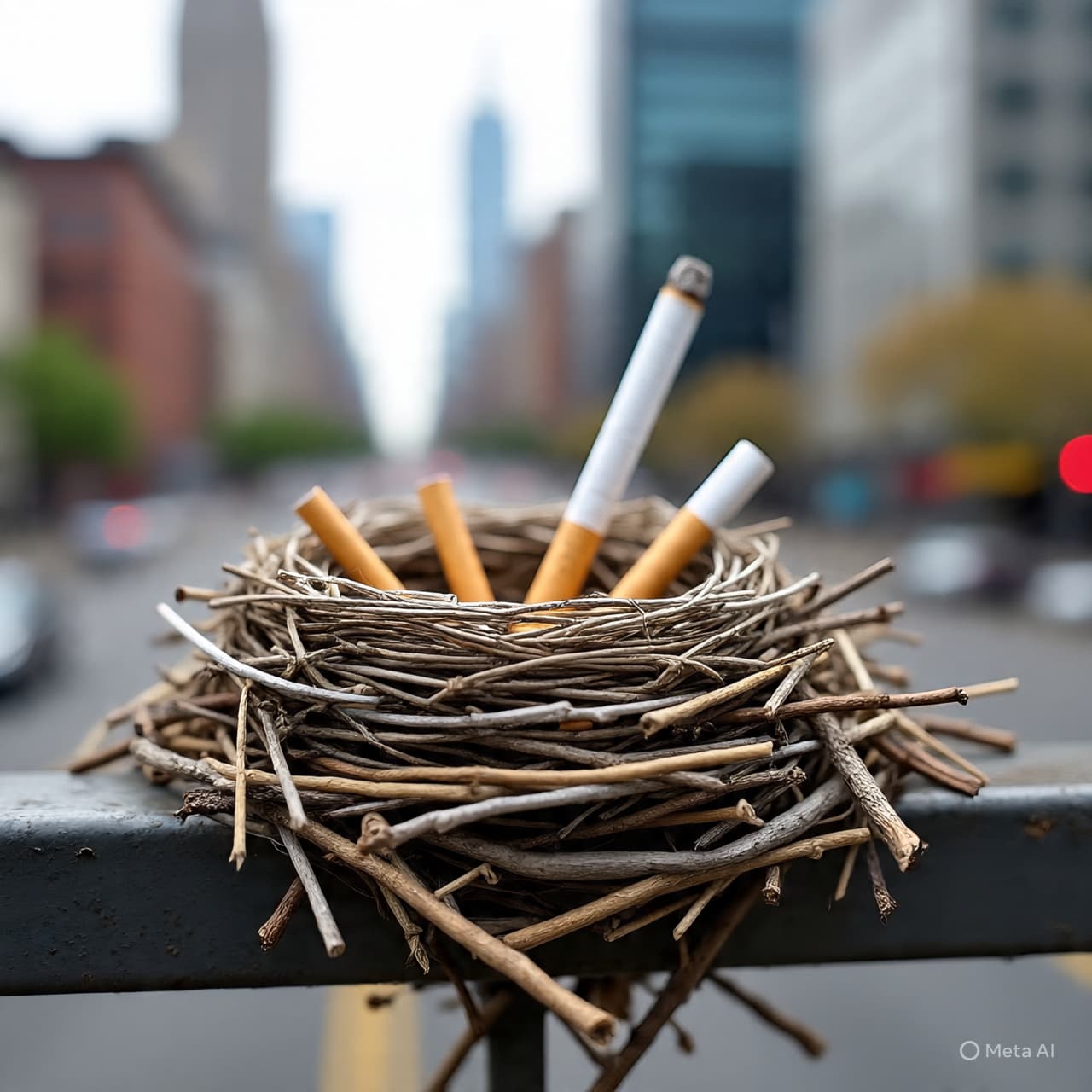
There are substances that carry a reputation so firmly established that their meaning seems fixed. Smoke rises, acrid and familiar, leaving behind a trace of what has been consumed and what remains altered. For humans, cigarettes are closely tied to harm, their effects measured across decades and lives. Yet in the quieter margins of the natural world, meaning can shift, and what is broadly harmful may, under certain conditions, take on a different role.
In urban environments, where human presence reshapes the materials available to other species, some birds have been observed incorporating discarded cigarette butts into their nests. The fibers, drawn from filters and scattered along streets and sidewalks, are gathered alongside twigs, leaves, and other natural elements. At first glance, the act seems incidental—a simple use of what is at hand. But closer observation has revealed a more complex interaction.
Research within urban ecology and behavioral ecology suggests that these cigarette remnants may serve a functional purpose. The chemical compounds embedded within the filters, including residues from tobacco, appear to deter parasites such as mites that commonly inhabit nests. In this context, the presence of cigarette material correlates with reduced parasite loads, offering a potential benefit to the birds and their offspring.
The mechanism is not one of nourishment, but of protection. The same compounds that are toxic in many contexts may act as a form of chemical defense when incorporated into nesting structures. It is an example of how organisms adapt to altered environments, drawing on available resources in ways that align with their immediate needs.
Yet the relationship remains complex. Cigarette filters contain substances that can be harmful, and their long-term effects on the birds themselves are not fully understood. While parasite reduction may improve certain outcomes, exposure to toxins introduces other risks. The balance between benefit and harm does not resolve cleanly; it shifts depending on concentration, duration, and context.
Such findings do not alter the broader understanding of cigarettes and their impact, particularly in human health. Instead, they highlight a narrower phenomenon—an instance where a species navigates its environment using what is present, even when those materials originate from human activity with known negative consequences.
There is a quiet adaptability in this behavior. It does not suggest preference or endorsement, but response. The birds do not create the material they use; they encounter it, assess it in their own way, and incorporate it into a system shaped by survival.
Researchers report that certain urban bird species use cigarette butts in their nests, with evidence suggesting reduced parasite presence as a result. However, scientists note that the potential toxic effects of these materials remain under study, and the overall impact on bird health is still being evaluated.
AI Image Disclaimer
Visuals are AI-generated and serve as conceptual representations.
Sources
Biology Letters National Geographic Scientific American BBC Earth Smithsonian Magazine
Published by Banx Network. This article is part of the Banx decentralized media programme, powered by the BXE token on the XRP Ledger.