In the quiet patience of stone, time keeps its own secrets. Beneath layers of sediment laid down over millions of years, the Earth sometimes preserves a whisper from another age — not in thunderous bones alone, but in something smaller, more intimate. A shell. A curve. A cradle that once held possibility.
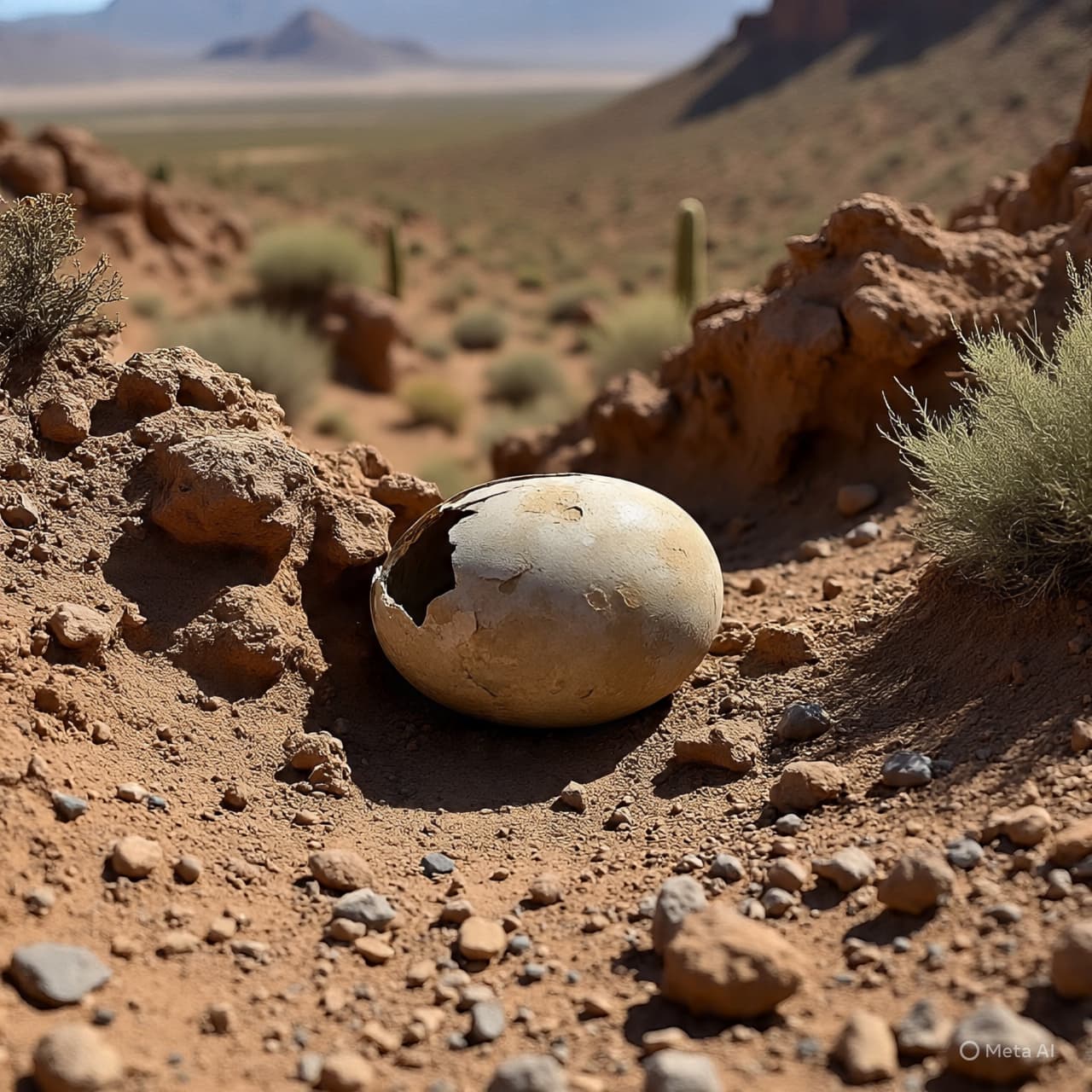
Now, in the windswept landscapes of South America, paleontologists have uncovered a 70-million-year-old dinosaur egg that may still contain the fragile outline of an unborn hatchling. It is a discovery that does not roar; it invites us closer. Because within that stone-bound oval may rest new clues about how dinosaurs began their lives — and perhaps how they were cared for in their earliest moments.
The fossilized egg, dating back to the Late Cretaceous period, was found in sediment layers long known for preserving ancient ecosystems. Yet eggs with potential embryonic remains are rare. Softer tissues decay easily, and the delicate architecture of a developing dinosaur rarely survives the deep pressures of geologic time. That this specimen appears intact enough to hint at a baby within makes it remarkable.
Researchers are proceeding with measured care. Using high-resolution imaging techniques such as CT scanning, they aim to look inside the egg without disturbing it. Early analyses suggest internal structures consistent with embryonic bones — subtle shapes embedded within mineralized layers. If confirmed, the find could expand our understanding of dinosaur reproduction and early development.
For decades, paleontologists have pieced together the story of dinosaur parenting from nesting sites, fossilized brooding postures, and clustered hatchlings preserved together. Discoveries in places such as Argentina have revealed nesting grounds where multiple eggs were laid in patterned arrangements, suggesting intentional placement rather than chance. Some species, including certain theropods, are believed to have guarded their nests, shielding eggs from predators and environmental extremes.
An embryonic fossil offers something more intimate than nests alone. It allows scientists to study bone formation before birth — to observe how quickly species developed, how large hatchlings may have been, and whether they were likely independent at birth or reliant on parental protection. Were they precocial, stepping into the world ready to move? Or altricial, dependent and vulnerable? The answers may lie curled within this stone shell.
The broader implications stretch beyond a single egg. Fossil embryos have previously reshaped scientific conversations about growth rates and behavior. They suggest that some dinosaurs may have shared surprising parallels with modern birds — attentive nesting, organized colonies, and developmental patterns that hint at complex life histories.
Still, the researchers emphasize caution. Fossil interpretation unfolds gradually. Imaging must confirm the presence of embryonic remains, and further analysis will determine the species and its evolutionary relationships. Each scan, each digital cross-section, is another careful step into the deep past.
There is something quietly profound about holding an egg that has waited 70 million years. In it rests not just a fossil, but a suspended beginning. The Earth, patient archivist of vanished worlds, has once again allowed a glimpse into life before humanity — before mammals dominated continents, before mountains shifted into their present forms.
This discovery does not rewrite the story of dinosaurs overnight. But it may add a new chapter about their earliest days — about nests warmed under ancient suns, about fragile beginnings in a world ruled by giants.
Scientists will continue imaging and analyzing the specimen in the coming months. If the embryo is confirmed, the findings will contribute to ongoing research into dinosaur development and reproductive behavior. And from a single egg, long buried beneath South American soil, a clearer portrait of prehistoric family life may slowly emerge.
AI Image Disclaimer
Graphics are AI-genIn the quiet patience of stone, time keeps its own secrets. Beneath layers of sediment laid down over millions of years, the Earth sometimes preserves a whisper from another age — not in thunderous bones alone, but in something smaller, more intimate. A shell. A curve. A cradle that once held possibility.
Now, in the windswept landscapes of South America, paleontologists have uncovered a 70-million-year-old dinosaur egg that may still contain the fragile outline of an unborn hatchling. It is a discovery that does not roar; it invites us closer. Because within that stone-bound oval may rest new clues about how dinosaurs began their lives — and perhaps how they were cared for in their earliest moments.
The fossilized egg, dating back to the Late Cretaceous period, was found in sediment layers long known for preserving ancient ecosystems. Yet eggs with potential embryonic remains are rare. Softer tissues decay easily, and the delicate architecture of a developing dinosaur rarely survives the deep pressures of geologic time. That this specimen appears intact enough to hint at a baby within makes it remarkable.
Researchers are proceeding with measured care. Using high-resolution imaging techniques such as CT scanning, they aim to look inside the egg without disturbing it. Early analyses suggest internal structures consistent with embryonic bones — subtle shapes embedded within mineralized layers. If confirmed, the find could expand our understanding of dinosaur reproduction and early development.
For decades, paleontologists have pieced together the story of dinosaur parenting from nesting sites, fossilized brooding postures, and clustered hatchlings preserved together. Discoveries in places such as Argentina have revealed nesting grounds where multiple eggs were laid in patterned arrangements, suggesting intentional placement rather than chance. Some species, including certain theropods, are believed to have guarded their nests, shielding eggs from predators and environmental extremes.
An embryonic fossil offers something more intimate than nests alone. It allows scientists to study bone formation before birth — to observe how quickly species developed, how large hatchlings may have been, and whether they were likely independent at birth or reliant on parental protection. Were they precocial, stepping into the world ready to move? Or altricial, dependent and vulnerable? The answers may lie curled within this stone shell.
The broader implications stretch beyond a single egg. Fossil embryos have previously reshaped scientific conversations about growth rates and behavior. They suggest that some dinosaurs may have shared surprising parallels with modern birds — attentive nesting, organized colonies, and developmental patterns that hint at complex life histories.
Still, the researchers emphasize caution. Fossil interpretation unfolds gradually. Imaging must confirm the presence of embryonic remains, and further analysis will determine the species and its evolutionary relationships. Each scan, each digital cross-section, is another careful step into the deep past.
There is something quietly profound about holding an egg that has waited 70 million years. In it rests not just a fossil, but a suspended beginning. The Earth, patient archivist of vanished worlds, has once again allowed a glimpse into life before humanity — before mammals dominated continents, before mountains shifted into their present forms.
This discovery does not rewrite the story of dinosaurs overnight. But it may add a new chapter about their earliest days — about nests warmed under ancient suns, about fragile beginnings in a world ruled by giants.
Scientists will continue imaging and analyzing the specimen in the coming months. If the embryo is confirmed, the findings will contribute to ongoing research into dinosaur development and reproductive behavior. And from a single egg, long buried beneath South American soil, a clearer portrait of prehistoric family life may slowly emerge.
AI Image Disclaimer
Graphics are AI-generated and intended for representation, not reality.
Sources
BBC News Reuters CNN National Geographic Live Science
Published by Banx Network. This article is part of the Banx decentralized media programme, powered by the BXE token on the XRP Ledger.