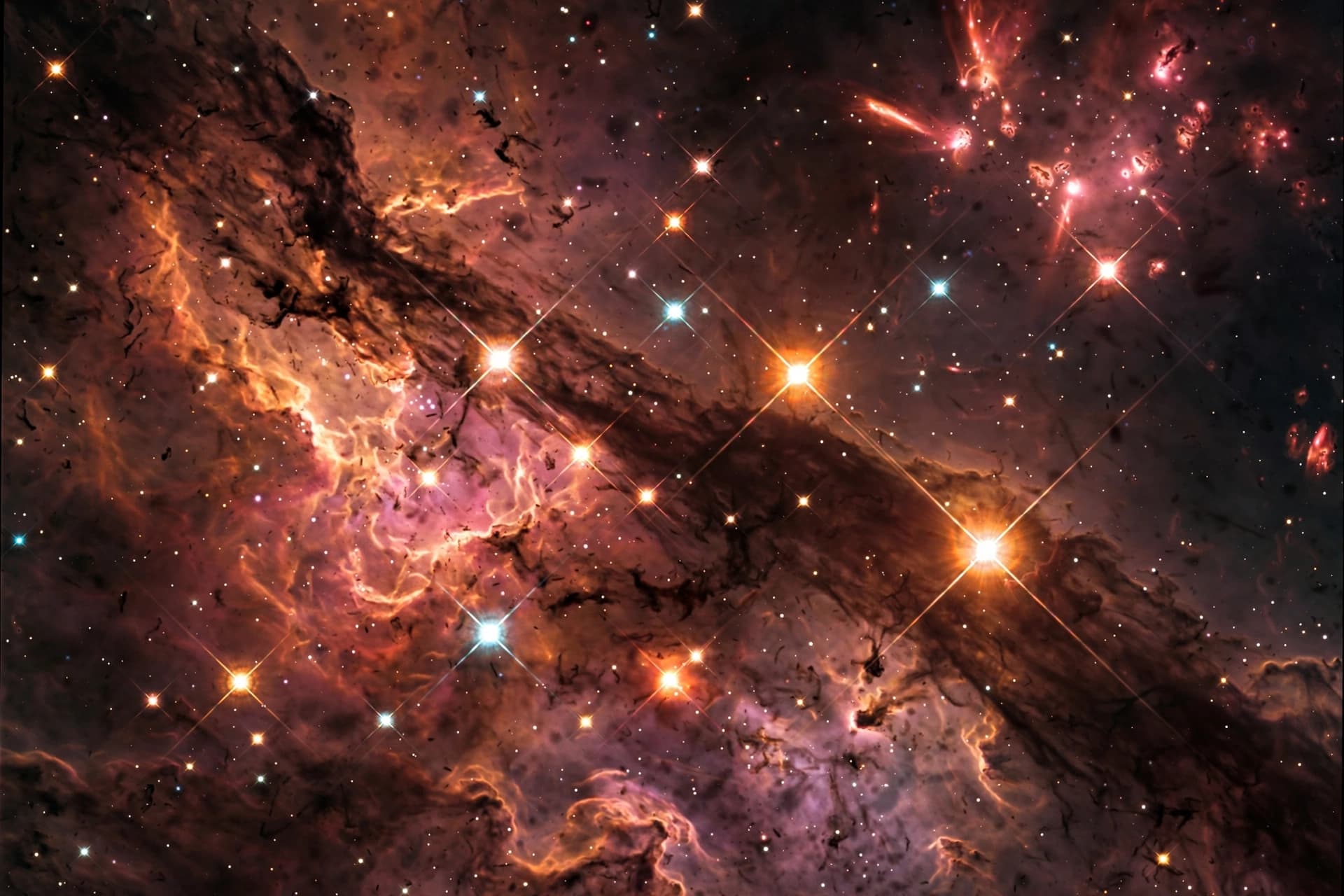
There is a nursery a thousand light-years away where infant stars are being born in clouds of dust so thick that, until recently, they were hidden from every eye that looked. The James Webb Space Telescope has now parted that veil, revealing one of its largest panoramas to date—a sprawling, intricate view of the star-forming region IC 348 in the constellation Perseus. Within this luminous landscape of gas and glowing material, astronomers have found something unexpected: the least massive brown dwarfs ever observed, objects so small they blur the line between planet and star.
The image, captured with Webb’s Near-Infrared Camera and released on September 15, 2026, shows IC 348 as an “intricate landscape of stars, glowing material and sweeping clouds of gas and dust” . Young stars cluster at the center, their brightness marked by Webb’s characteristic diffraction spikes. In the upper-right, still-forming protostars launch jets of material that stretch trillions of miles into space, creating luminous structures known as Herbig-Haro objects .
The brown dwarfs are the quieter discovery. These substellar objects form like stars—from collapsing clouds of gas and dust—but their cores never grow hot enough to fuse hydrogen. They are sometimes called “failed stars,” though the label hardly captures their strange position between the smallest stars and the largest planets . In 2024, researchers used Webb’s NIRCam instrument to survey part of IC 348 and identified 39 brown dwarf candidates. The following year, NIRSpec studied the light of 15 of them, confirming nine as new substellar members of the cluster. The faintest of these has an estimated mass of around two Jupiters—the smallest brown dwarf ever found .
How small a brown dwarf can be remains an open question in astrophysics. The objects in IC 348 will help researchers constrain the lower limit of star formation, the boundary where a collapsing cloud produces a star rather than a planet-like body . The presence of so many tiny brown dwarfs in a single nursery suggests that the process of star formation can produce objects across a remarkably wide range of masses.
IC 348 is one of the closest stellar nurseries to Earth, making it an ideal laboratory for studying the early stages of star and planet formation . The region’s proximity, combined with Webb’s infrared sensitivity, allows astronomers to peer through the dust that blocks visible light and observe the youngest, faintest objects that would otherwise remain invisible.
The image is more than a pretty picture. It is a census of a stellar nursery at a moment of active creation, a snapshot of objects at the very beginning of their existence. For astronomers studying how stars and their smaller siblings form, IC 348 offers a window into processes that shaped our own solar system billions of years ago—and a reminder that even in the dust, there are worlds waiting to be found.
The James Webb Space Telescope has released one of its largest images ever, showing the star-forming region IC 348 in unprecedented detail. The panorama reveals young stars, protostellar jets, and the least massive brown dwarfs ever observed, objects with masses as low as two Jupiters.
AI Image Disclaimer: The images in this article are AI-generated and are for illustrative purposes only. They do not depict actual astronomical observations.
Sources: Yahoo Tech, Space.com, NASA, ESA, CSA
Published by Banx Network. This article is part of the Banx decentralized media programme, powered by the BXE token on the XRP Ledger.