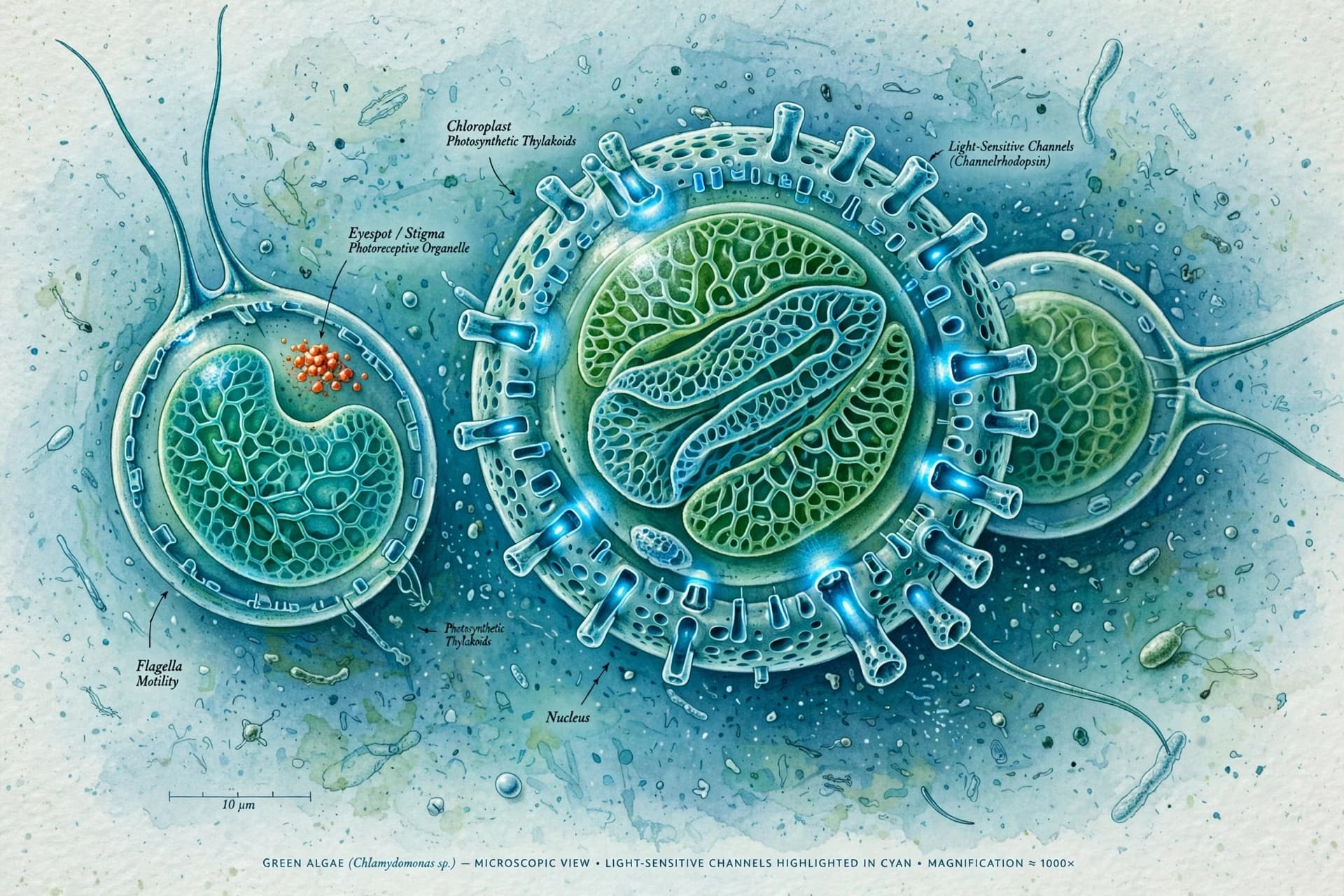
There is a particular elegance in a scientific discovery that arrives not from the most sophisticated laboratory but from the simplest of places—a pond, a patch of algae, a chance observation that opens a door no one knew existed. In 2005, researchers at the University of Würzburg were studying a protein in green algae that responded to light. They were not thinking about the brain. They were thinking about how algae sense their environment. But the protein they were studying—channelrhodopsin—would become the foundation of a technique that has transformed neuroscience, allowing researchers to turn specific neurons on and off with pulses of light.
That technique is called optogenetics. It works by inserting the gene for a light-sensitive protein, like channelrhodopsin, into neurons. When those neurons are exposed to light, the protein opens a channel, allowing ions to flow in or out and either activating or silencing the cell. For the first time, researchers could control the activity of specific neurons with millisecond precision, in living animals, without drugs or electrodes. The implications were enormous. Optogenetics has been used to study the neural circuits underlying memory, addiction, fear, and movement. It has illuminated the causes of Parkinson's disease and depression. It has allowed scientists to map the brain with a precision that was previously unimaginable.
The journey from pond algae to Nobel Prize began with a simple question: how do single-celled organisms respond to light? The answer, it turned out, was a protein that acts as a light-gated ion channel—a kind of molecular eye. When researchers realized they could insert this protein into mammalian neurons, the field of neuroscience changed. The Nobel Prize in Chemistry was awarded in 2021 to David Julius and Ardem Patapoutian for their discoveries of receptors for temperature and touch—not directly for optogenetics. But optogenetics itself has been widely recognized as one of the most transformative techniques in modern neuroscience, and it began with a pond.
What makes the story remarkable is not just the science but the improbability of it. The protein that allows algae to swim toward light is the same protein that allows neuroscientists to control the brain. There is no design in this. There is only the slow, patient work of basic research, of asking questions that seem disconnected from any practical application, of following curiosity wherever it leads. The pond algae did not know they were contributing to a revolution. They were simply responding to the sun. And that response, translated through decades of research, has given us a new way to understand the organ that makes us who we are.
AI Image Disclaimer: The visual elements in this article were created using AI generation tools and are intended for illustrative purposes only.
Sources: Nature, Nobel Prize, Scientific American, The Conversation
Published by Banx Network. This article is part of the Banx decentralized media programme, powered by the BXE token on the XRP Ledger.