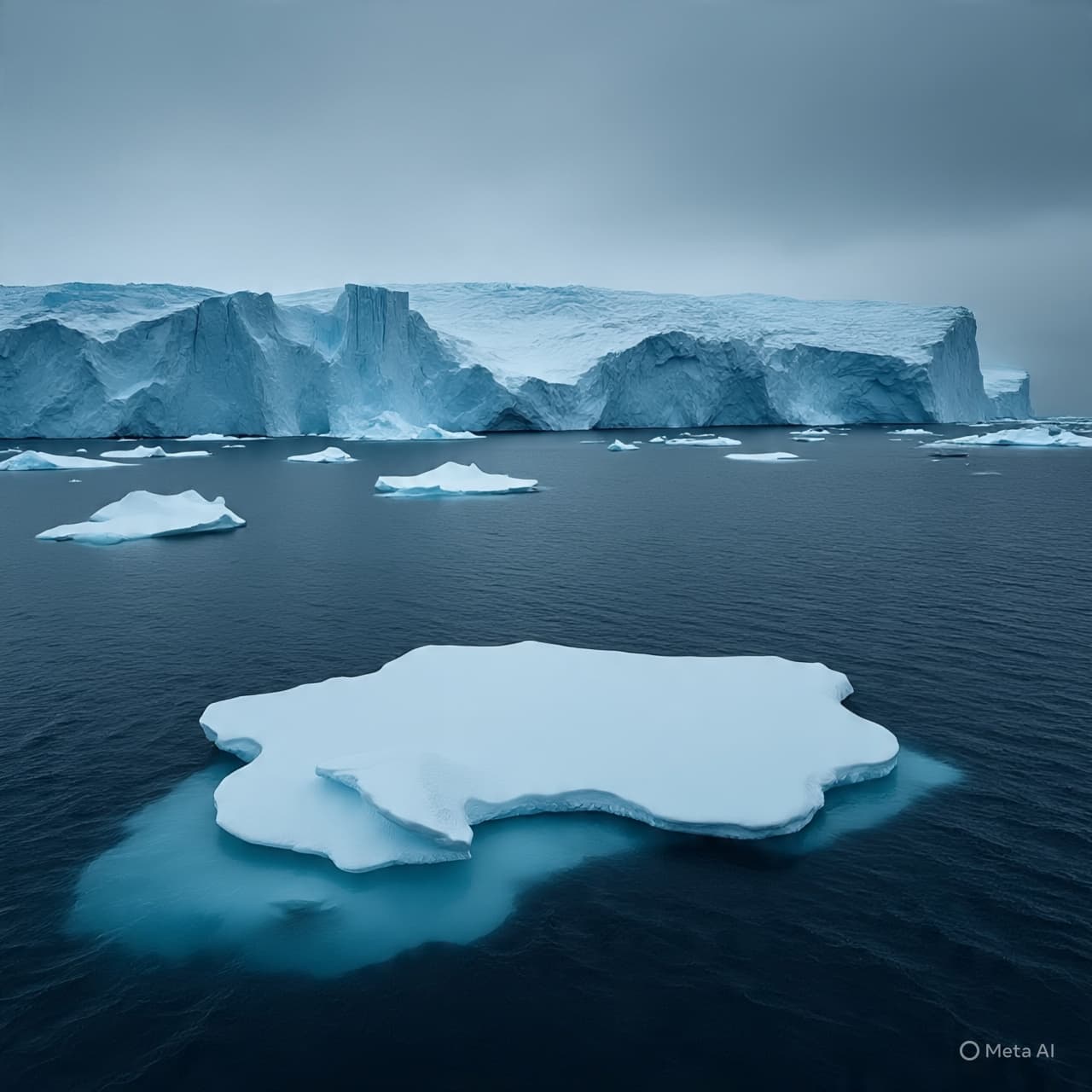
At the edge of Antarctica, where ice meets ocean in slow, grinding silence, a glacier the size of a small country continues to loosen its grip on the continent. Thwaites Glacier — often called the Doomsday Glacier — does not collapse loudly. It thins, fractures, and retreats with a patience that makes its danger easy to underestimate.
New observations show that the glacier is melting faster than earlier projections suggested. Warm ocean currents are slipping beneath its floating ice shelf, eroding it from below and weakening the structure that once held the inland ice in place. What looks solid from above is increasingly hollowed underneath, its base dissolving in darkness.
The concern is not just Thwaites itself, but what it holds back. The glacier acts as a kind of keystone, bracing neighboring ice basins that together contain enough frozen water to raise global sea levels by several meters. As the glacier thins, that restraint weakens. The process is gradual, but its consequences would unfold far beyond Antarctica, reshaping coastlines over centuries.
In response to this slow-moving threat, a radical idea has surfaced: constructing a massive underwater barrier, a wall rising roughly 150 meters from the seafloor, designed to block warm water from reaching the glacier’s base. In theory, such a structure could slow melting and stabilize the ice, buying time for mitigation and adaptation elsewhere.
Yet the scale of the proposal borders on the unreal. Building in Antarctic waters would require engineering under extreme cold, pressure, and isolation. The wall would need to withstand shifting ice, seismic activity, and relentless ocean forces for decades. Even then, scientists caution that no structure could fully halt the glacier’s retreat — only delay it.
The idea exposes a deeper tension in humanity’s response to climate change. Faced with planetary-scale consequences, technological ambition strains against physical limits. A wall might protect ice for a time, but it would not cool the oceans, nor reverse the warming already set in motion.
Thwaites continues to melt whether plans are drawn or not. Its fate is tied not to a single intervention, but to the collective trajectory of global temperatures. In the long view, the glacier asks a quieter question than catastrophe headlines suggest: not whether we can stop the ice from moving, but whether we are willing to slow ourselves before it does.
AI Image Disclaimer Illustrations are AI-generated and serve as conceptual representations.
Sources Nature Climate Change Science British Antarctic Survey
Published by Banx Network. This article is part of the Banx decentralized media programme, powered by the BXE token on the XRP Ledger.