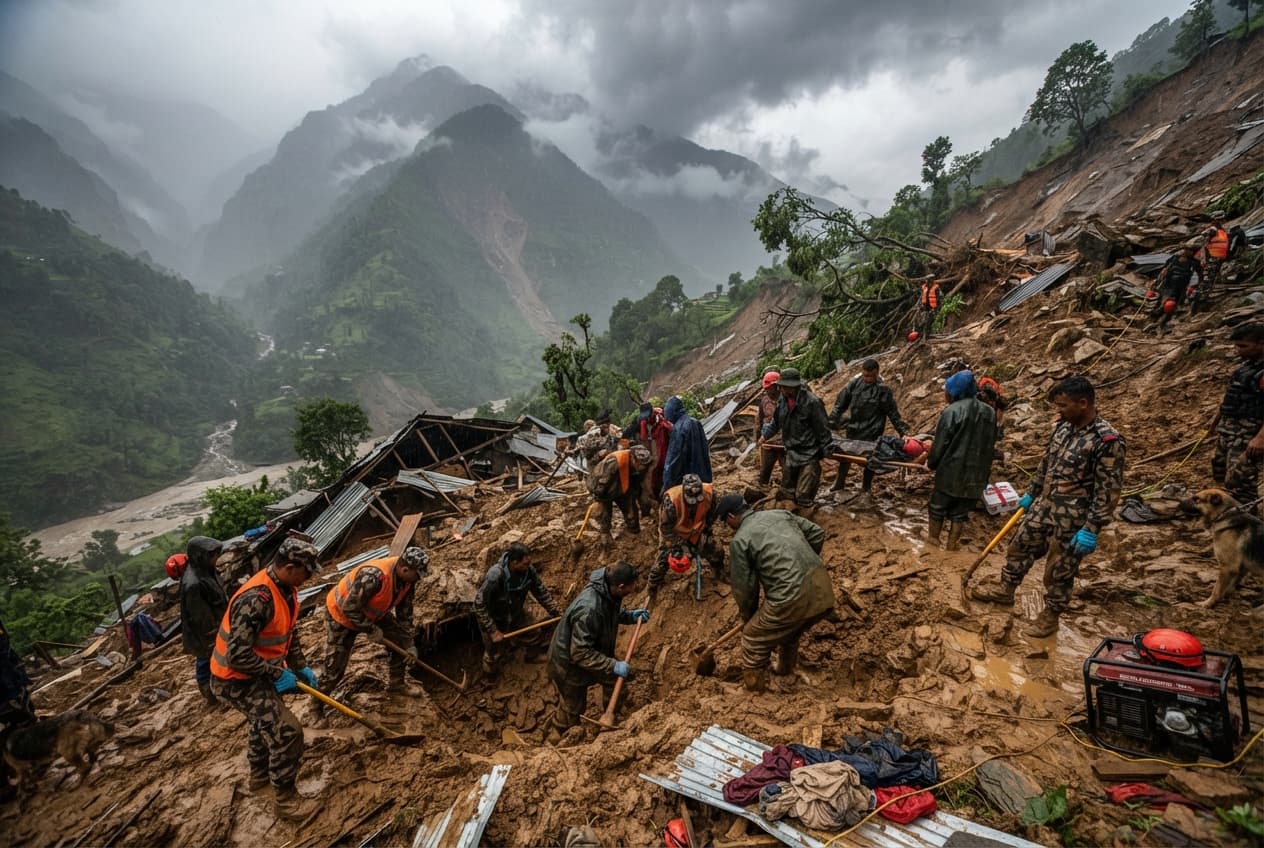
New Delhi, India—Massive walls of mud and rock tore down steep mountain slopes early Friday morning, burying rustic valley settlements under tons of dense debris. Continuous monsoon downpours saturated regional soils beyond their natural holding capacity, triggering sudden slope failures across multiple districts. Local police confirmed that fourteen villagers died when cascading soil masses flattened residential dwellings while families slept.
Rescue squads equipped with shovels and hand-held pickaxes dug frantically through grey slurry to reach victims trapped beneath collapsed timber roofs. Torrential rain continued to pound the steep terrain, hampering rescue efforts and threatening responders with secondary mudslides. Survivors stumbled through knee-deep mud to reach higher ground, carrying injured children and minimal personal belongings.
State disaster response forces mobilized heavy earth-moving machinery to clear blocked mountain highways and re-establish contact with cut-off rural communities. Medical teams established field checkpoints along passable road sections to administer tetanus shots and treat cuts, bruises, and fractures. District administrators ordered mandatory evacuations for households situated directly beneath unstable rocky outcrops and river gorges.
Geological survey experts arrived at the disaster zones to evaluate slope stability and identify potential zones at risk of further collapse. Preliminary assessments indicate that unchecked deforestation and road-widening projects destabilized natural soil structures ahead of the heavy monsoon downpour. Local residents expressed anger over unheeded warnings regarding hillside construction safety and inadequate drainage channels.
Relief distribution centers opened in government school buildings, offering temporary shelter and dry rations to displaced villagers facing cold mountain nights. Community volunteers organized community kitchen stalls to feed hundreds of homeless residents sheltering under plastic sheeting. Power outages plunged entire valleys into darkness as downed transmission towers cut off regional electricity networks.
State government officials announced immediate compensation packages for families who lost relatives in the pre-dawn disaster. Transport ministries deployed engineering battalions to shore up vulnerable embankments along major pilgrimage and trade routes winding through the mountains. Meteorological bureaus maintained red alerts across the region, predicting additional heavy rainfall over the next twenty-four hours.
Relief workers cautioned that swollen streams could cause flash floods downstream if debris dams break without warning. Helicopters hovered above the jagged peaks, scouting for isolated pockets of survivors needing emergency food or medical evacuation. Families waited anxiously near rescue checkpoints, hoping for news of missing loved ones as daylight faded behind heavy storm clouds.
The ongoing weather emergency underscores the persistent danger faced by rural mountain communities during the peak of the South Asian rainy season. Local authorities vowed to review zoning regulations and restrict permanent construction in designated high-risk landslide corridors. Cleanup operations will likely extend well into the weekend as heavy machinery works to clear blocked transportation arteries.
Published by Banx Network. This article is part of the Banx decentralized media programme, powered by the BXE token on the XRP Ledger.