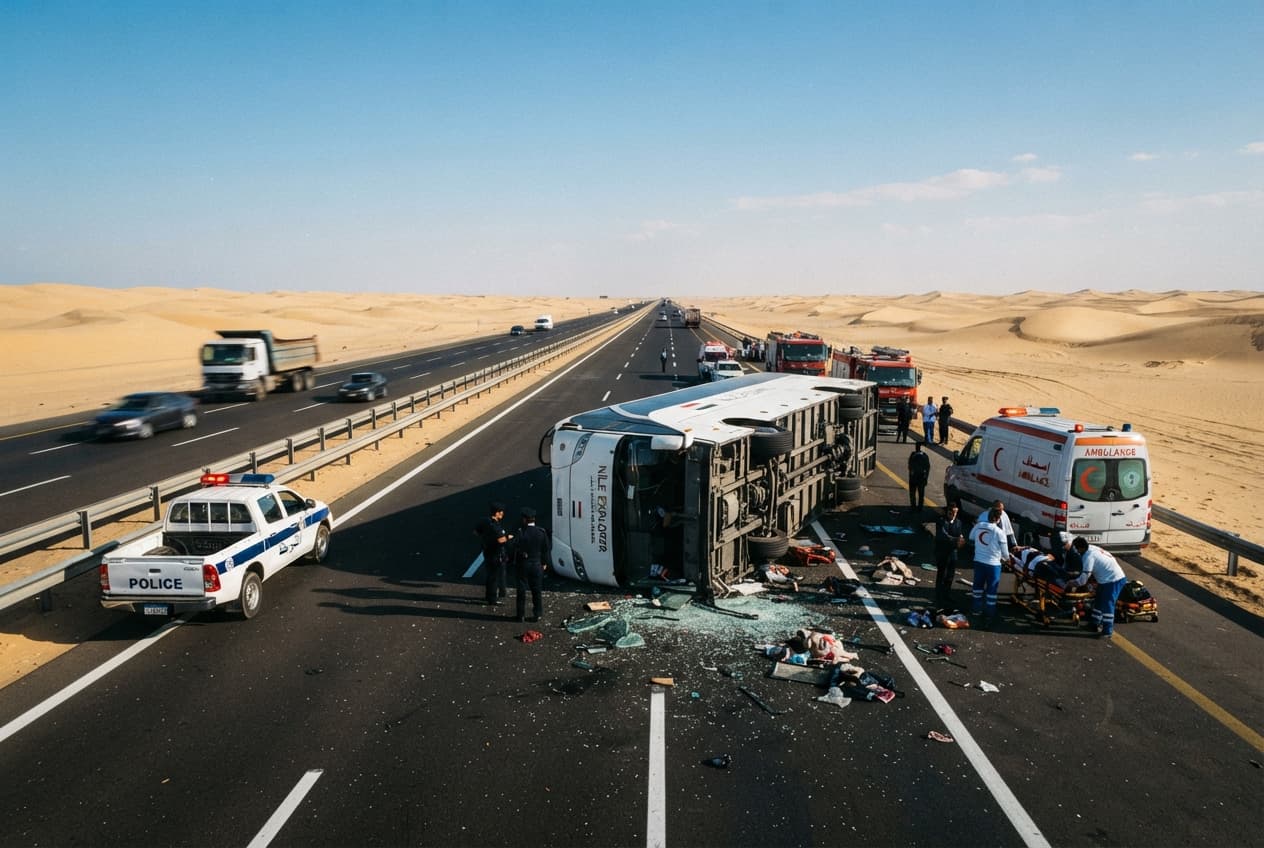
Cairo, Egypt—A passenger coach carrying international sightseers overturned on a desolate desert expressway late Sunday morning, claiming four lives. The vehicle veered off the asphalt lane while navigating a sweeping bend, rolling multiple times before coming to rest on its side. Shattered glass and personal belongings littered the sun-baked sand for dozens of meters around the wreckage. Twelve other passengers sustained severe trauma and fractures during the violent rollover sequence.
Passing motorists immediately pulled over to render aid and contact emergency dispatchers using satellite communication devices. A fleet of twelve ambulances and specialized trauma response teams rushed to the remote highway segment from nearby regional medical hubs. Paramedics established an emergency triage station on the scorching asphalt to treat the wounded before transport. Four critically injured individuals were airlifted by military medical helicopters toward central university hospitals.
Traffic police cordoned off both directions of the multi-lane expressway to accommodate the heavy rescue equipment and clearance operations. Investigators on the scene suggested that excessive speed combined with a sudden mechanical failure likely precipitated the loss of control. The bus driver, who survived the incident with minor cuts, was detained by local law enforcement for questioning. Initial alcohol and drug screenings administered at the scene returned negative results.
Consular officials from several foreign embassies arrived at the provincial hospital to assist surviving tourists and coordinate identification procedures. Ministry of Health representatives released a preliminary casualty breakdown confirming the national identities of the deceased. Hospital corridors filled with anxious diplomatic staff, translators, and medical personnel managing emergency admissions. Blood bank reserves across the governorate were mobilized to handle emergency surgical interventions.
Road safety advocates noted that long-distance desert corridors frequently witness high-speed transit accidents due to fatigue and lax enforcement. Heavy transport vehicles often bypass mandatory rest periods while traversing expansive inter-city networks. Crews used heavy industrial cranes to upright the crushed bus hull and hoist it onto a commercial flatbed transporter. Maintenance crews swept accumulated glass and oil slick residues from the road surface before reopening lanes.
Flow along the strategic expressway resumed slowly under restricted speed advisories as evening traffic accumulated past the checkpoint. State prosecutors formally opened a comprehensive technical investigation into the carrier company's safety compliance records. Transport ministry officials pledged a thorough audit of long-distance tourist fleets operating across eastern desert routes. The wreckage remains impounded at a secure municipal depot pending final forensic evaluation.
Published by Banx Network. This article is part of the Banx decentralized media programme, powered by the BXE token on the XRP Ledger.