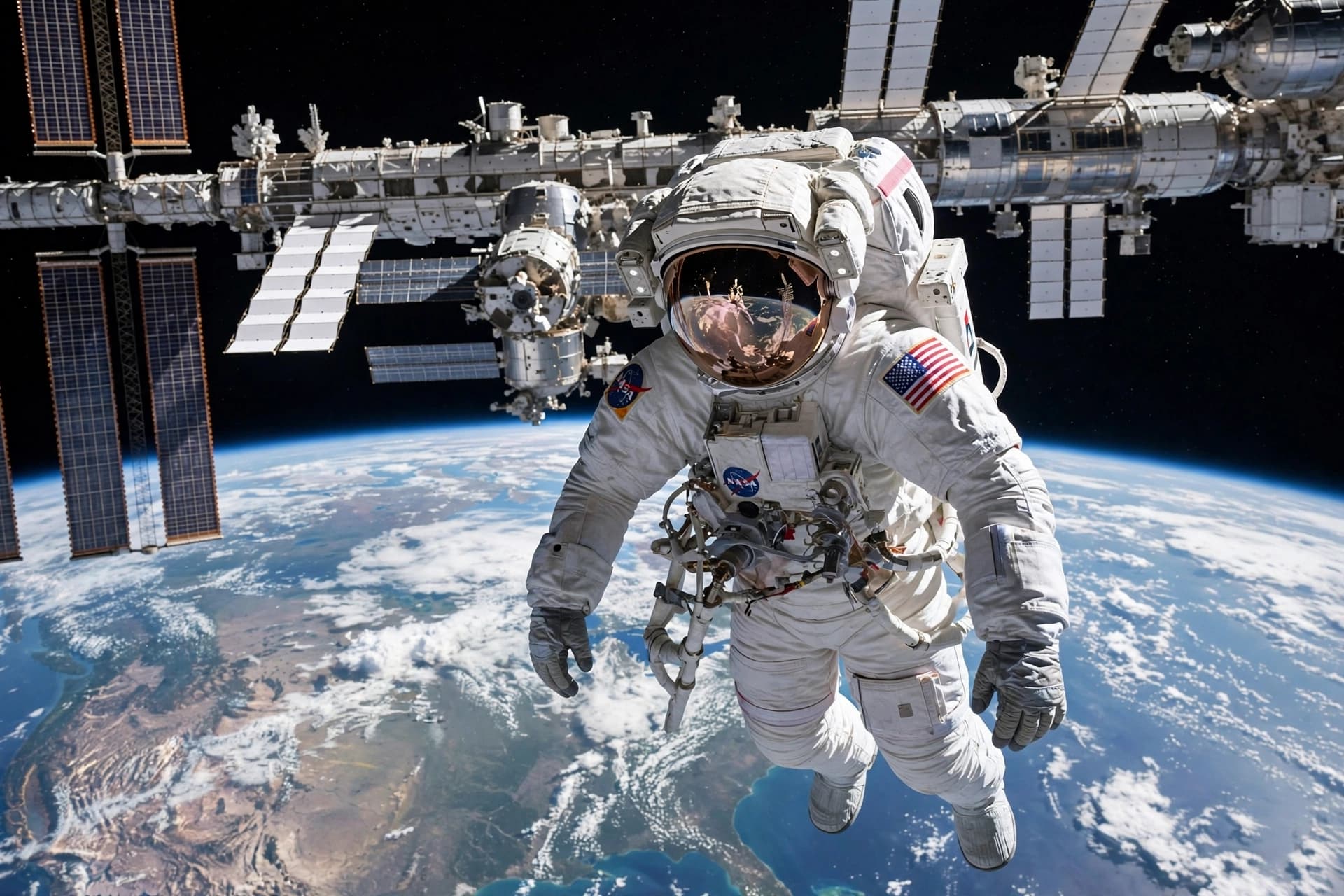
There is a particular kind of quiet that exists 250 miles above the Earth, where the only sounds are the hum of machinery and the breath inside a helmet. On October 29, Canadian astronaut Joshua Kutryk will step into that quiet for the first time, floating outside the International Space Station with nothing between him and the void but a suit and the training that brought him there.
Kutryk, who arrived at the station on October 1 aboard SpaceX Crew-13, is scheduled to perform two spacewalks alongside NASA astronaut Anil Menon. The first, on October 29, will install and deploy the seventh International Space Station Roll-Out Solar Array (IROSA). The second, on November 5, will install the eighth and final array, completing the station's power augmentation upgrades .
The work is part of a multi-year effort to boost the station's electrical capacity. The eight roll-out arrays will increase available power by up to 30 percent, raising the station's generation from 160 kilowatts to approximately 215 kilowatts. That additional power will support critical station operations, including the controlled deorbit planned for the end of the station's life around 2030 .
Kutryk will become the fifth Canadian Space Agency astronaut to perform a spacewalk, following Chris Hadfield, Steve MacLean, Dave Williams, and David Saint-Jacques. He is the first since Saint-Jacques's outing in April 2019 . Canadarm2, the Canadian-built robotic arm, will serve as a platform for one of the spacewalkers—a quiet echo of the tool Hadfield helped attach during Canada's first spacewalk in 2001 .
The timing of these spacewalks carries a numerical weight. NASA has designated the October 29 outing as U.S. spacewalk 100, and the November 5 outing as U.S. spacewalk 101. They will be the 285th and 286th spacewalks conducted in support of station assembly, maintenance, and upgrades .
NASA will preview both spacewalks at a news conference on Tuesday, October 20, from Johnson Space Center in Houston . For Kutryk, the weeks ahead will hold the particular intensity of preparing for an experience that no simulation can fully replicate. For the station, they will mark the completion of a power system that will carry it through its final years.
AI Image Disclaimer: Visual content accompanying this article is generated by artificial intelligence for illustrative purposes only.
Sources: SpaceQ, NASA, Canadian Space Agency, RRI.co.id, BNT News
Published by Banx Network. This article is part of the Banx decentralized media programme, powered by the BXE token on the XRP Ledger.