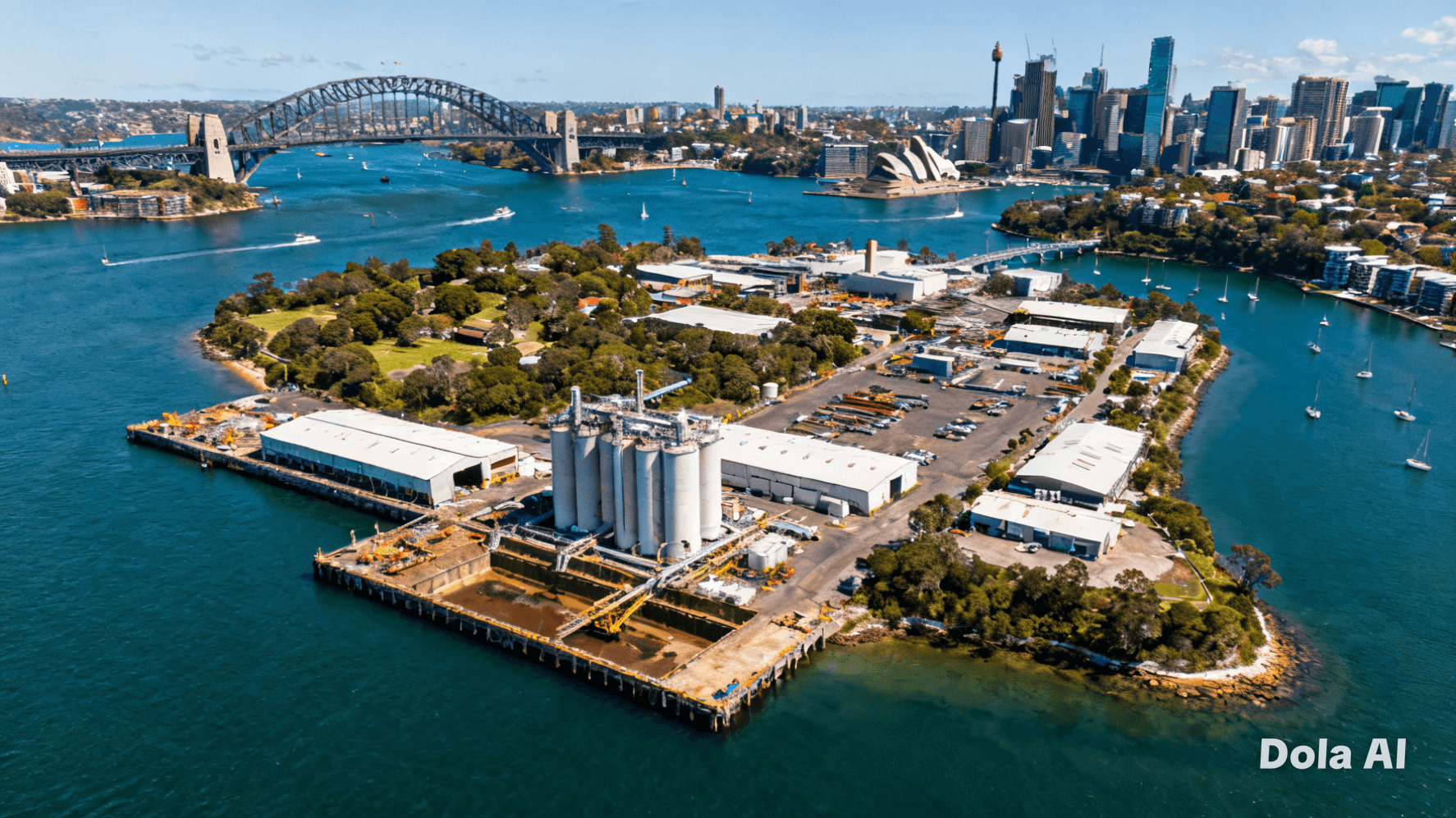
Cities rarely reinvent themselves in a single gesture. More often, they shift gradually — shoreline by shoreline, street by street — until one day a familiar map carries a new name. In Sydney, that quiet transformation is poised to take shape along its western harbor edge, where the industrial outlines of Glebe Island are set to give way to something altogether different. In time, it will be known not for cranes and cargo, but as Bays West — the city’s first new inner-city suburb in decades.
The New South Wales government has unveiled plans to redevelop Glebe Island and surrounding harbor precincts into a mixed-use neighborhood designed to house thousands of residents. Framed as a major urban renewal initiative, the project promises homes, public spaces, waterfront access, and transport links — an attempt to knit a long-industrial stretch of land back into the everyday life of Sydney.
For generations, Glebe Island has functioned largely as a working port and logistics zone, separated from nearby communities by its industrial purpose. The proposal for Bays West signals a broader shift in how global cities reconsider former industrial land: as potential neighborhoods rather than fenced-off frontiers. Officials have described the development as an opportunity to address housing demand while preserving elements of the site’s maritime history.
Plans indicate that the new suburb could eventually accommodate thousands of dwellings, alongside green spaces and pedestrian connections to surrounding areas. Advocates argue that inner-city expansion is preferable to unchecked suburban sprawl, offering proximity to employment hubs and established infrastructure. The waterfront location also raises the prospect of new public access to harbor views long obscured by industrial operations.
Yet redevelopment on this scale inevitably invites debate. Questions have emerged about affordability, environmental impact, and how seamlessly Bays West can integrate into the fabric of neighboring communities such as Pyrmont and Balmain. Infrastructure capacity — from public transport to schools — will shape how successfully the suburb evolves from blueprint to lived reality.
Urban planners note that inner-city land is finite, and opportunities for large-scale transformation are increasingly rare. That rarity gives Bays West a symbolic dimension: it is not only a housing project but a statement about how Sydney imagines its future growth. The city that once expanded outward now looks inward, toward underutilized edges of its harbor.
For residents watching the cranes begin to move, the change may feel gradual at first. Industrial lots will give way to construction fences; shipping routes to streets. Over time, what was once defined by its function may be redefined by its community.
The name Bays West, still new on the tongue, carries with it both ambition and uncertainty. As plans move from proposal to implementation, Sydney prepares to welcome a suburb that did not exist on its maps a decade ago — a reminder that even established cities continue to redraw themselves.
AI Image Disclaimer Images in this article are AI-generated illustrations, meant for concept only.
Sources ABC News The Sydney Morning Herald The Guardian Australia Domain 7NEWS Sydney
Published by Banx Network. This article is part of the Banx decentralized media programme, powered by the BXE token on the XRP Ledger.