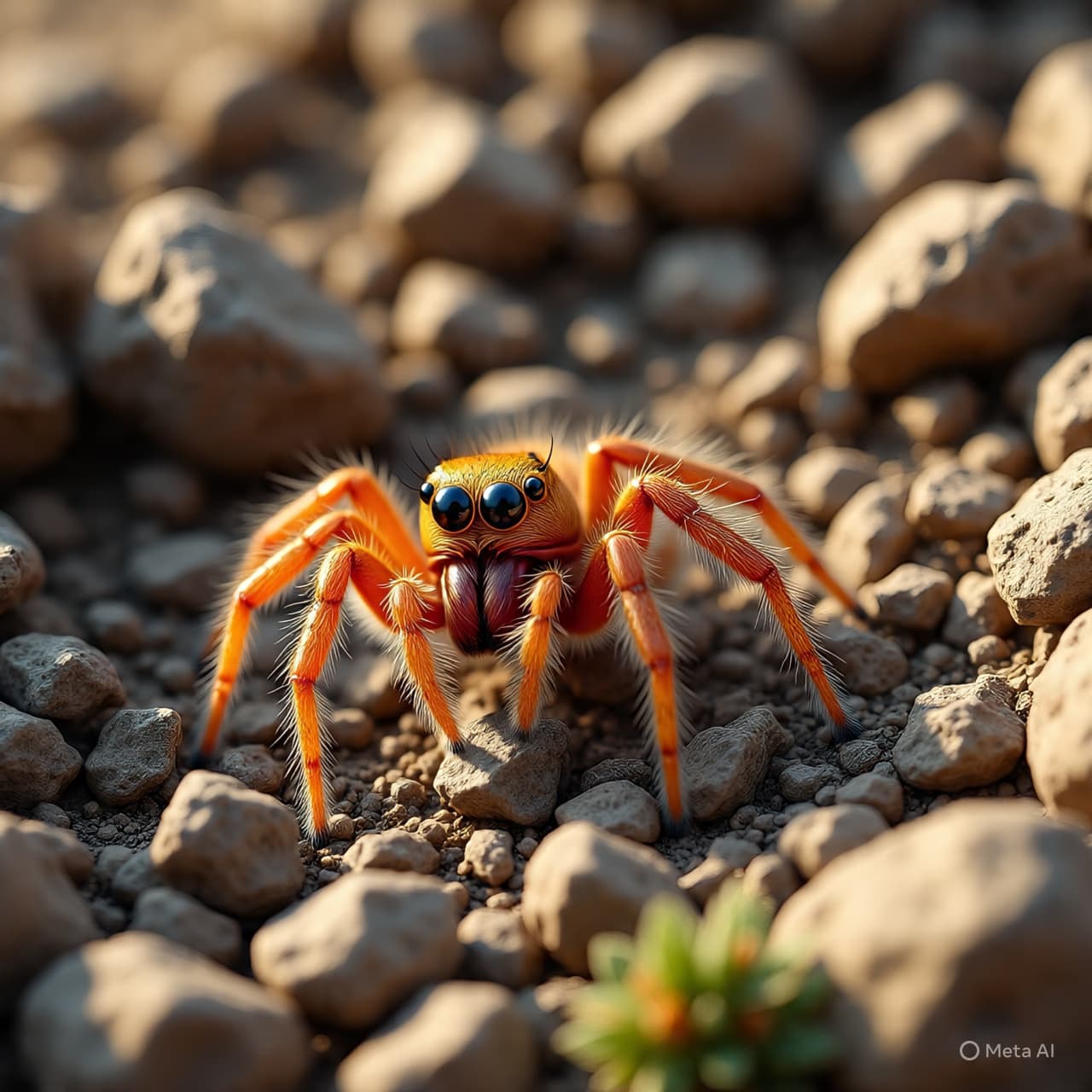
Out on the volcanic slopes of Gran Canaria, where wind and sea shape the land like a slow hand of time, there exists a spider whose genetic story reads more like poetic paradox than textbook certainty. In a world of labyrinthine DNA, where complexity often grows like vines in fertile soil, this humble island resident has quietly pared down its own blueprint. Like a writer choosing clarity over excess, it has trimmed its genome to nearly half the size of its closest continental kin — yet, curiously, woven in a richness of variation that defies common expectation.
Scientists working at the University of Barcelona and collaborators across Europe peered into the genetic code of this small arachnid, Dysdera tilosensis, and compared it with its mainland cousin, Dysdera catalonica. The contrast was stark: where the continental spider carries about 3.3 billion base pairs of DNA, the island dweller retains only about 1.7 billion. In other words, evolution on this patch of earth has stripped away nearly half of the genetic material, crafting a leaner genomic form. Yet rather than weakening, the island spider’s genetic diversity blossoms with an unexpected fullness.
In classical evolutionary thought, small isolated populations such as those founded on remote islands tend to accumulate redundant or repetitive DNA sequences because selective pressures diminish and the founder effect loosens the genetic reins. Over generations, genomes of island species often bloat rather than shrink. But this spider stands as a thoughtful counterexample: its compact genome suggests that rather than passing through a bottleneck of reduced variation, the island population remained stable and large enough for natural selection to steadily prune away superfluous genetic clutter.
The DNA that was shed appears chiefly to have belonged to repetitive and non-coding sections — the so-called “genomic junk” that contributes little to essential function. What remains is a streamlined script, whose tight organization seems to embody a paradox of evolutionary efficiency. Mainstream genomic theories struggle to explain not just the scale of the change, but the accompanying uptick in genetic diversity that underlies it.
Researchers caution against simple interpretations: this genomic halftime show isn’t about better or worse, but about different paths life may take. Evolution is not a single script with one predictable arc, but a chorus of possibilities, where even the smallest threads in the web of life can surprise us with their twists.
In the tapestry of life, this tiny island spider has shown that nature’s patterns are sometimes subtler than our theories. The discovery that a species can significantly reduce its DNA while maintaining — even enhancing diversity offers a gentle reminder that scientific understanding evolves, too. It invites reflection on how much there still is to learn about the mechanisms shaping genomes across the tree of life.
AI Image Disclaimer
Visuals are created with AI tools and are not real photographs, meant for conceptual illustration only.
Source Check:
ScienceDaily
IFLScience
Phys.org
Earth.com
Published by Banx Network. This article is part of the Banx decentralized media programme, powered by the BXE token on the XRP Ledger.