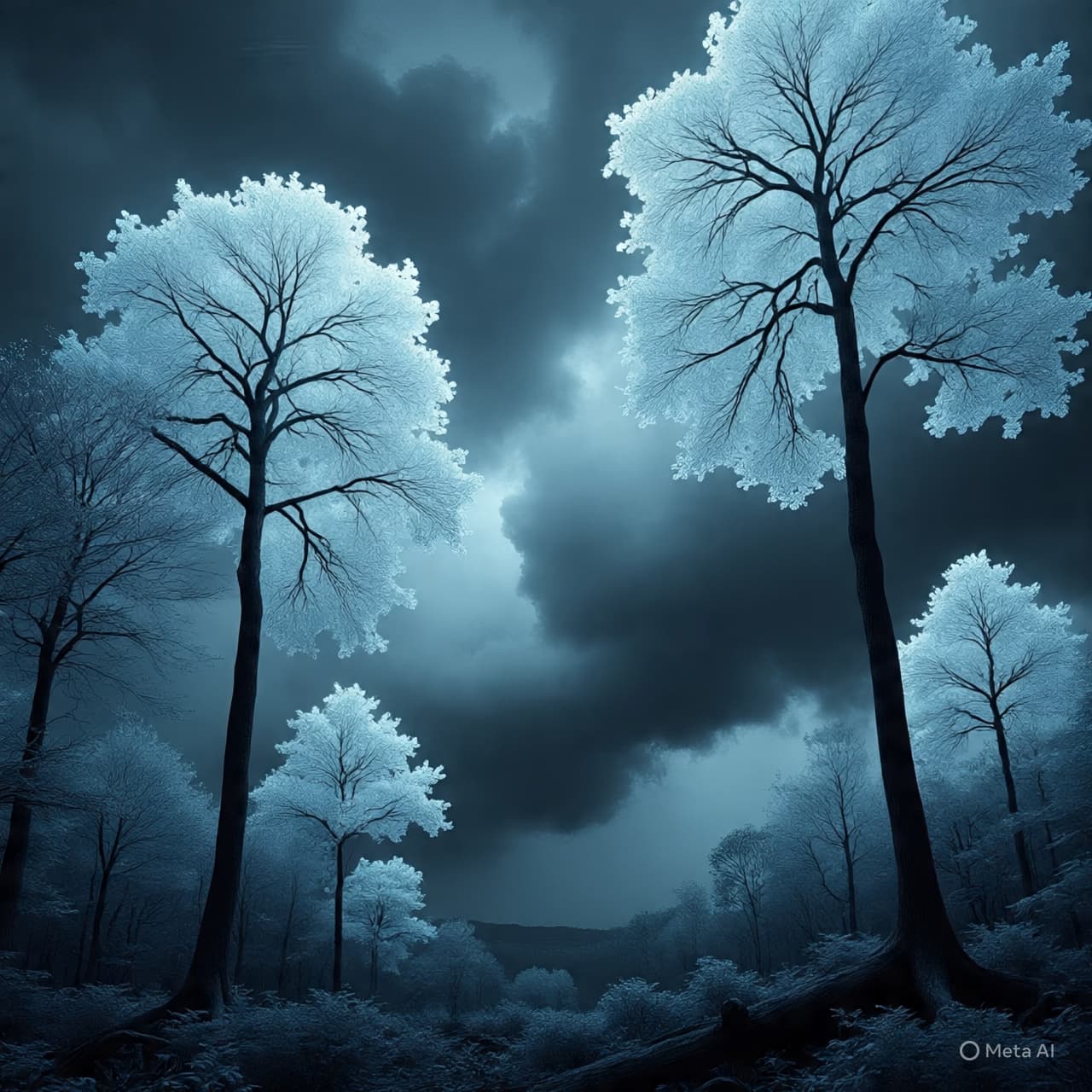
There are moments in nature that unfold quietly, hidden from our ordinary senses, like a secret woven into the fabric of everyday life. Thunderstorms are familiar companions to summer skies — dramatic clouds, distant rumbles, and brilliant lightning arcing through the air. Yet beneath the thunderheads and above the forest canopy, another, subtler phenomenon has now been observed for the first time in the open world: tiny, ghostly flashes of electrical glow on the tips of treetops, known as coronae. These delicate discharges, invisible to the unaided eye, reveal a new layer of the electrical dance between storm and woodland.
For nearly a century, scientists speculated that weak electrical discharges might occur on plants under the electrified fields of thunderstorms. Laboratory experiments had hinted at the possibility, showing how electric charge could concentrate on the sharp points of leaves, causing a faint glow under controlled conditions. But until now, no one had directly seen or measured these coronae in nature, where daylight and ambient light drown out such subtle emissions.
In a creative field campaign, researchers led by meteorologist Patrick McFarland of The Pennsylvania State University equipped a modified vehicle with specialized sensors, including a roof‑mounted periscope and ultraviolet‑sensitive camera. During multiple thunderstorms along the U.S. East Coast in the summer of 2024, this portable observatory recorded ultraviolet flashes on the tips of leaves from trees such as sweetgum and loblolly pine. These tiny glimmers appeared intermittently — lasting up to a few seconds and sometimes seeming to jump from leaf to leaf as branches swayed in the wind.
Because the light emitted by these corona discharges lies in the ultraviolet spectrum, it is essentially hidden from human vision. The specialized camera made it possible to detect clusters of ultraviolet signals that moved with the trees, confirming that real electrical activity was occurring on the surface of leaves beneath thunderstorm clouds. If one could see in ultraviolet, the researchers suggest, the entire canopy of a forest might appear to flicker faintly under a charged sky — like thousands of tiny fireflies dancing above the treetops.
These discharges arise from the electric fields naturally produced during thunderstorms. Tall and pointed surfaces, like the tips of leaves high in a tree, enhance the local electrical stress and facilitate corona formation. In the laboratory, these coronas appear as a subtle blue glow when conditions are right, but under real storm conditions, only instruments tuned to ultraviolet light can pick up their presence.
The study’s findings point to corona activity not as rare curiosities, but as potentially widespread phenomena wherever strong electric fields and forest canopies coincide. The researchers estimate that coronae could be occurring on many trees under a storm’s core, even if they remain undetectable to ordinary sight.
While a single corona discharge does little visible harm, laboratory experiments indicate that repeated electrical currents can scorch leaf tips and damage cellular structures involved in photosynthesis. This raises new questions about how frequent storms might subtly influence forest health over time — perhaps encouraging evolutionary traits that mitigate electrical stress on leaves. The team plans to collaborate with botanists and ecologists to investigate these ecological implications further.
In the broader tapestry of atmospheric science, the discovery opens a new window into the interactions between electrical storms and the living world below. It underscores how much there is still to learn about the subtle processes that unfold around us, invisible yet real, shaping ecosystems and the atmosphere in ways we are only beginning to perceive.
As storm seasons return and research tools evolve, these ghostly coronae may become a familiar chapter in the story of weather, trees, and the electric threads that connect them.
AI Image Disclaimer Visuals are created with AI tools and are not real photographs.
Sources
Phys.org Scientific American EurekAlert! Penn State University press releases sumi.news summary of recent science news
Published by Banx Network. This article is part of the Banx decentralized media programme, powered by the BXE token on the XRP Ledger.