Key Highlights
- Location:Chiquita Canyon Landfill, Castaic, California.
- Event:Geyser eruption releasing toxic liquid and gas.
- Impact:Heightened health concerns for nearby residents.
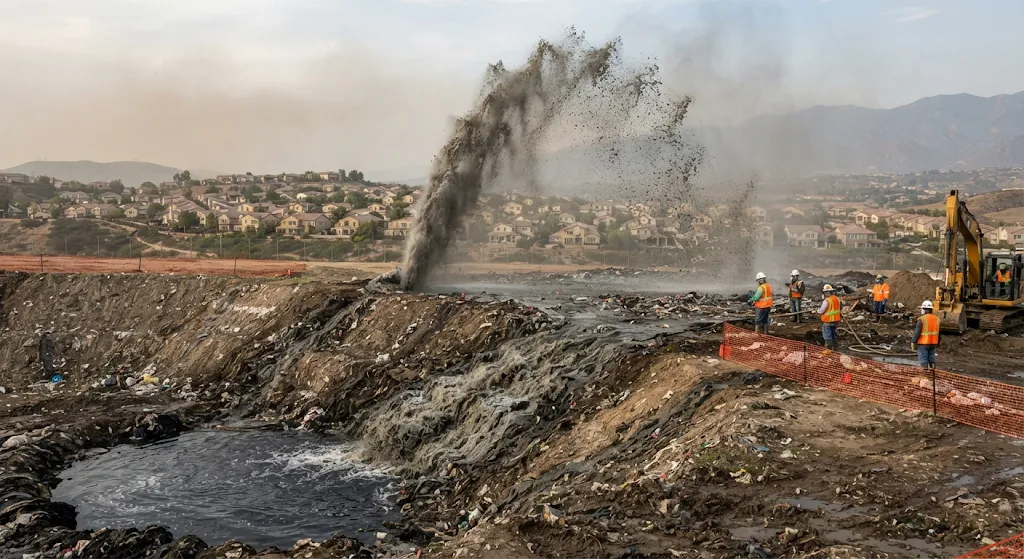
CASTAIC, California — A pressurized geyser erupted at the troubled Chiquita Canyon Landfill, shooting foul-smelling liquid and noxious gases high into the air and intensifying health and environmental concerns for neighboring communities in northern Los Angeles County.
The eruption was triggered by a buildup of extreme heat and subsurface pressure stemming from an ongoing underground chemical reaction deep within the landfill's older waste mass. As pressure reached a critical threshold, liquid leachate—contaminated water that has percolated through decomposing trash—and landfill gases burst through the surface layer, creating a volatile plume visible from nearby residential areas.
For months, residents in Castaic, Val Verde, and surrounding neighborhoods have reported severe headaches, nausea, respiratory irritation, and nosebleeds linked to persistent odors and emissions from the facility. The sudden geyser eruption has heightened alarm among local families and environmental advocates, who warn that pressurized liquid releases threaten both surrounding air quality and local soil and groundwater systems.
State and county regulatory agencies, including the South Coast Air Quality Management District (AQMD) and the California Department of Toxic Substances Control, have issued numerous violation notices to the landfill's operator over uncontained odors and leachate seeps. Following the eruption, inspectors were dispatched to evaluate the breach, monitor emission spikes, and verify containment measures.
Facility crews worked to cap the pressurized vent, divert the spilled leachate into containment basins, and reinforce surrounding slopes to prevent further blowouts. Landfill representatives stated that extreme internal temperatures caused by the subsurface smoldering reaction have complicated standard gas-collection and liquid-extraction operations.
Meanwhile, local community groups and county officials are renewing calls for stricter regulatory intervention, expanded air-monitoring networks, and temporary relocation assistance for vulnerable residents living nearest to the site's perimeter until the underground reaction is fully stabilized.
In response to the mounting pressure from local leaders and environmental watchdogs, state lawmakers and county supervisors are scheduled to convene an emergency public hearing later this week to hold the facility’s operators accountable and establish a binding timeline for mitigation. As regulatory scrutiny intensifies, legal representatives for affected households have also indicated that the latest eruption could bolster ongoing class-action lawsuits seeking compensation for property devaluation, medical expenses, and prolonged disruption to daily life across the Santa Clarita Valley.
Published by Banx Network. This article is part of the Banx decentralized media programme, powered by the BXE token on the XRP Ledger.