Some signals arrive from the universe like whispers carried across unimaginable distance. They last no longer than a blink of time—mere milliseconds—yet they travel across billions of light-years before touching the instruments that listen from Earth.
These are fast radio bursts, brief flashes of radio energy that have puzzled astronomers for more than a decade. Each burst appears suddenly, bright and intense, before fading again into silence.
For years, scientists have wondered what kind of cosmic event could produce such fleeting brilliance.
Among the most compelling suspects are magnetars, a rare and extreme type of neutron star born from the collapse of massive stars. When such stars exhaust their nuclear fuel, their cores implode under gravity, leaving behind a compact remnant packed with matter and threaded with magnetic fields trillions of times stronger than Earth’s.
The birth of a magnetar is not a gentle event. It is accompanied by violent explosions, bursts of radiation, and powerful shockwaves that ripple outward through space.
Recently, astronomers believe they may have witnessed something remarkable: the first clear evidence of a magnetar forming while simultaneously producing radio signals similar to fast radio bursts.
The observation followed an unusual cosmic explosion known as a fast blue optical transient, a short-lived flash of light believed to originate from the violent death of a star. In this case, the event—cataloged as AT2022cmc—was detected by telescopes scanning the sky for sudden changes in brightness.
As the explosion unfolded, radio telescopes began to detect brief pulses emerging from the same region of space.
The signals resembled fast radio bursts in several important ways. They were extremely bright in radio wavelengths and appeared to originate from a compact source created by the stellar explosion. Researchers analyzing the data proposed that the collapse of the star likely produced a newborn magnetar, whose intense magnetic environment generated the observed radio flashes.
For astronomers studying fast radio bursts, the moment carried particular weight.
If the birth of a magnetar can produce radio bursts soon after a star collapses, it would provide a direct physical mechanism for at least some of these mysterious signals. The idea fits well with previous observations linking magnetars to similar bursts inside our own galaxy.
Yet the universe rarely resolves its puzzles in a single step.
The radio pulses associated with the newborn magnetar differ in certain ways from the most famous fast radio bursts detected across the cosmos. Many known bursts repeat over long periods or emerge from galaxies billions of light-years away. Others appear in environments that do not resemble the aftermath of a recent stellar explosion.
This suggests that magnetar births may explain only part of the phenomenon.
Some fast radio bursts could arise from young magnetars formed in explosive stellar deaths. Others may come from older magnetars undergoing sudden magnetic instabilities, while still more possibilities remain under investigation.
For now, astronomers regard the new observation as an important clue rather than a final answer.
Across the night sky, telescopes continue their patient watch, recording each sudden flash of radio light that reaches Earth. With every detection, the archive of cosmic signals grows a little larger.
Researchers say the observation of radio bursts linked to a newly formed magnetar provides the first evidence that such stellar births can generate fast radio burst–like signals, though scientists note that the discovery does not yet explain all known fast radio bursts.
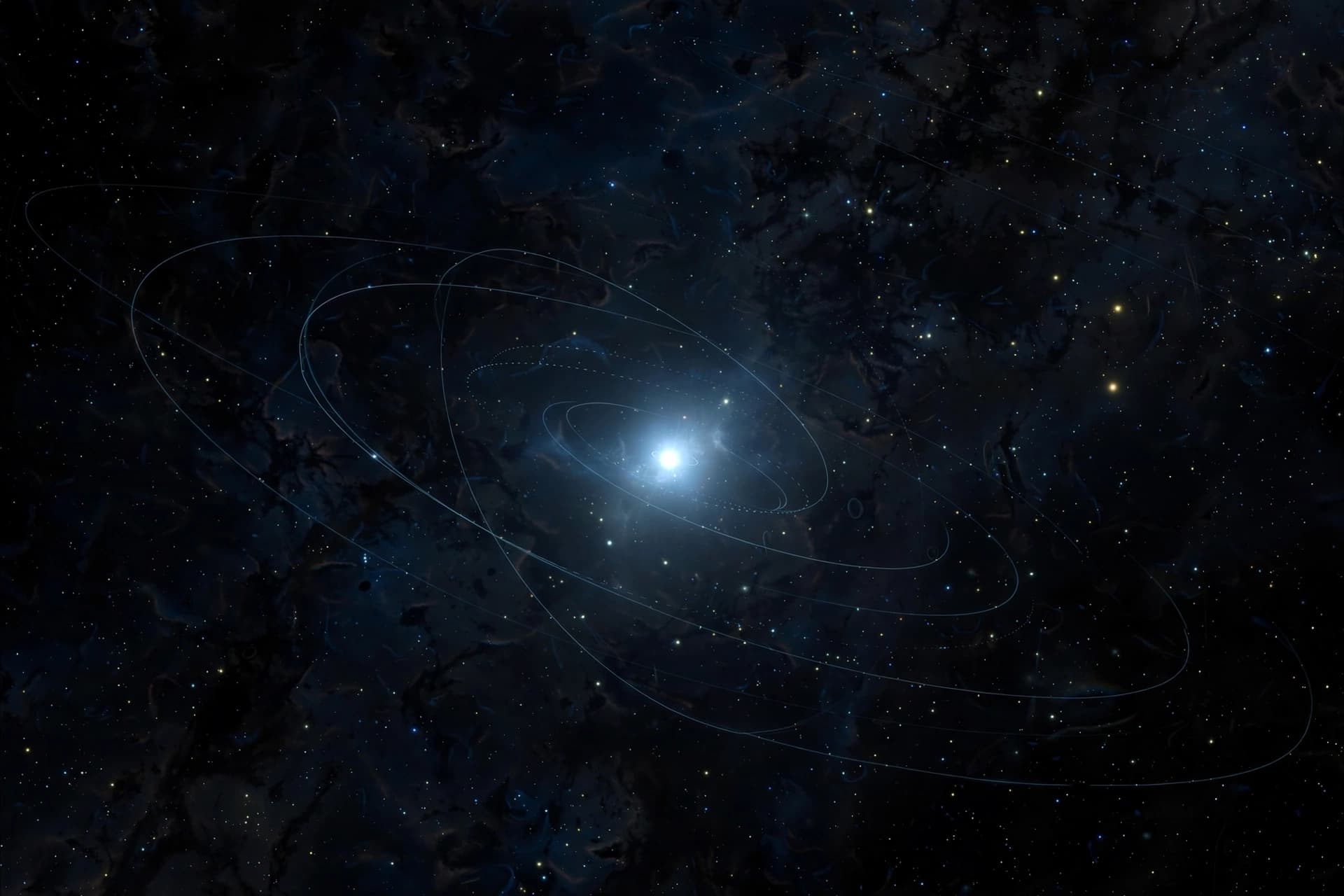
AI Image Disclaimer Artwork shown with this article was generated with artificial intelligence to represent scientific concepts visually.
Source Check
Nature ScienceAlert Space.com Phys.org Scientific American
Published by Banx Network. This article is part of the Banx decentralized media programme, powered by the BXE token on the XRP Ledger.