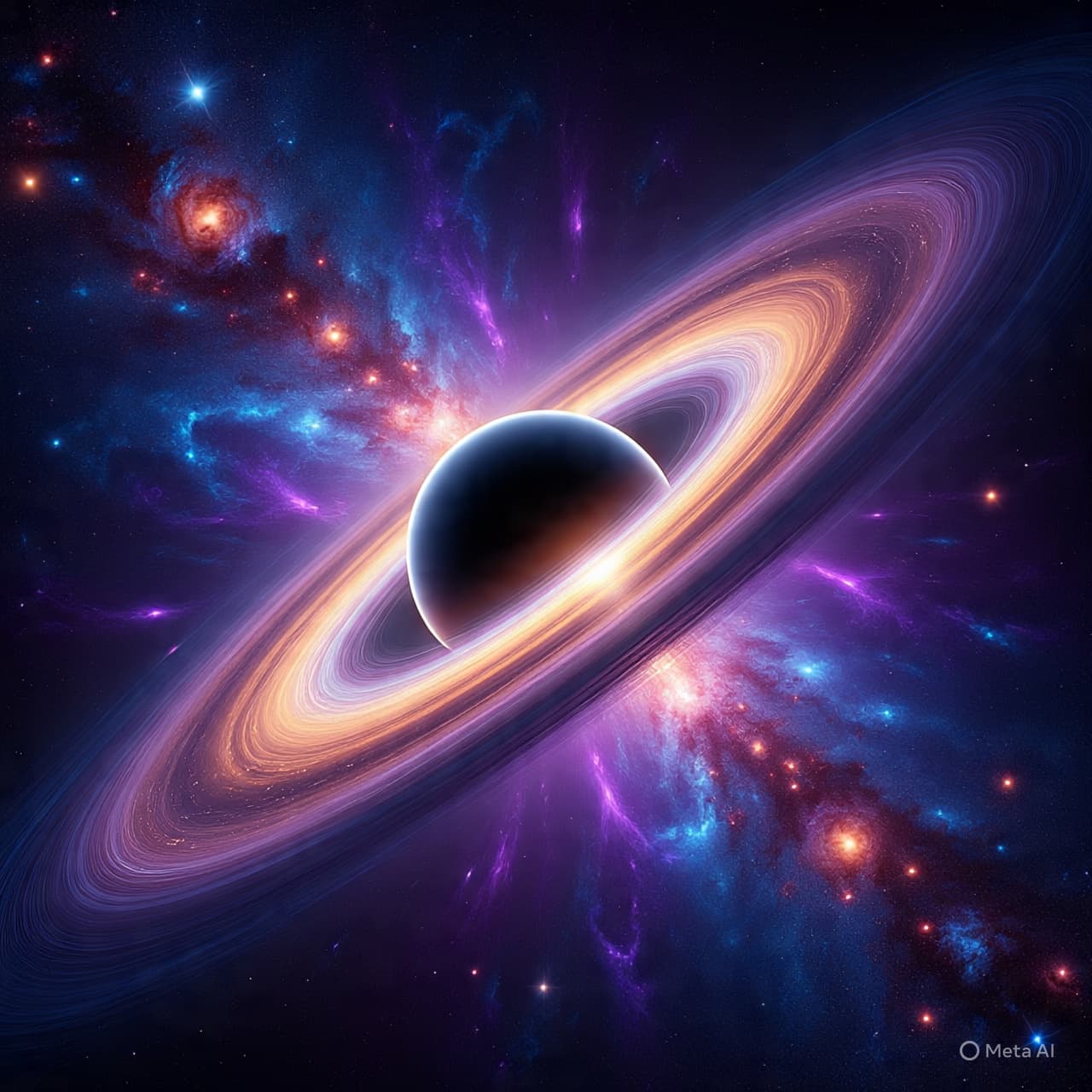
Far beyond the reach of ordinary light, in the shadowed hearts of distant galaxies, a black hole awakens. Recent observations from the James Webb Space Telescope reveal a cosmic spectacle: a feeding frenzy so intense that it may illuminate a long-standing mystery about how these gravitational giants shape the universe. In this darkness, where matter bends and time seems to stretch, the drama of creation and destruction unfolds silently yet profoundly.
Black holes are often imagined as solitary, insatiable predators, consuming everything that strays too close. Yet this latest discovery paints a more intricate picture. Streams of gas and dust spiral inward in luminous arcs, heated to extreme temperatures, glowing with the faint but persistent echo of cosmic history. The “feeding frenzy” is not mere consumption—it is an act of transformation, releasing energy that ripples across galaxies and hints at the processes that govern star formation, galactic evolution, and the hidden architecture of the cosmos.
For scientists, the significance is both empirical and poetic. The patterns and brightness captured by Webb’s instruments suggest mechanisms previously unseen, offering clues to phenomena that had puzzled astronomers for decades. Each photon collected is a message from the abyss, a record of matter’s final descent and the black hole’s quiet yet immense influence on its surroundings. It is a reminder that even in apparent voids, the universe is alive with motion, consequence, and invisible interconnections.
Yet amidst the enormity and intensity, there is also perspective. The frenzy of a black hole, occurring over millions of years, unfolds on scales difficult for human minds to grasp. Observing these cosmic acts is an exercise in humility, an acknowledgment of our smallness and our curiosity. Through the lens of Webb, we glimpse both the violent power and subtle orchestration of the universe, a choreography that stretches across space and time, revealing the hidden rhythms that shape galaxies and, ultimately, the cosmos itself.
AI Image Disclaimer Visuals are AI-generated and serve as conceptual representations.
Sources James Webb Space Telescope research publications Astronomy and astrophysics journals Science news outlets covering galactic phenomena
Published by Banx Network. This article is part of the Banx decentralized media programme, powered by the BXE token on the XRP Ledger.