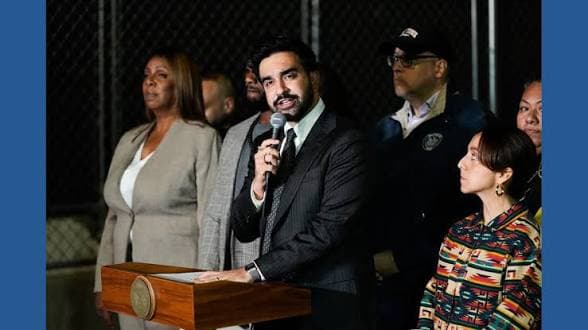
In the tapestry of New York City’s neighborhoods — from the bustling corridors of Jackson Heights to the markets of “Little Yemen” in the Bronx — new patterns of civic life are emerging. What was once the quiet rhythm of everyday life for countless immigrant families now pulses with a growing voice, one increasingly counted among the city’s political forces.
The backdrop for this shift is the 2025 mayoral election, which culminated in Zohran Mamdani’s historic victory. At 34 years old, Mamdani became New York City’s first Muslim and South Asian mayor, a milestone that reflects not only his own campaign’s appeal but also the demographic and political maturation of the city’s Muslim community.
Estimates suggest that New York is home to roughly one million Muslims — a community that includes South Asians, Indo-Caribbeans, Arabs, Africans, and African Americans — forming a substantial and increasingly visible demographic presence across the boroughs. Over past decades, mosques and cultural centers have risen in number, serving as both spiritual homes and community anchors in places like Queens and Brooklyn.
That growth has been matched by a shift in political engagement. In the recent election, Muslim voters were drawn not only by shared identity, but by Mamdani’s campaign focus on issues such as affordable housing, expanded transit, universal childcare, and protection for immigrant communities. Exit data indicates that Muslim voters — including both longtime residents and newcomers — turned out at notably high rates in areas where they are concentrated, boosting Mamdani’s coalition.
For many Muslim New Yorkers, Mamdani’s win carries personal resonance. At mosques in Astoria and elsewhere, worshippers celebrated not just a political victory, but a sense of representation long absent in city leadership. Some described the moment as a powerful affirmation that their presence and concerns are finally recognized in civic life. Yet with that pride comes a mix of expectations and debates about the future — from how the new administration will address cost-of-living pressures to how it navigates tensions around policing and education.
Beyond electoral gains, the rise of Muslim influence in New York underscores wider demographic shifts. Neighborhoods that once supported primarily European and Caribbean immigrant communities now reflect a broader, more global set of cultures and experiences. This diversity reshapes not only voting patterns but also the city’s social and cultural rhythms.
Mamdani’s ascent also arrives amid a complex national atmosphere. While many celebrate the symbolic and substantive gains for Muslim Americans, others have responded with criticism or resistance, reflecting broader political polarization. Nonetheless, in the streets from Queens to the Bronx, the sense among supporters is that civic engagement — rooted in everyday struggles and aspirations — has reconfigured what it means to participate in America’s largest city.
As the new administration settles into City Hall, the voices that helped bring it there will continue to shape the conversations ahead — not as a fringe movement, but as an integral part of New York’s evolving political and demographic story.
AI Image Disclaimer “Images in this article are AI-generated illustrations, meant for concept only.”
Sources The Washington Post, Guardian, ABC News, local New York reporting, Washington Post inauguration coverage, Guardian personal essay.
Published by Banx Network. This article is part of the Banx decentralized media programme, powered by the BXE token on the XRP Ledger.

.jpg&w=3840&q=75 "Zelensky Warns China Is Helping Russia Develop a Starlink Rival")