Mercury, the smallest and innermost planet of our solar system, is a world of extremes. Scorched by the sun and pockmarked by craters, it has long been a subject of scientific curiosity. New research now sheds light on its geological origins, revealing that its crust was formed by intense, ancient volcanism. This discovery invites us to look closer at our planetary neighbor, understanding how violent fiery processes shaped a world that now appears cold and static. It is a reminder that even the most barren landscapes have dynamic histories.
The study utilizes data from NASA’s MESSENGER mission, which orbited Mercury from 2011 to 2015. By analyzing the chemical composition of the planet’s surface, scientists identified high levels of magnesium and low levels of aluminum in certain regions. These signatures are consistent with rocks formed from deep mantle melting, suggesting that massive volcanic eruptions played a key role in creating Mercury’s early crust.
Unlike Earth, where plate tectonics recycle the crust, Mercury’s geological activity was driven by internal heat and massive impacts. The research suggests that shortly after its formation, the planet experienced a period of extreme volcanism that resurfaced large areas. This process created a thin, rigid crust that has remained largely unchanged for billions of years, preserving a record of the early solar system.
The findings challenge previous assumptions about Mercury’s formation. Some theories suggested that the planet’s crust was primarily the result of impact gardening, where meteorite strikes churned the surface. However, the chemical evidence points strongly toward volcanic origin, indicating that internal processes were more dominant than previously thought. This shifts our understanding of how small, rocky planets evolve.
Understanding Mercury’s geology helps scientists compare it to other terrestrial planets. By studying how volcanism operated under different gravitational and thermal conditions, researchers can refine models of planetary formation. It provides a unique data point in the diverse family of solar system bodies, highlighting the variety of geological pathways available to rocky worlds.
The extreme nature of Mercury’s volcanism also offers insights into the planet’s interior structure. The depth and extent of the melting suggest a large iron core and a thin mantle, consistent with other observations. This internal architecture influences the planet’s magnetic field and thermal evolution, linking surface features to deep planetary dynamics.
For planetary geologists, this research opens new questions about the timing and duration of volcanic activity. Did it occur in a single burst or over millions of years? Future missions, such as ESA’s BepiColombo, will provide higher-resolution data to answer these questions. The current findings serve as a foundation for further exploration and analysis.
The beauty of Mercury lies in its starkness, but beneath that surface is a story of fire and creation. Recognizing the volcanic origins of its crust adds depth to our appreciation of the planet. It transforms Mercury from a mere rock into a complex world with a rich geological past.
New research indicates that Mercury’s crust was formed by extreme ancient volcanism, challenging previous theories about its geological history. This finding enhances our understanding of planetary formation and highlights the dynamic processes that shaped the inner solar system.
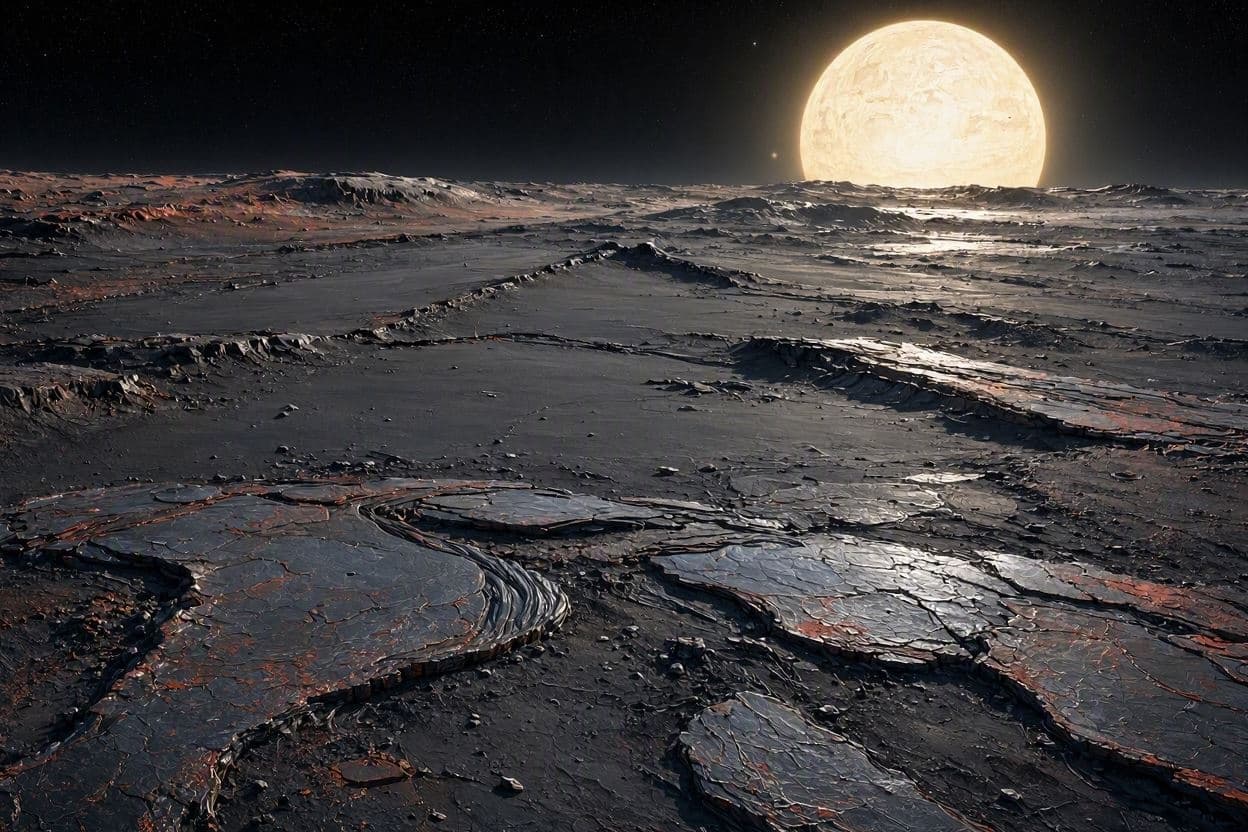
AI Image Disclaimer: The images associated with this article are AI-generated visualizations intended to depict planetary geology and volcanic activity, using respectful and descriptive imagery.
Sources: Nature Geoscience NASA MESSENGER Mission Data Planetary Science Journal
Published by Banx Network. This article is part of the Banx decentralized media programme, powered by the BXE token on the XRP Ledger.