
The sea often appears indifferent to the affairs of nations.
At dawn, the waters of the Black Sea reflect the same shifting light they have carried for centuries. Cargo vessels move steadily toward distant markets. Fishing boats trace familiar routes. Along the coast, beaches and ports awaken to another ordinary day shaped by tides, weather, and commerce. Yet in regions touched by conflict, even the horizon can carry unexpected reminders that wars rarely remain confined to the places where they begin.
That reality emerged once again on Romania’s Black Sea coast when a maritime drone exploded in the port of Constanța, the country’s largest harbor and one of the region’s most important gateways for trade. Authorities reported that no one was injured in the incident, though security forces quickly evacuated parts of the area and launched precautionary operations to assess any additional risks.
The drone was discovered near an oil terminal inside the port before later self-detonating after authorities had secured the surrounding zone. Romanian officials stated that the device was not part of the country’s military inventory and described it as a type of maritime drone associated with the war in neighboring Ukraine. Emergency alerts were issued, helicopters surveyed the coastline, and security agencies coordinated efforts to ensure the safety of nearby residents and workers.
For Romania, the event arrived against a backdrop of growing vigilance along its eastern frontier. Since Russia’s invasion of Ukraine, the Black Sea has become not only a strategic waterway but also a space where military activity, commercial shipping, and regional security concerns increasingly intersect. What once seemed like distant developments unfolding beyond the horizon have, on several occasions, drifted closer to Romanian territory.
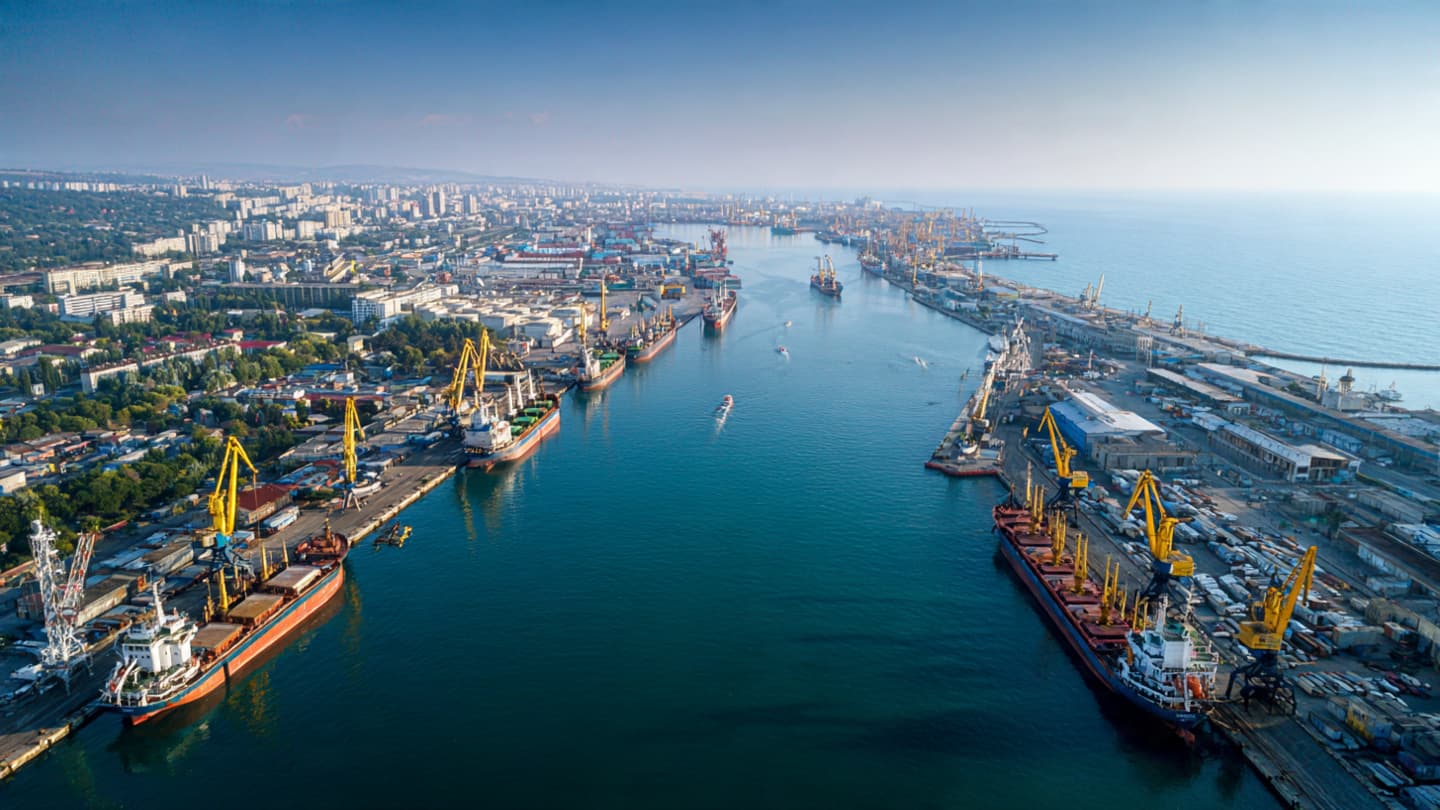
Constanța occupies a particularly important position within this landscape. The port serves as a critical hub for regional trade, including alternative export routes that have helped move Ukrainian grain and other goods through the Black Sea during years of disruption. Cranes, warehouses, rail lines, and shipping terminals form a vast network connecting inland Europe to maritime routes stretching far beyond the region.
In recent years, Romania has repeatedly confronted the unintended consequences of a conflict taking place just across its border. Drone fragments have landed on Romanian territory. Airspace incursions have been recorded. Naval mines have drifted through Black Sea waters, prompting multinational efforts to locate and neutralize them before they reach populated areas or shipping lanes. Only days before the latest incident, Romanian authorities reported the destruction of a drifting mine along the coast.
The explosion also followed another significant security episode a week earlier, when a drone linked to attacks in Ukraine crashed into a residential building in the Romanian city of Galați, injuring two people. That event heightened concerns about how modern warfare increasingly extends beyond traditional battlefields through the movement of drones, missiles, and other unmanned systems.
There is a certain irony in the technology itself. Maritime drones are designed to travel across open water with precision and purpose. Yet the same systems can become vulnerable to interference, weather, navigation failures, or the unpredictable conditions created by electronic warfare. When that happens, machines intended for one destination may arrive somewhere entirely different.
For countries neighboring active conflict zones, such possibilities have become part of daily security calculations. The challenge is no longer simply defending borders in the traditional sense, but monitoring airspace, coastlines, shipping corridors, and critical infrastructure against threats that can appear suddenly and move across vast distances with little warning.
Still, life along the Romanian coast continued after the alarms subsided. The port resumed its operations. Ships remained anchored in the harbor. Residents returned to beaches and neighborhoods that had briefly been evacuated as a precaution. The rhythms of commerce and daily life reasserted themselves, as they often do.
Yet the incident leaves behind a quieter reflection. The Black Sea has long connected nations through trade, migration, and shared geography. Today it also carries the consequences of a war whose effects ripple outward in unexpected ways. A single drone drifting into a harbor may not alter the course of events, but it serves as a reminder of how closely linked neighboring countries have become to the conflict’s expanding perimeter.
The explosion in Constanța caused no injuries and little physical damage. Its greater significance may lie in what it revealed: that even in places far from the front lines, the boundaries between peace and conflict can sometimes be measured not in miles, but in the distance between a horizon and a harbor.
AI Image Disclaimer These visuals are AI-generated representations created to illustrate the subject matter and should not be interpreted as actual photographs of the incident.
Sources Reuters Associated Press Romanian Ministry of National Defense European Commission NATO
Published by Banx Network. This article is part of the Banx decentralized media programme, powered by the BXE token on the XRP Ledger.


.jpg&w=3840&q=75 "Intelligence Agencies Suspect Russia Is Developing Anti-Satellite Weapon to Target Starlink")
