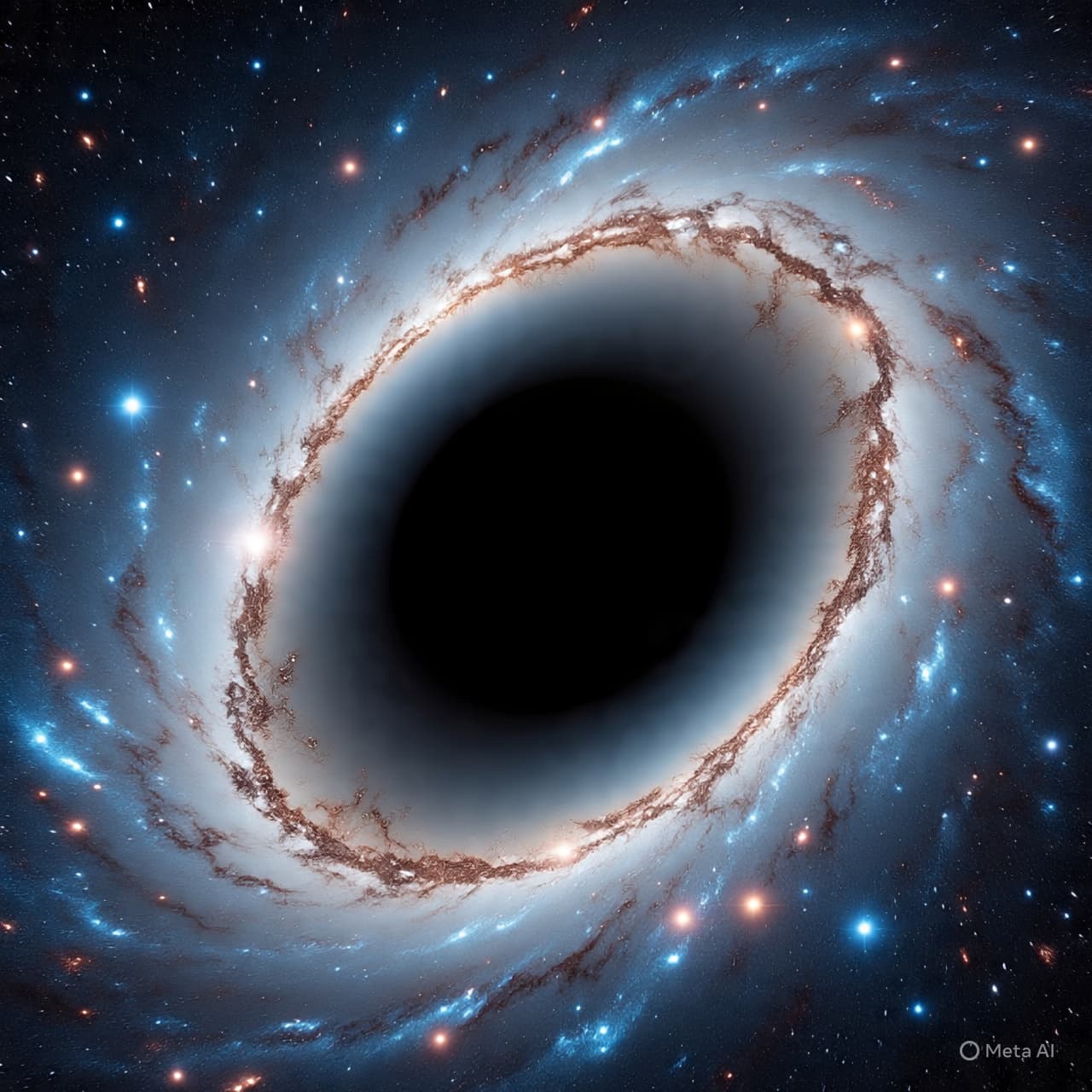
There is a quiet kind of hunger that does not announce itself with urgency, but with absence. In the far reaches of the universe, where gravity gathers its strength into invisible wells, even the most insatiable forces can begin to feel this stillness. Supermassive black holes—those immense anchors at the hearts of galaxies—have long been imagined as perpetual consumers, endlessly drawing matter into their depths. Yet, as new observations suggest, even these cosmic giants may be learning what it means to slow down.
In recent findings supported by observations from NASA and the ESA, astronomers are beginning to trace a subtle shift in the behavior of supermassive black holes. The change is not abrupt, nor dramatic in a human sense, but it carries profound implications. Many of these black holes appear to be accreting less material than before, their once-bright surroundings dimming as the supply of nearby gas and dust grows increasingly scarce.
For decades, the brilliance of active galactic nuclei—regions where black holes feed voraciously—has served as a beacon across the cosmos. These luminous centers, powered by infalling matter heated to extreme temperatures, can outshine entire galaxies. But now, researchers are observing more galaxies where this brilliance is fading, replaced by quieter, less active cores. It is not that the black holes themselves have weakened, but rather that their environment has changed. The reservoirs of fuel that once sustained their growth are thinning, gradually reshaping their influence.
This scarcity of fuel reflects a broader evolution within galaxies. Over billions of years, star formation consumes vast amounts of gas, while galactic interactions redistribute what remains. In some cases, energetic feedback from the black holes themselves—jets and radiation powerful enough to push matter away—may have contributed to this depletion. The result is a kind of cosmic equilibrium, where growth slows not by force, but by limitation.
There is a certain symmetry in this process. The same black holes that once thrived on abundance may now exist in relative quiet, their presence marked less by brilliance and more by subtle gravitational influence. Yet, even in this quieter phase, they continue to shape their galaxies—guiding stellar motions, influencing structure, and maintaining a delicate balance within their cosmic neighborhoods.
The emerging picture is not one of decline, but of transition. As astronomers refine their models and gather more data, they are beginning to understand that black hole activity is not constant, but cyclical—rising and falling in response to the availability of fuel. This perspective invites a more nuanced view of the universe, one where even the most extreme phenomena are subject to change over time.
In the broader scope of cosmic history, this slowdown may represent a natural stage in galactic evolution. The universe, after all, is not static; it is a system in motion, shaped by both abundance and scarcity. And in this gradual shift, there is a quiet reminder that even the most powerful forces are connected to their surroundings in ways that are both intricate and enduring.
Looking ahead, ongoing observations will continue to clarify how widespread this trend may be and what it reveals about the long-term future of galaxies. For now, scientists approach the findings with careful attention, noting patterns rather than conclusions, and allowing the data to unfold at its own pace.
AI Image Disclaimer Illustrations were produced with AI and serve as conceptual depictions.
Source Check (Credible Media Outlets):
NASA ESA Space.com Nature Astronomy BBC Science
Published by Banx Network. This article is part of the Banx decentralized media programme, powered by the BXE token on the XRP Ledger.