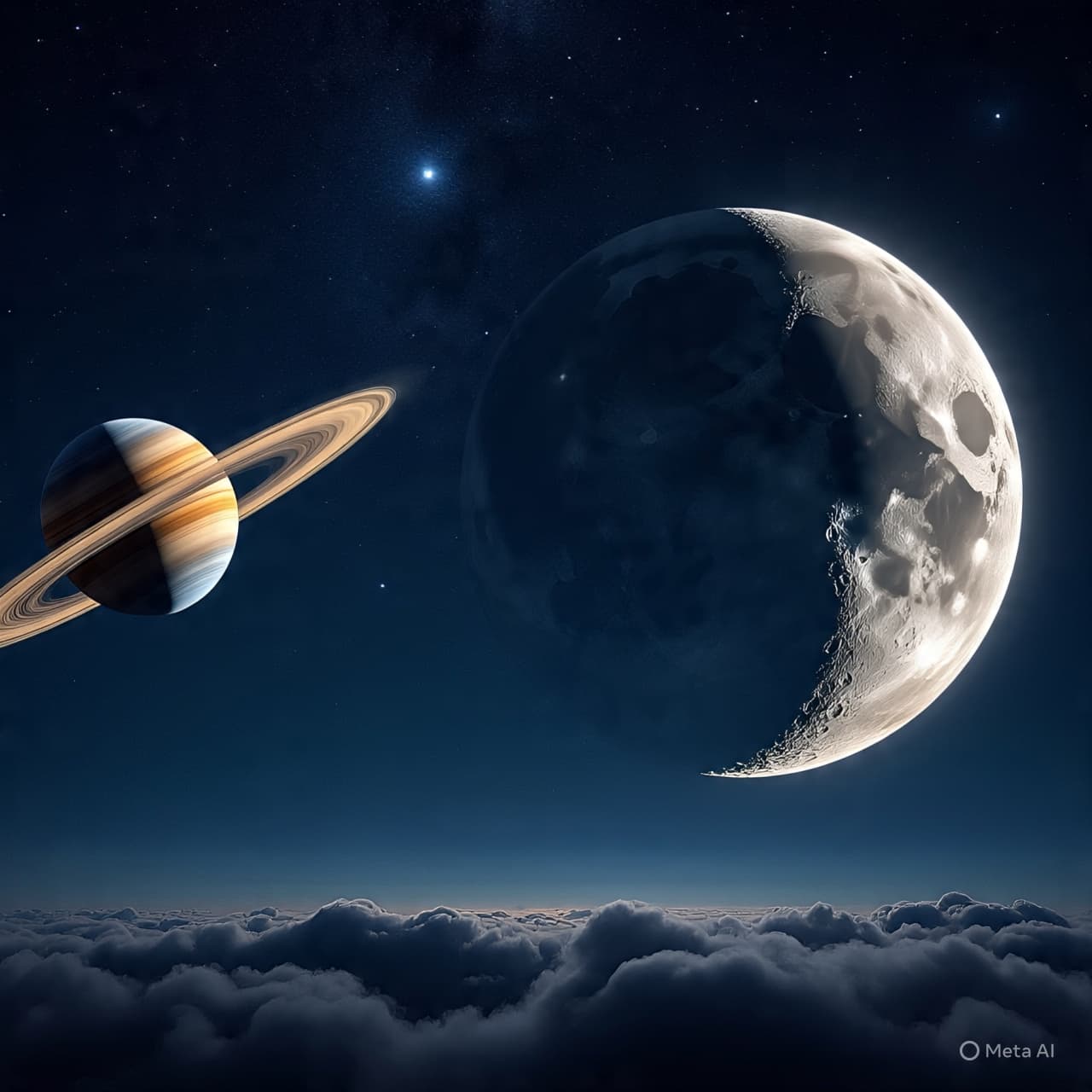
In the vast theater of the night sky, Saturn, our Moon, and Neptune perform a silent, timeless ballet. The Moon, a familiar companion tracing its slow arc across Earth’s sky, casts gentle light on our waking world. Saturn, adorned with its golden rings, glimmers like a distant crown, a reminder of the elegance and precision of celestial mechanics. Farther still, Neptune dwells in serene isolation, a deep blue sentinel marking the outer edge of our solar system, silent yet steadfast.
Observing these three worlds together evokes a sense of layered time and scale. The Moon, mere days or weeks old in its phases, speaks to our intimate connection with the cosmos. Saturn, with rings spun from ice and rock, whispers of ages measured in millions of orbits, of matter shaped and reshaped over eons. Neptune, nearly invisible without aid, is a distant memory of the solar system’s infancy, a guardian of mysteries that stretch beyond ordinary comprehension.
These bodies, though separated by vast distances, offer a meditation on movement, gravity, and harmony. They remind us that our place in the universe is both small and significant—that while the Moon lights our nights, planets like Saturn and Neptune chart the grand rhythms of celestial time. Watching them, one feels the pull of curiosity, the quiet awe of existence, and the delicate poetry written in the language of orbits and light-years.
As telescopes capture their subtle glows and amateur stargazers trace their paths, Saturn, the Moon, and Neptune become more than astronomical objects; they are guides to reflection. They invite us to slow our gaze, to ponder scale and distance, to consider the beauty of order in a universe that is simultaneously immense and intimate.
AI Image Disclaimer Illustrations were created using AI tools and are not real photographs.
Sources NASA Solar System Exploration; European Space Agency; Astronomy Magazine; Space.com; Hubble and James Webb Telescope data.
Published by Banx Network. This article is part of the Banx decentralized media programme, powered by the BXE token on the XRP Ledger.