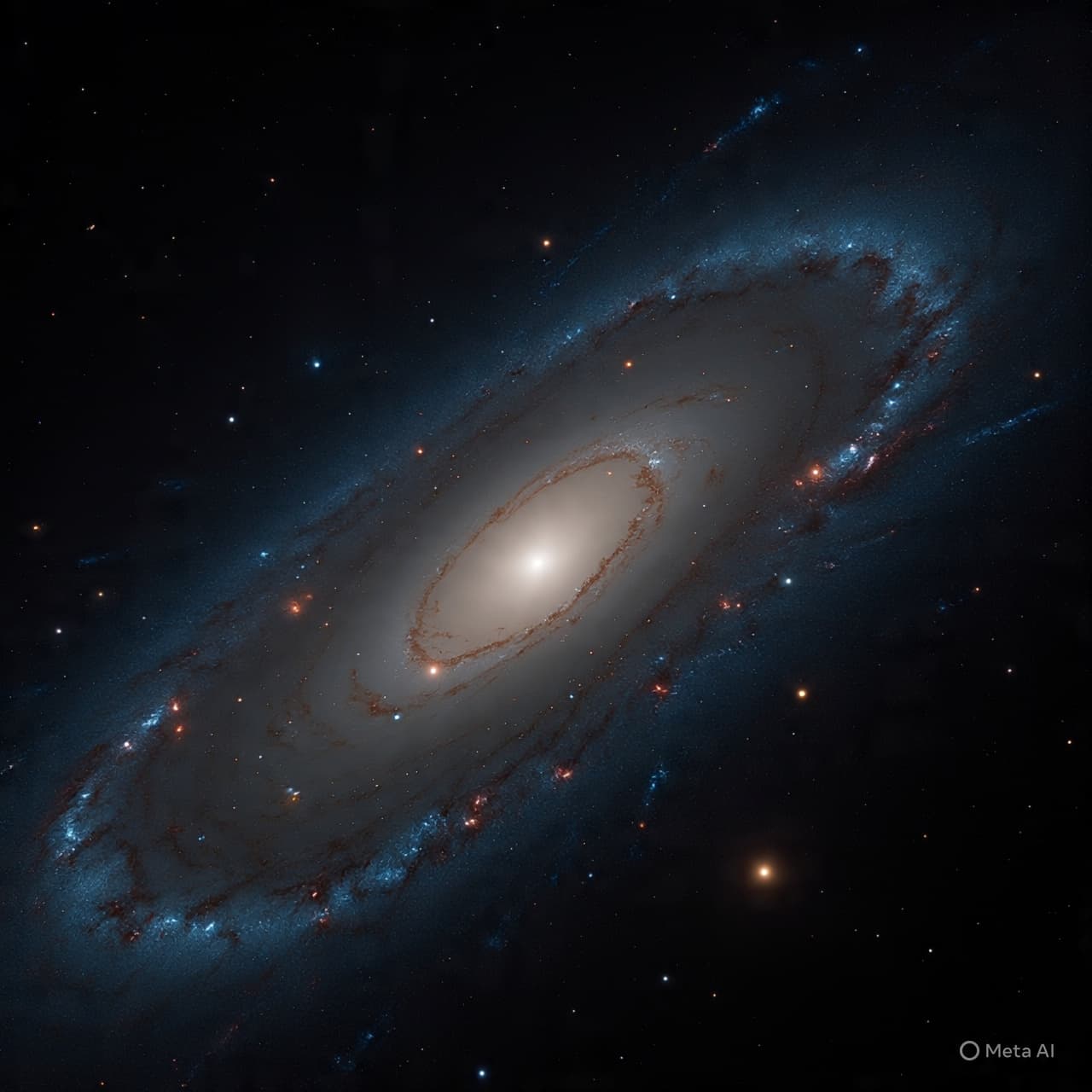
In the immensity of space there are places where light seems hesitant, where the glow of familiar stars retreats like dawn shy of morning. In these twilight realms of the cosmos, some worlds are less a tapestry of brilliance and more a whisper of existence, hinting at the subtler contours of reality. Among them, a newly identified galaxy drifts like a shadow given shape — a rare cosmic island where the glitter of stars is but a trace, and where the invisible holds sway.
This elusive object, known among astronomers as Candidate Dark Galaxy‑2, sits in the Perseus galaxy cluster at a distance of roughly 300 million light‑years from our own Milky Way. To look at it through the lens of the Hubble Space Telescope is to witness a faint glow only just distinguishable against the dark — the kind of barely perceptible light that speaks not of abundance, but of absence. Its stars, few as they are, cluster in four small globular systems that act like beacons against the deep expanse. These tight groupings were the first signs that something more substantial might be hidden there, prompting astronomers to probe further with observatories including ESA’s Euclid space telescope and the Subaru Telescope on Earth. Together, their observations revealed a diffuse halo of light embracing those clusters — the feeble pulse of a galaxy otherwise near invisible.
In most galaxies, ordinary matter — stars, gas, dust — shines brightly and gives shape to our expectations of cosmic form. Yet in this rare case, the balance is almost entirely tipped toward something unseen: dark matter. Preliminary analysis suggests that approximately 99 percent of this galaxy’s mass lies in dark matter, the mysterious substance that interacts not with light, but with gravity, gently shaping the motions of stars and gas while itself remaining undetected by electromagnetic means. It is the silent scaffolding of the cosmos, and here, in this faint galaxy, its presence is laid bare in stark relief.
The sparse stars and faint glow suggest a history more of erosion than creation. Astronomers theorize that, over eons, interactions with neighboring galaxies may have stripped away much of the normal matter that once lay within CDG‑2 — the hydrogen gas that fuels star birth, the clouds that coalesce into the brilliant points of light we associate with galaxies. What remains is a structure held together not by luminous bodies but by the gravity of dark matter, a place where the familiar radiance of a billion suns is replaced by a soft echo, barely above the cosmic hush.
To stumble upon such a galaxy is to glimpse the underside of cosmic architecture: where light is the exception rather than the rule, and where gravity’s quiet hand binds what little remains. These findings challenge and refine our understanding of how galaxies form and evolve, suggesting that some may be hidden from view, waiting only for the most sensitive instruments and patient eyes to reveal them. In this shadowy tableau, the universe murmurs of its own complexity, offering not only spectacle but meditation on what lies beyond what we can see.
In clearer terms, astronomers using the Hubble Space Telescope, joined by observations from ESA’s Euclid and the Subaru Telescope, have identified a galaxy designated CDG‑2 in the Perseus cluster that appears to be composed of roughly 99 percent dark matter. It contains only a sparse population of stars visible through their globular clusters, and may have lost much of its ordinary matter through gravitational interactions, leaving behind a dark matter‑dominated galaxy that is among the most extreme examples yet discovered.
AI Image Disclaimer
Illustrations were created using AI tools and serve as conceptual representations.
Sources (Media Names Only)
NASA (Hubble & Science Releases) ESA (European Space Agency) Space.com BBC Sky at Night Magazine Phys.org
Published by Banx Network. This article is part of the Banx decentralized media programme, powered by the BXE token on the XRP Ledger.