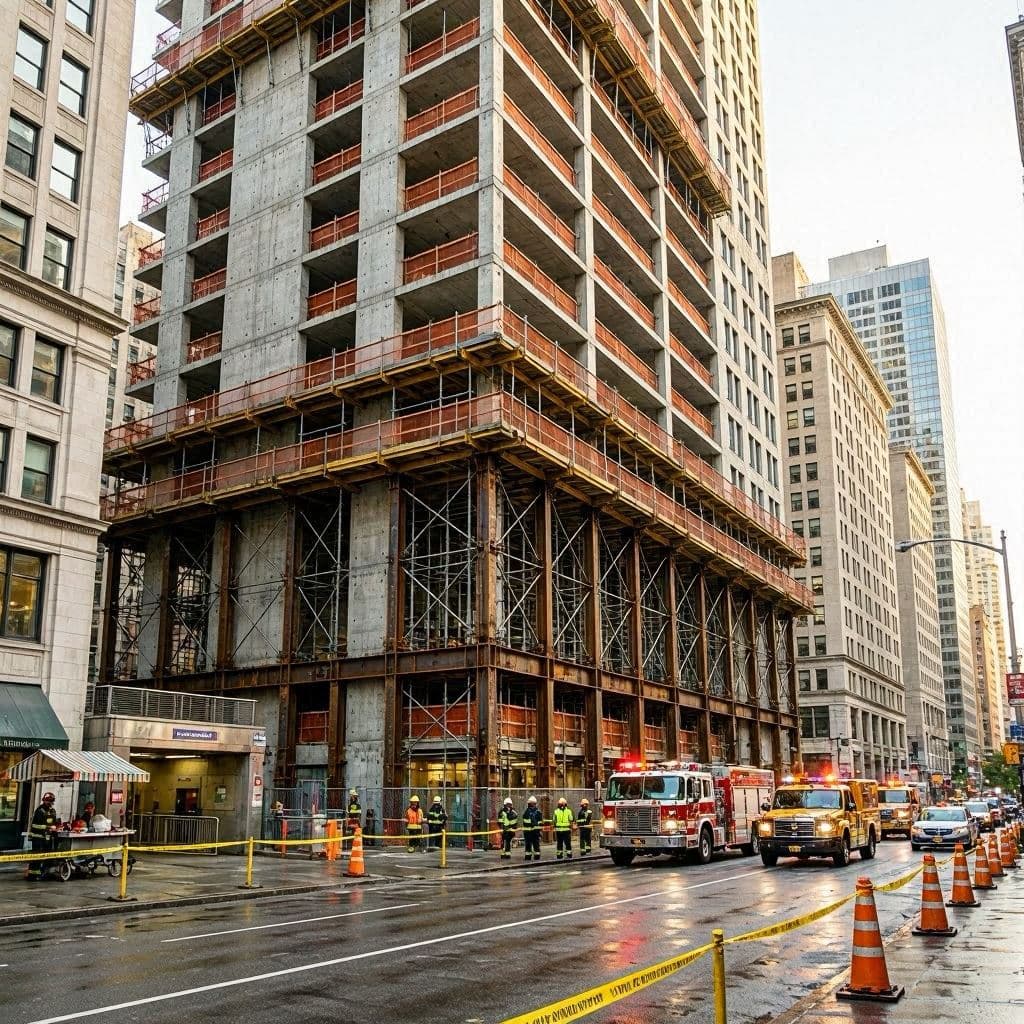
Opening: In the heart of Midtown Manhattan, where the skyline serves as a testament to human ambition and engineering prowess, a quiet drama of structural integrity has unfolded. The sight of a towering edifice, momentarily paused in its ascent, reminds us that even our most permanent creations are subject to the delicate balance of physics and precision. As emergency crews work through the night, the city holds its breath, not in panic, but in a collective appreciation for the meticulous care required to keep our shared spaces safe.
Body: The incident involving the 37-story building on East 42nd Street began with the unsettling sight of buckled support columns, a rare occurrence that triggered immediate evacuations and street closures. Yet, amidst the urgency, there was no chaos, only a coordinated response that highlighted the resilience of New York’s emergency infrastructure. Engineers and construction workers moved with purpose, installing temporary shoring and beams to stabilize the structure, ensuring that the building remained secure while assessments were conducted.
As the days passed, officials confirmed that no additional movement had been detected, a reassuring sign that the initial stabilization efforts were effective. The developer, maintaining a transparent dialogue with the public, assured residents that the building was never at risk of collapse, attributing the damage to specific renovation activities rather than foundational flaws. This clarity helped to ease tensions, allowing the surrounding community to gradually return to their daily routines with renewed confidence.
The technical challenge now lies in the careful reconstruction of the damaged section. Experts suggest that the two compromised columns may need to be replaced entirely, a task that requires both surgical precision and robust planning. The process is not merely about repairing steel and concrete; it is about restoring trust in the built environment, ensuring that every beam and bolt meets the highest standards of safety and durability.
Throughout this ordeal, the narrative has been one of caution rather than catastrophe. The mass evacuations, while disruptive, were a testament to the proactive measures taken by city officials to prioritize human life above all else. Streets that were once closed off have begun to reopen, and the hum of the city has returned, albeit with a heightened awareness of the intricate systems that support our urban lives.
The developer’s commitment to rebuilding the damaged section underscores a broader principle in modern construction: accountability and continuity. By addressing the issue head-on and outlining clear plans for restoration, the project aims to transform a moment of vulnerability into a demonstration of reliability. This approach reflects a mature understanding of urban development, where setbacks are managed with transparency and resolve.
As the stabilization work continues, the focus remains on long-term safety and structural integrity. The incident serves as a reminder that even in a city defined by its vertical aspirations, the foundation of progress is built on careful oversight and responsive action. The community watches on, not with fear, but with an expectation of thoroughness and excellence in the work ahead.
Closing: With streets reopening and stabilization measures holding firm, the situation at the Midtown high-rise has transitioned from emergency response to methodical repair. The event stands as a case study in modern urban resilience, where swift action and clear communication help maintain public trust during moments of structural uncertainty.
AI Image Disclaimer: Please note that any accompanying visuals for this story are AI-generated representations intended to illustrate the context of urban construction and stabilization efforts.
Sources: CNN NBC New York ABC News The Washington Post
Published by Banx Network. This article is part of the Banx decentralized media programme, powered by the BXE token on the XRP Ledger.