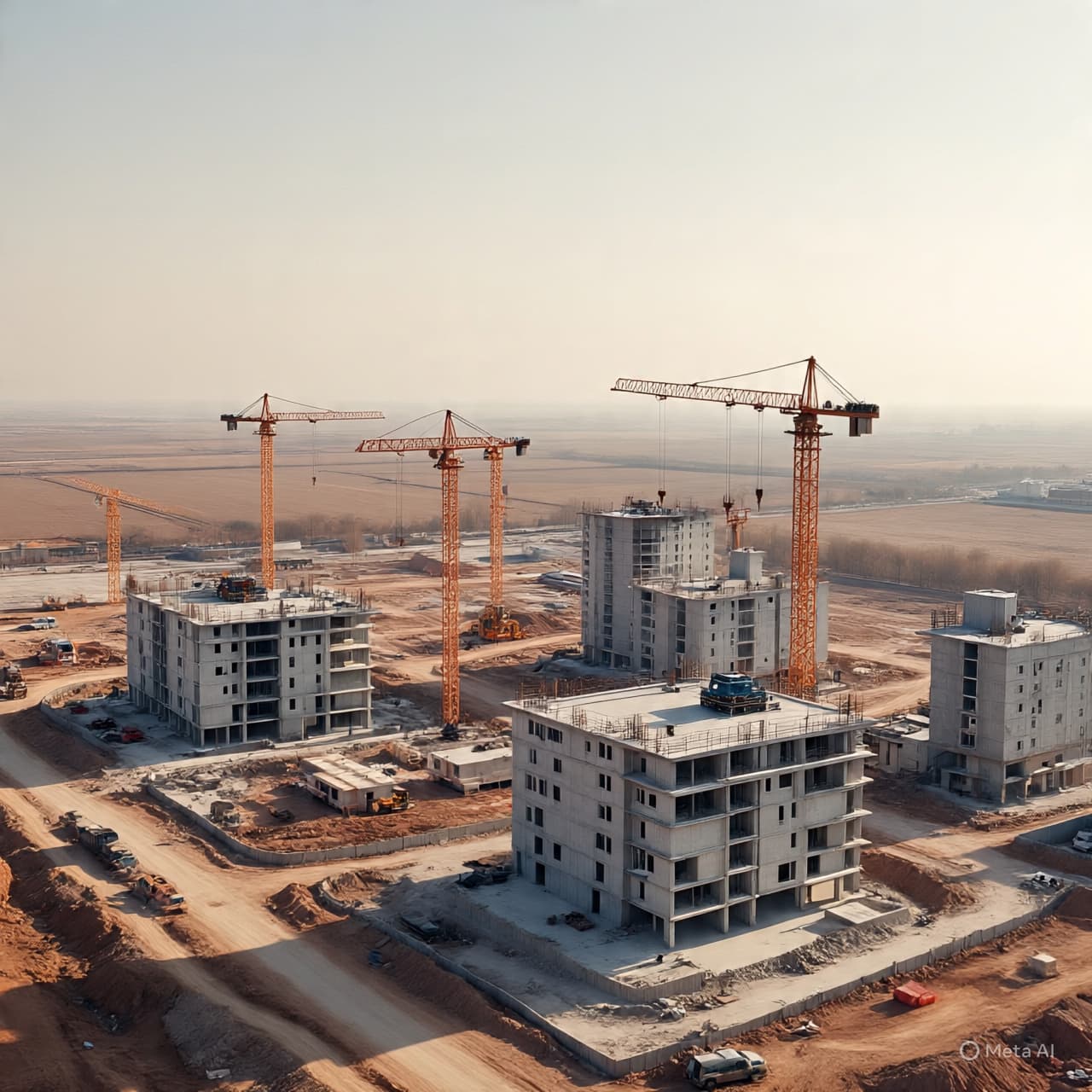
Morning light moves differently across a city under construction. Where cranes once traced confident arcs against the sky, their motion now feels restrained, as if waiting for a signal that has not yet arrived. In China’s property sector, that pause has become visible not only in unfinished projects, but in the numbers that quietly reorder status and scale.
The latest industry ranking shows that roughly half of China’s top property developers have fallen out of a key list, a shift that reflects the depth and duration of the country’s real estate downturn. Once-dominant names, long associated with rapid expansion and national reach, have slipped as sales weaken, financing tightens, and confidence continues to erode.
The ranking, which measures developers by contracted sales and market presence, has long served as a barometer of the sector’s health. Its latest revision underscores how far conditions have changed. Developers that relied heavily on leverage and constant presales have been especially exposed, struggling to maintain cash flow amid slower demand and stricter regulatory oversight.
China’s property slump has been unfolding for several years, shaped by policy efforts to rein in excess borrowing and by a broader economic slowdown. What began as a targeted attempt to reduce financial risk has evolved into a prolonged adjustment, affecting homebuyers, local governments, and the broader construction supply chain. For developers, the result has been consolidation, restructuring, and, for some, a quiet retreat from prominence.
Survivors on the list tend to share certain traits. State backing, diversified revenue streams, and a more conservative approach to expansion have helped some firms weather the downturn. Their ascent within the ranking is less a sign of renewed growth than of relative stability in a contracting field.
Analysts note that the reshuffling does not signal an imminent rebound. Housing demand remains uneven across regions, and buyer sentiment has yet to fully recover. Policy support has increased in measured steps, aimed at stabilizing rather than reigniting the market. In this environment, rankings become less about celebration and more about endurance.
The disappearance of familiar names from the list carries symbolic weight. It marks the fading of an era when scale itself was a measure of success. Today, restraint and balance appear to matter more than sheer volume, even if that lesson has come at considerable cost.
As the sector continues to adjust, the rankings will likely remain fluid. What they record is not only performance, but transition. In the slowed rhythm of construction and finance, China’s property market is learning to move differently, one recalibrated step at a time.
Published by Banx Network. This article is part of the Banx decentralized media programme, powered by the BXE token on the XRP Ledger.