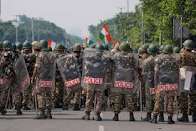
In the early chill of a January morning along Yemen’s eastern coast, the dusty streets of Mukalla — a port city that once bustled with the rhythms of trade and sea breezes — became the quiet backdrop of a different kind of motion: the return of government troops welcomed by residents and tribal leaders alike. After days of Saudi-backed airstrikes and clashes with southern separatist fighters, Yemen’s internationally recognized government has regained control of Hadramout province, marking a significant shift in a war-scarred nation’s complex tapestry of alliances and conflict.
Hadramout, Yemen’s largest governorate and home to vital oil resources and a strategic coastline along the Arabian Sea, had been seized late last month by the Southern Transitional Council (STC) — a separatist faction supported by the United Arab Emirates — during a rapid southern offensive that also captured neighboring al-Mahra province. The STC’s advance not only unsettled local governance but also strained relations among Yemen’s foreign backers, particularly between Saudi Arabia and the UAE, two nations that have long cooperated in the coalition against the Iran-aligned Houthi movement in the north but diverged sharply over the South’s future.
Beginning last Friday, Saudi air forces and allied ground units — including Yemen’s National Shield Forces aligned with the internationally recognized Presidential Leadership Council — launched a counteroffensive to reclaim Mukalla and surrounding districts. The operation combined targeted airstrikes with coordinated ground advances, pressing STC fighters to withdraw from key military camps and urban centers. By Sunday, government loyalists reported that they had retaken all major military and security positions across Hadramout, with video from the streets showing locals greeting troops as they secured the provincial capital and symbolic port.
The retaking of Mukalla — an economic lifeline with its ports and airports — carries implications for Yemen’s tangled civil war. For Yemen’s internationally recognized government, it represents a reassertion of authority at a time when the country’s unity faces threats from multiple fronts. For Saudi Arabia, which has long supported the recognized government against the northern Houthi insurgency, the success reinforces Riyadh’s insistence on maintaining Yemen’s territorial integrity and counters what it views as undue influence by the UAE in southern affairs.
Yet the broader conflict remains far from resolved. While Saudi-backed forces now patrol Hadramout’s streets, the fractured landscape of Yemeni politics — with rival factions jockeying for power and foreign patrons negotiating influence — suggests that peace is still fragile. Saudi Arabia has renewed calls for dialogue among Yemeni factions in Riyadh, seeking political solutions alongside military gains, but deep mistrust and competing visions for Yemen’s future linger.
In Hadramout, where the scent of the sea mingles with the dust of recent battles, residents and fighters alike face the uncertain task of rebuilding — homes, markets, and trust alike — as the broader Yemen war, now in its twelfth year, continues to unfold.
AI Image Disclaimer “Visuals are created with AI tools and are not real photographs.”
Sources Used Associated Press / AP News, Al Jazeera, Bloomberg, South China Morning Post, Reuters.
Published by Banx Network. This article is part of the Banx decentralized media programme, powered by the BXE token on the XRP Ledger.