There are messengers that travel across the universe for billions of years, passing through planets and people without leaving a trace, carrying secrets of distant galaxies and dying stars. For most of human history, we could not hear them. This week, the man who built a telescope to listen was honored with the Nobel Prize in Physics.
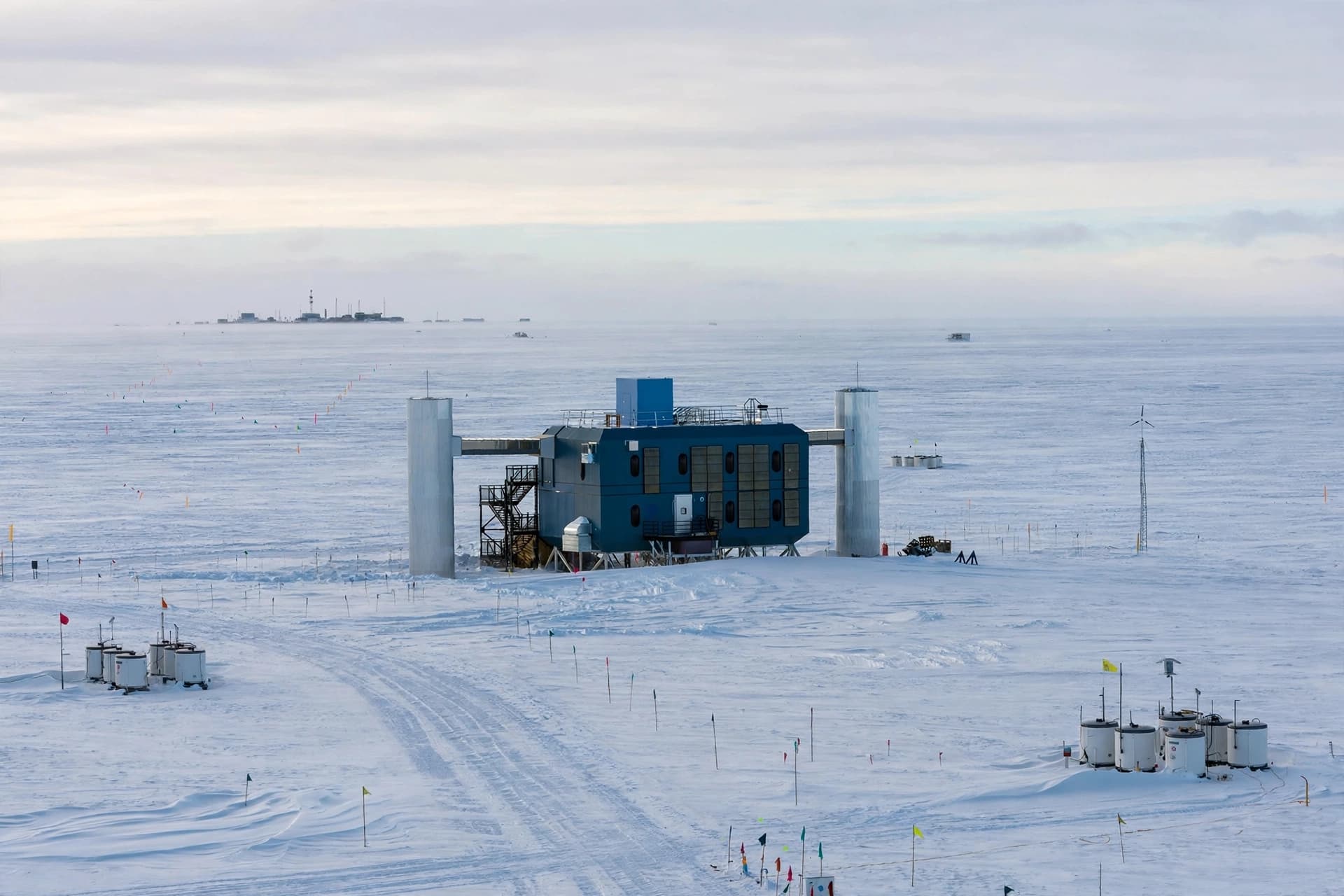
Francis Halzen, a Belgian-born physicist at the University of Wisconsin-Madison, has been awarded the 2026 Nobel Prize in Physics for his work on the IceCube Neutrino Observatory and the discovery of high-energy neutrinos of astrophysical origin. The Royal Swedish Academy of Sciences cited his "vision and scientific leadership" in creating the observatory, which uses a cubic kilometer of Antarctic ice to detect particles that pass through the Earth almost without interacting .
Neutrinos are among the most elusive particles in existence. They have no electric charge and extraordinarily small mass, and they stream from stars, including our Sun, in unimaginable numbers—trillions pass through our bodies every second . But the neutrinos IceCube hunts are different: they carry energies thousands of times greater than any particle accelerator can produce, and they come from violent cosmic events far beyond our galaxy .
Halzen first proposed using Antarctic ice as a neutrino detector in 1988. The idea was audacious: drill thousands of sensors deep into a cubic kilometer of clear ice, and wait for the rare moment when a neutrino collides with an atom, producing a faint blue flash of light that sensors can capture. The pattern of that light points back to the neutrino's source .
"I have to emphasise how lucky I was," Halzen said at a news conference. "When we started this project, everybody realised this was maybe a good idea, but very few thought it would work, including myself" .
The IceCube observatory was completed in 2010, and in 2013, researchers announced the first detection of high-energy neutrinos from outside our solar system—a discovery that opened a new window on the universe. Since then, it has recorded more than 900,000 neutrino interactions, providing insights into exploding stars, giant black holes, and the fundamental nature of matter .
"His tenacity and scientific vision has paved the way for a new kind of astronomy," said Mark Pearce, chair of the Nobel Committee for Physics .
Halzen, now 82, said he was working on a research proposal when the Nobel committee called. "I hope that this prize will help getting it approved," he joked . For a man who spent decades chasing particles that most thought impossible to catch, the recognition is both a personal honor and a testament to the power of patient, collaborative science.
AI Image Disclaimer: The images accompanying this article are generated by artificial intelligence and are intended for illustrative purposes only.
Sources: AP News, BBC, Sveriges Radio, Armenpress, DESY, University of Wisconsin-Madison
Published by Banx Network. This article is part of the Banx decentralized media programme, powered by the BXE token on the XRP Ledger.