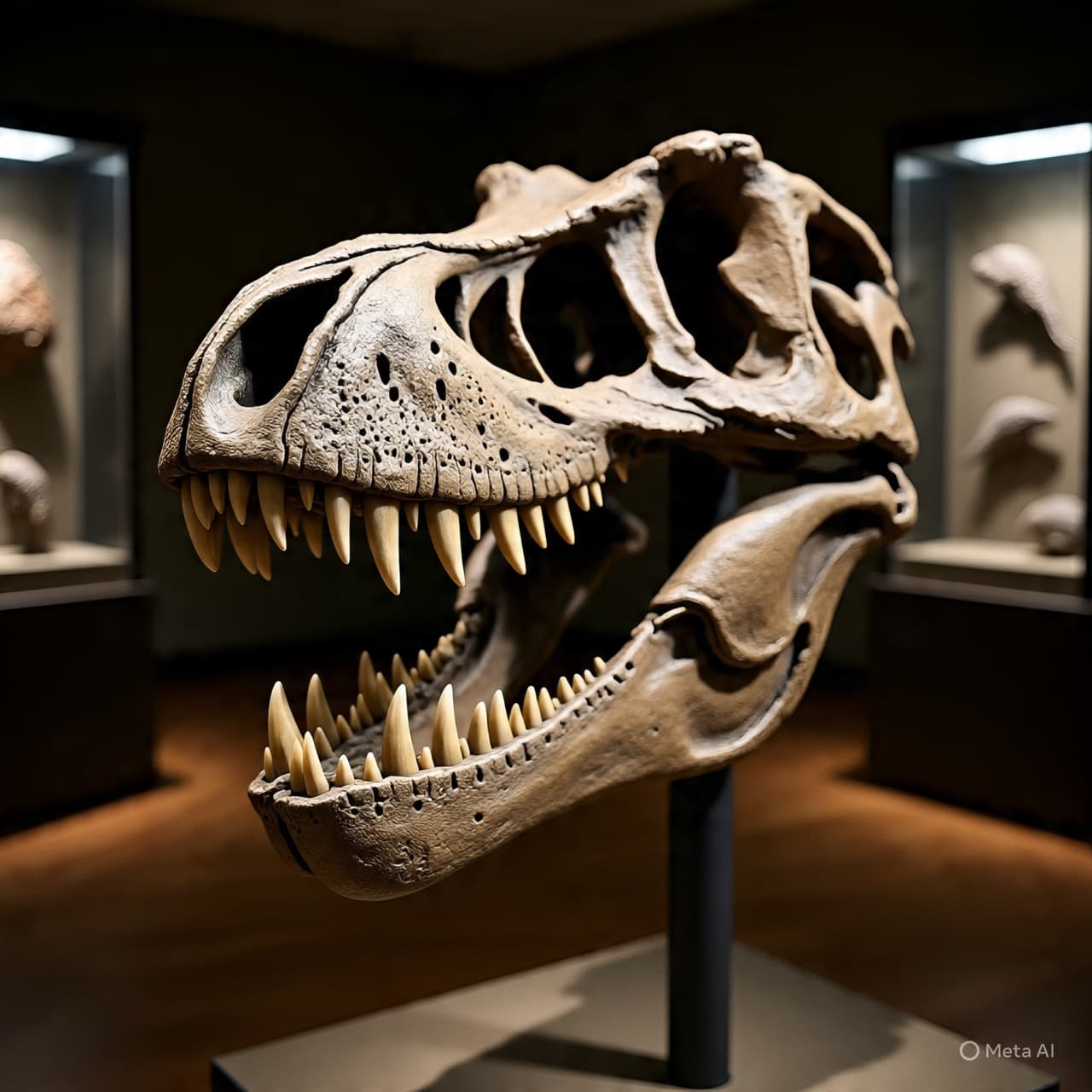
In a quiet hall where light meets dust, ancient bones lie on display, whispering stories from a world long buried. Among them, one fossil quietly reshapes our understanding of life and death from more than 66 million years ago — a moment frozen in time deep within the rock of Montana’s Hell Creek Formation.
At the Museum of the Rockies in Bozeman, a nearly complete skull of an Edmontosaurus is captivating visitors and scientists alike because of a startling detail: embedded deep in the face of the duck‑billed dinosaur is a tooth from a tyrannosaur — most likely Tyrannosaurus itself. Scientists say such a discovery is extremely rare, and this single embedded tooth offers a unique glimpse into predator‑prey interactions from the end of the Age of Dinosaurs.
Usually, bite marks on fossilized bones can tell paleontologists that an animal was attacked or scavenged after death. But finding a tooth still lodged in the bone is unusual — especially in the skull — because it provides direct evidence not only of who was bitten, but also who did the biting. Like detectives at a Cretaceous crime scene, researchers analyzed the tooth and compared it to known carnivorous dinosaurs from the region, concluding that it most closely matches Tyrannosaurus.
CT scans of the skull revealed no signs of healing around the embedded tooth, suggesting that the encounter occurred at or near the moment of death. Paleontologists speculate that the Edmontosaurus may have been killed by the tyrannosaur’s bite, or possibly scavenged immediately after death. Either way, the force required to break and lodge a tooth in bone points to the formidable bite power of this apex predator.
What makes this fossil so compelling is not only its rarity but the story it tells. It connects us to a single, visceral interaction between two ancient animals — a fleeting clash now preserved for ages. This helps scientists better understand the behavior, feeding practices, and ecological relationships of dinosaurs in one of North America’s most famous fossil landscapes.
In a museum corridor, where children crane their necks and adults linger in wonder, this skull stands as both a relic and a storyteller. It reminds us that beneath layers of sediment and time, life once thrummed with drama and danger — and that even in fragments of bone, history can speak with clarity and power.
AI Image Disclaimer Illustrations were produced with AI and are intended for conceptual depiction, not real photographs.
Sources:
Reuters Phys.org Popular Science PeerJ journal research coverage Montana State University news and paleontology reports
Published by Banx Network. This article is part of the Banx decentralized media programme, powered by the BXE token on the XRP Ledger.