There are moments in science when a puzzle lingers so long that it begins to feel almost like a quiet companion. For decades, astronomers looked at certain stars and noticed something curious, like a faint whisper carried across cosmic time. On the surface of aging stars known as red giants, chemical signatures appeared that should not have been there—elements from deep inside the star somehow rising to the surface.
For more than half a century, this quiet inconsistency lived in the margins of astrophysics. Observations continued, theories came and went, but the mechanism behind the strange stellar chemistry remained elusive. The stars themselves offered no clear explanation, glowing patiently in the sky while scientists searched for the missing piece of their story.
Now, with the help of powerful supercomputers and sophisticated simulations, researchers believe they may have finally found the answer.
The mystery centers on red giant stars, a late stage in the life cycle of stars similar to our Sun. As these stars age and expand, astronomers have long observed unusual changes in the chemical composition of their outer layers. Elements that should remain buried deep within the stellar interior appear at the surface, suggesting that some hidden process is transporting material upward through the star.
For decades, models struggled to reproduce this phenomenon. Traditional theories predicted that the layers inside these stars should remain relatively separated, with a barrier preventing deep material from easily mixing with the outer envelope. Yet observations consistently showed evidence of mixing.
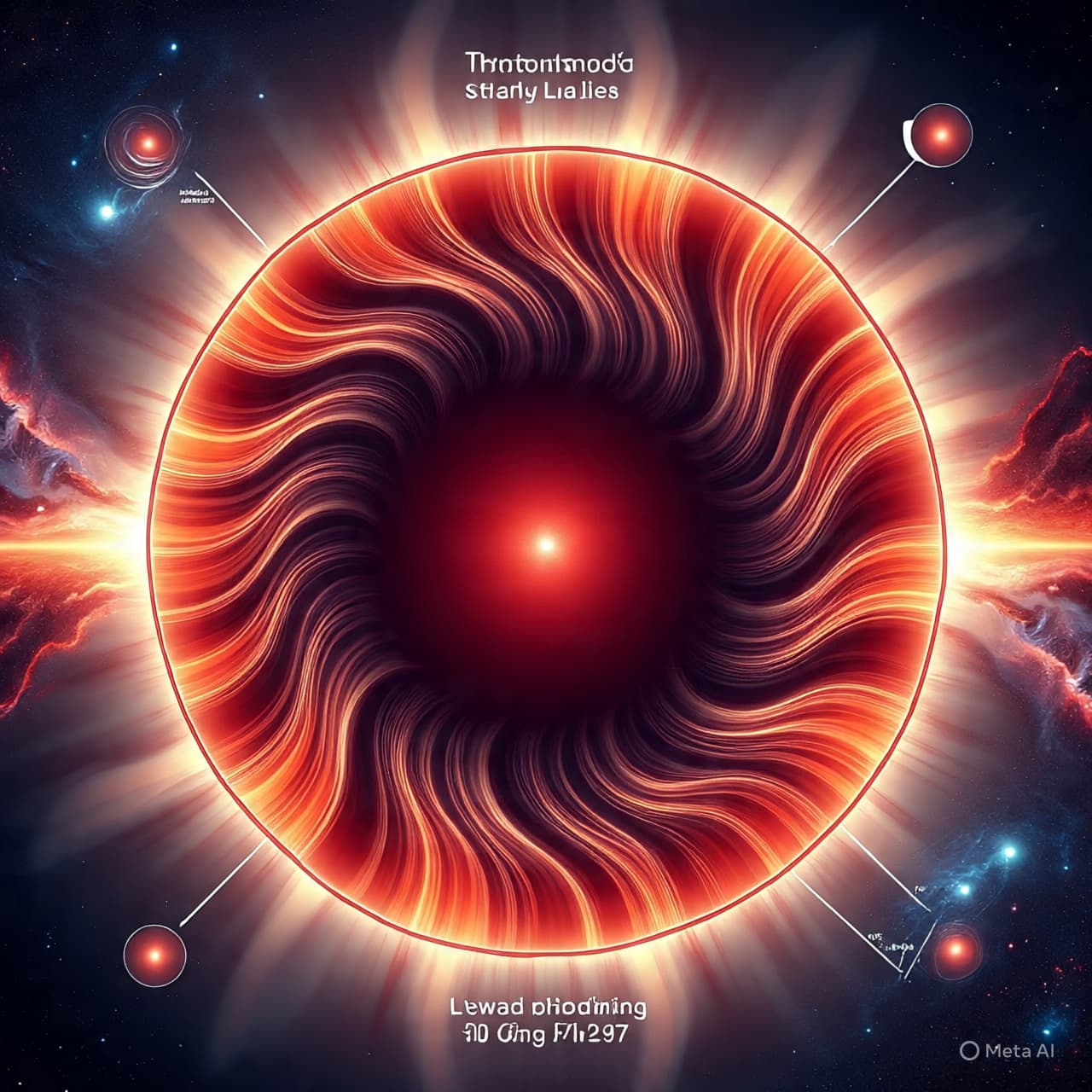
The breakthrough came through detailed three-dimensional hydrodynamic simulations, run on advanced supercomputing systems. These simulations allowed scientists to recreate the complex interior environment of red giant stars—an environment shaped by turbulence, waves, and rotation.
The key, researchers discovered, may lie in the star’s spin.
According to the new findings, stellar rotation dramatically enhances a process known as wave-driven mixing. Waves generated in the outer layers of the star travel inward, interacting with the boundary between different stellar regions. When rotation is present, these waves become far more effective at transporting material across that barrier.
In the simulations, mixing occurred more than 100 times faster in rotating stars compared with stars that do not spin. This acceleration allows elements produced deep within the star to gradually migrate toward the surface, explaining the puzzling chemical signatures astronomers have observed for decades.
Beyond solving an old puzzle, the discovery offers a glimpse into the distant future of our own Sun. Billions of years from now, the Sun will also expand into a red giant, undergoing many of the same physical processes now being studied in distant stars.
Understanding how material moves within these stars helps scientists build more accurate models of stellar evolution. It also sheds light on how elements created in stars are redistributed into space, eventually becoming part of new stars, planets, and perhaps even life itself.
The role of supercomputers in this discovery highlights how modern astrophysics increasingly depends on enormous computational power. Simulating the chaotic interior of a star requires calculations across many dimensions, tracking turbulence, gravity, heat, and rotation simultaneously—tasks that would have been nearly impossible just a few decades ago.
In many ways, these machines act as laboratories for the cosmos. While telescopes allow scientists to observe the universe from afar, supercomputers make it possible to recreate the physics of stars themselves, step by step, inside a digital environment.
After fifty years of quiet speculation, the puzzle of mixing inside red giants may finally be giving way to understanding. The stars that once seemed to guard their secrets so carefully are beginning, slowly and patiently, to reveal how their hidden currents move.
And as simulations grow more powerful, researchers expect that other long-standing cosmic questions—equally subtle and equally enduring—may soon find their answers as well.
AI Image Disclaimer Graphics are AI-generated and intended for representation rather than real astronomical photographs.
Sources Reuters SciTechDaily Space.com Phys.org Universe Today
Published by Banx Network. This article is part of the Banx decentralized media programme, powered by the BXE token on the XRP Ledger.