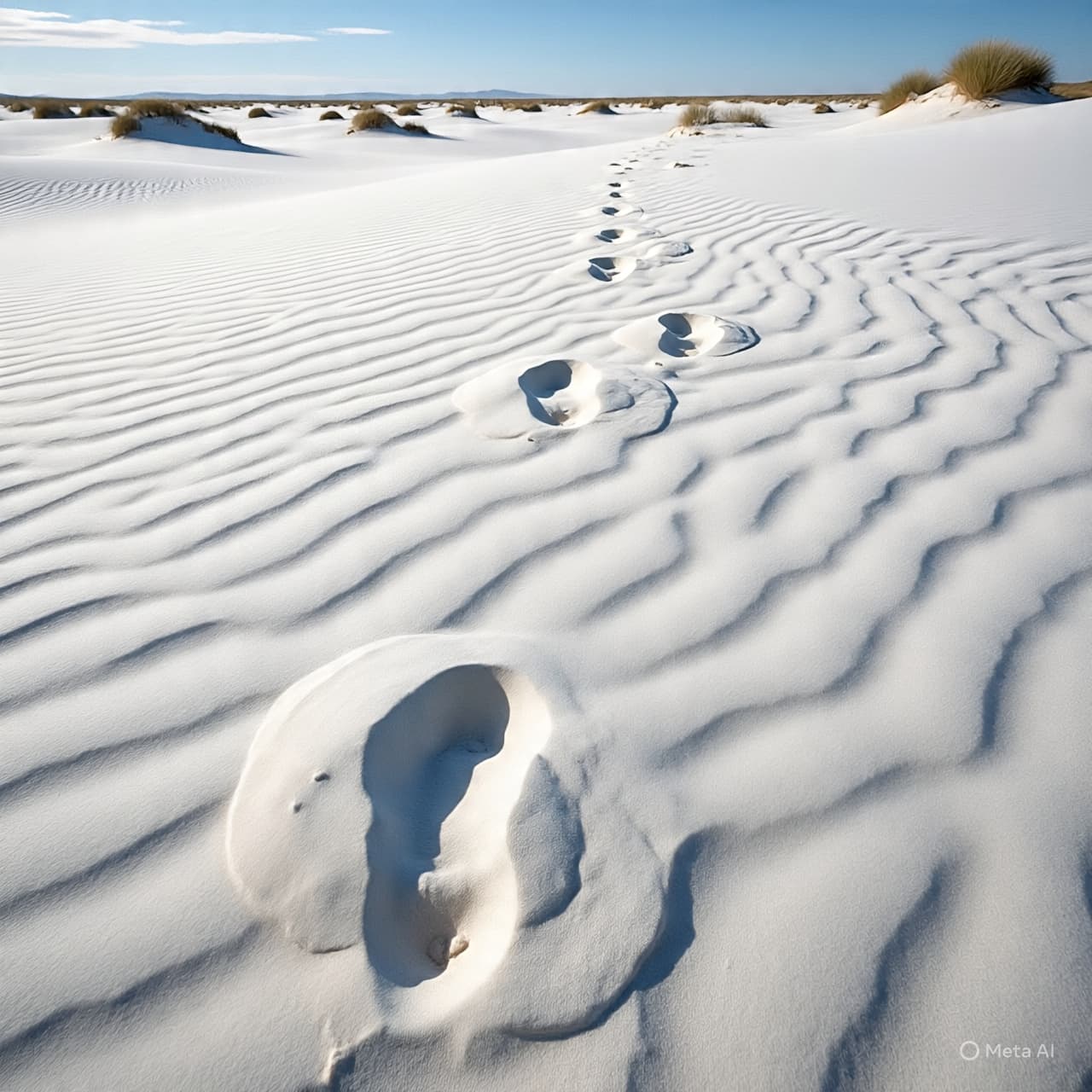
There is a unique hush that falls over a place where countless years have folded like pages in a weathered book. In such places, even small impressions can whisper to us across time, inviting us to ponder what once was. At White Sands in New Mexico, a set of human footprints — pressed into ancient mud long before the last great thaw — is doing just that: offering a trace of human presence that speaks softly yet profoundly about our species’ early footsteps on this continent.
For decades, many archaeologists believed that the first people arrived in the Americas shortly after the retreat of giant ice sheets, roughly 13,000 years ago. Such a timeline snugly fit with the evidence available for much of the past century. But these footprints — once obscured in layers of gypsum and sediment — have become markers of a journey taken much earlier, back into a time when glaciers still ruled much of the northern landscapes. According to a series of radiocarbon dating studies, these tracks were made between about 21,000 and 23,000 years ago, placing human activity in North America during the peak of the Last Glacial Maximum rather than after it.
Standing in the place where children, adults, and perhaps families once walked, we find not just evidence of age but of life — of motion, of community, and of survival long before the world warmed and changed again. For scientists, the discovery has presented a gentle but powerful nudge to reconsider how and when humans migrated across the globe, reminding us that the story of humanity is not fixed but always unfolding with each new layer of evidence.
These footprints, preserved beneath what was once a lakebed of soft mud, were dated using multiple lines of evidence, including radiocarbon dating of embedded seeds and surrounding pollen, strengthening confidence in their antiquity. As researchers compared different methods of dating and layers of sediment, a consistent picture emerged: people were walking in what is now the southwestern United States tens of thousands of years earlier than older models had allowed.
For some, the finding raises graceful questions about how those early people lived and moved — how they coped with a world covered in ice, where they found food, and what routes they followed across a landscape so different from today’s. While these questions are complex, the footprints themselves remain as straightforward as a path worn by feet — a direct link to a moment when an ancient family paused, stepped forward, and left a trace behind.
In the realm of straightforward news, researchers report that multiple dating techniques now support the conclusion that human footprints found at White Sands National Park in New Mexico date to between about 21,000 and 23,000 years ago, a period much earlier than the previously accepted arrival times for humans in the Americas. This evidence suggests that humans were present on the continent during the peak of the last Ice Age, reshaping scientific understanding of early migration into North America.
AI Image Disclaimer Illustrations were produced with AI and serve as conceptual depictions.
Source Check Credible sources found:
Reuters (archaeology and dating confirmation) BBC Sky at Night Magazine (news of the discovery) ScienceAlert (analysis of dating evidence) Sci.News (archaeological context) Discover Magazine coverage (scientific interest)
Published by Banx Network. This article is part of the Banx decentralized media programme, powered by the BXE token on the XRP Ledger.