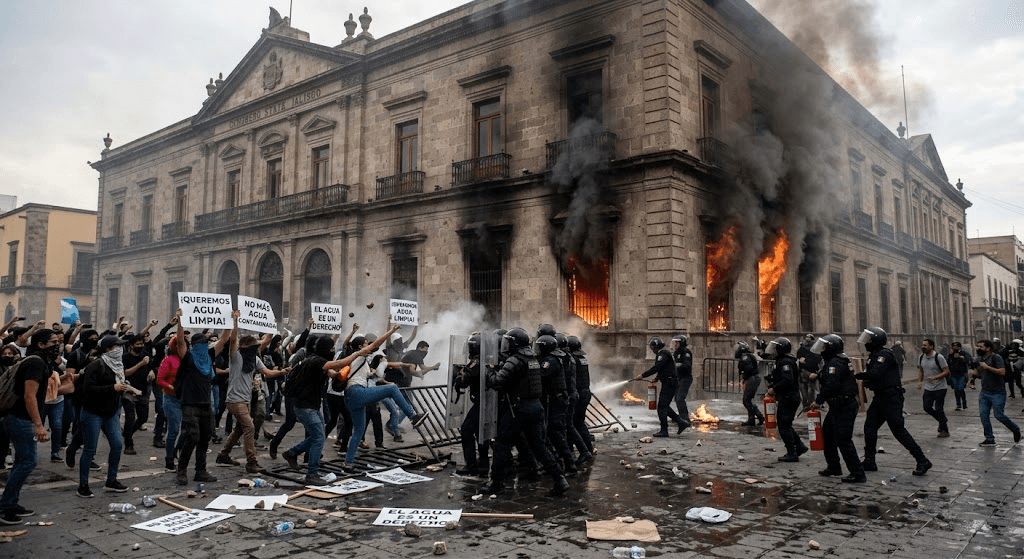
GUADALAJARA, Mexico — Violence erupted in the capital of Jalisco as thousands took to the streets to demand action over months of contaminated, foul-smelling tap water reaching homes across the metropolitan area. What began as a massive public demonstration quickly escalated, culminating in clashes with security forces and fires breaking out near state government infrastructure.
Residents across Guadalajara have reported cloudy, brown-colored tap water emitting a strong odor for several months. A recent study conducted by civil society groups analyzed nearly 200 water samples across the region, confirming contamination levels exceeding federal health safety standards.
Frustrations mounted after regional authorities struggled to resolve the quality issues, leading local environmental organizations, neighborhood associations, and university groups to organize a mass demonstration.
While the vast majority of the estimated 10,000 marchers demonstrated peacefully, tension spiked as groups converged on official sites. Demonstrators breached perimeter barricades, throwing projectiles and setting fires that ignited nearby legislative and executive structures.
Riot police responded by deploying tear gas and high-pressure water cannons to disperse the crowds. Emergency services fought blazes at state facilities while medical personnel treated dozens of casualties on site.
According to official reports from Jalisco authorities, 28 police officers were injured in the unrest, with two listed in serious condition. Additionally, 31 civilians required medical treatment due to tear gas exposure and physical clashes, while law enforcement detained 39 individuals on charges including assault and public property damage.
The crisis has sparked sharp debate at both the state and federal levels. Mexican President Claudia Sheinbaum addressed the unrest, calling on state officials to avoid heavy-handed police tactics and maintain a clear distinction between riot containment and political repression.
Disagreements over how to finance long-term infrastructure overhauls—including potential public-private partnerships currently debated within the Jalisco Congress—have further stalled progress. As state prosecutors continue investigations into those detained during the violence, residents remain without clear answers on when clean drinking water will be restored to their taps.
Published by Banx Network. This article is part of the Banx decentralized media programme, powered by the BXE token on the XRP Ledger.