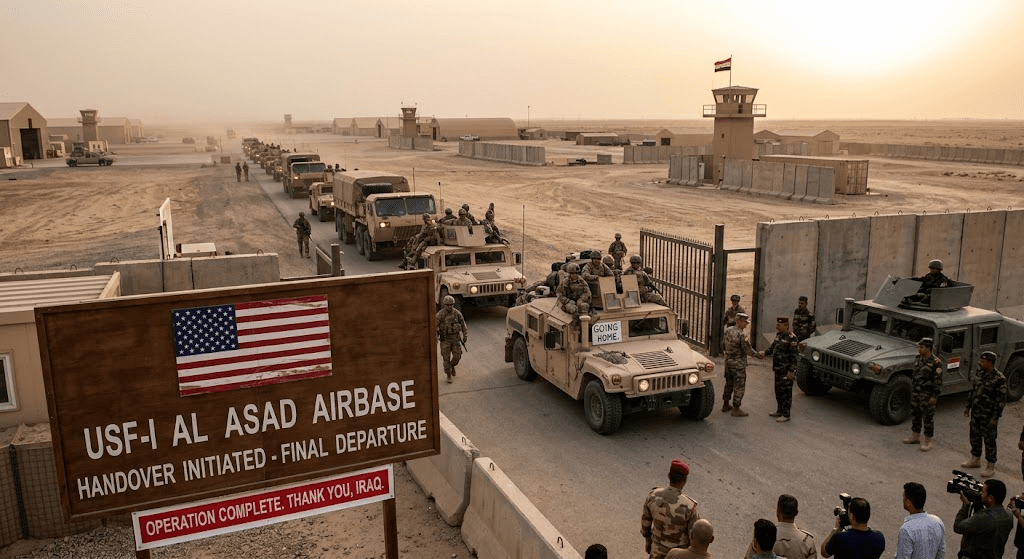
BAGHDAD, IRAQ — United States military forces are preparing to vacate their remaining installations in Iraq by Wednesday, September 30, 2026 marking the official end to more than two decades of American military deployment in the nation.
The withdrawal, structured under a bilateral agreement finalized between Washington and Baghdad, concludes a historical era that began with the 2003 invasion. Over the past week, U.S. troops have systematically transferred operational control of coalition facilities and headquarters to Iraqi security forces, securing equipment and lowering American colors across installations in central and northern Iraq.
The departure is being loudly celebrated by Iranian leadership and aligned political factions across the region, who frame the pullout as a landmark strategic victory over American influence in the Middle East.
Tehran-backed political networks and affiliated militia groups in Baghdad have held public rallies and issued statements asserting that the exit signals a fundamental realignment of power. Regional analysts note that the complete exit removes a major pillar of direct American deterrence along Iran’s western border, affording Tehran unprecedented political and military leverage within Iraqi state structures.
Despite assurances from Baghdad that national defense forces are fully capable of maintaining sovereign security, military intelligence experts and local authorities warn of potential vulnerabilities.
Uncertainty remains regarding the long-term containment of insurgent remnants, including Islamic State underground cells that continue to operate in rural corridors. As the last military transport flights depart, regional observers are closely monitoring whether Iraqi forces can independently preserve stability or if the resulting vacuum will trigger renewed domestic strife.
In response to the strategic realignment, Iraqi government officials emphasized that future defense relations with Washington will pivot strictly toward bilateral intelligence-sharing, anti-terrorism training, and high-level advisory support. Iraqi Prime Minister Ali Al-Zaidi reiterated that while foreign combat troops will no longer maintain a permanent physical footprint on Iraqi soil, diplomatic and institutional partnerships will continue to focus on counter-terrorism capabilities, ensuring that local forces remain equipped to uphold state sovereignty independently.
Published by Banx Network. This article is part of the Banx decentralized media programme, powered by the BXE token on the XRP Ledger.