There is a particular poignancy in revisiting old data—the sense that a machine, long silent, might still have something to say if only someone listened carefully enough. For nearly fifty years, the Viking 2 lander's seismic record has been treated as a footnote, a failed experiment, a case of instrumentation defeated by the Martian wind. A new analysis suggests that judgment may have been too hasty.
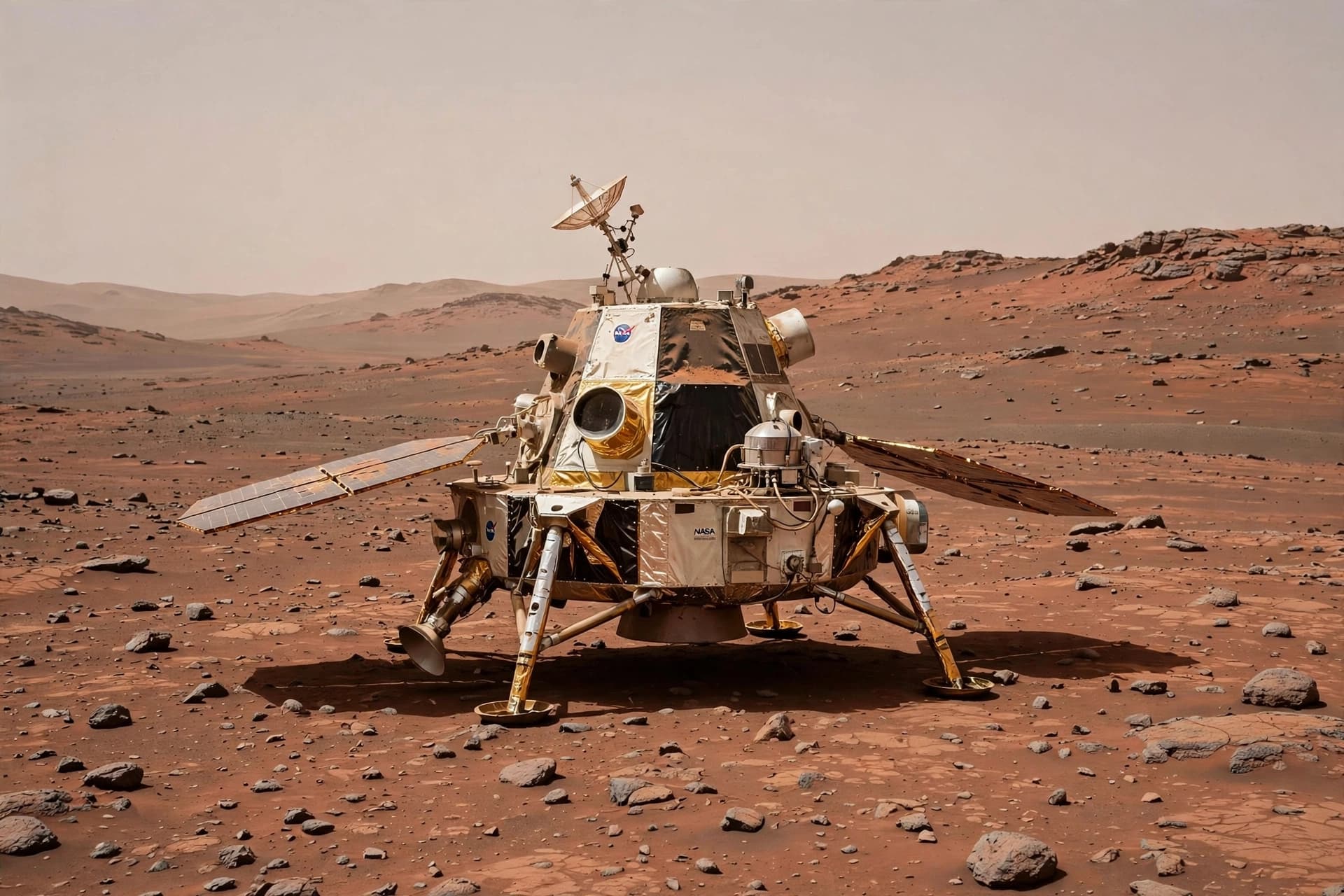
Viking 2 touched down in Utopia Planitia in 1976 with a seismometer mounted on its deck. The instrument was compromised from the start, vulnerable to wind-induced noise that made it difficult to distinguish genuine ground motion from the shaking of the lander itself . Of the 560 Martian days it recorded, only two candidate signals emerged—one on Sol 53, during a windy daytime period, and one on Sol 80, during a comparatively calm night . Neither could be confirmed as a marsquake, and the mission's seismic yield was deemed essentially barren .
A study published in AGU Advances has reexamined those two signals using a novel approach: researchers passed known InSight seismic events through a virtual Viking seismometer, reconstructing the old instrument's sensitivity and limitations . They then compared the results to the original Viking recordings. The Sol 80 event, they found, shared characteristics with marsquakes that InSight would later detect—emergent waveforms, multiple arrivals, and a timing consistent with a source region that InSight would identify decades later as a hotspot of seismic activity .
That region, in the northern plains of Mars, produced nearly 1,000 high-frequency marsquakes during InSight's four-year mission between 2018 and 2022 . The Viking Sol 80 signal, if it was a marsquake, originated roughly 110 kilometers from the lander—within the same broad area . The implication is striking: a patch of Martian crust may have been seismically active in 1976 and remained active nearly half a century later.
The researchers are careful with their language. The Sol 80 event could still have been a nighttime wind gust, though the supporting wind data downlink failed that sol, leaving the question formally open . The Sol 53 event, occurring during daytime winds, is considered less likely to be seismic. But the study's comparison with InSight data suggests that Viking's instrument was particularly insensitive to the low-frequency vibrations that dominate Martian tectonics—meaning the lander may have missed many quakes it was never designed to hear .
For planetary scientists, the finding is less about rewriting history than about recovering it. Viking was sent to Mars to search for life, not to study its interior. That its compromised seismometer may have caught the faint signature of a living planet is a reminder that instruments sometimes exceed their intended brief, and that old data, revisited with new tools and new understanding, can yield answers no one thought to ask for at the time.
Image Disclaimer: The visuals accompanying this article were generated using artificial intelligence and are not photographs of the Viking 2 lander or Mars.
Sources: AGU Advances, Eos, Scinexx, Universe Space Tech, JGR Planets
Published by Banx Network. This article is part of the Banx decentralized media programme, powered by the BXE token on the XRP Ledger.