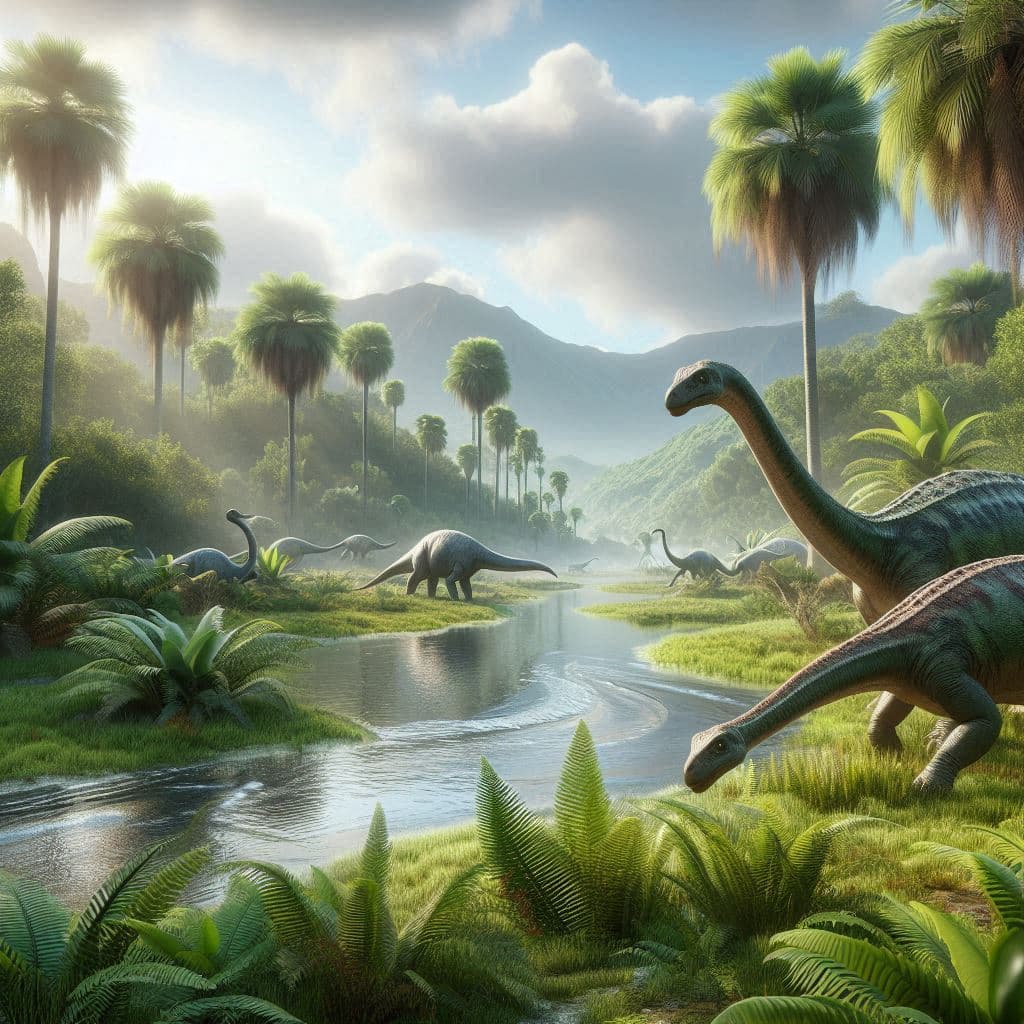
In the soft hush of a prehistoric morning, long before humans ever looked skyward in curiosity, life in the ancient landscapes of what would become the western United States hummed with its own rhythm. Vast plains of conifers and ferns stretched toward distant horizons, and among these green reaches, giants walked — creatures whose names now echo through museum halls: Diplodocus, Brachiosaurus, Apatosaurus. Yet in the dawn of life, when these behemoths were no taller than a child’s waist, their fragile forms stirred the very pulse of the ecosystem. It was in the delicate balance between vulnerability and abundance that the youngest sauropods helped nourish an entire web of ancient life.
The Morrison Formation, a span of rock etched with the stories of life from roughly 150 million years ago, acts as a deep fossilaceous tapestry. In Colorado’s Dry Mesa Dinosaur Quarry, bones once buried by ancient river floods now reveal secrets of an interconnected world long vanished. Paleontologists have worked to piece together a detailed portrait of not merely who lived there but how life fed on life in those distant millennia.
While adult sauropods towered over the land — their necks and tails arcing like living bridges over the vegetation — it was their newborns who played a pivotal role in the flow of prehistoric energy. Emerging from eggs scarcely a foot wide, these hatchlings faced the world largely on their own. The evidence suggests that, akin to some modern reptiles, parental care was minimal, leaving the young giants to navigate hazards without the shelter of protection.
In reconstructing the ancient food web, researchers applied a mosaic of clues: fossilized bones, chemical traces within tooth enamel, wear patterns on teeth, and even the fossilized contents of digestive tracts. With the aid of analytical tools more often used in modern ecological studies, they mapped thousands of potential feeding relationships — a network of connections weaving plant life, herbivores, and carnivores into a complex ecosystem.
The picture that emerged was one in which very young sauropods — small, defenseless, and abundant — were frequent targets for carnivores such as Allosaurus, Torvosaurus, and other meat-eating dinosaurs. In a world without fast refuge, these juveniles became vital threads in the tapestry of existence, offering sustenance to predators who might otherwise have found only sporadic nourishment.
There is poetry in such an ancient cycle: the largest creatures ever to walk the land, in their infancy, served as essential fuel for the survival of other great beasts. The unfolding story of this ecosystem — once a flat floodplain of whispering leaves and shifting sands — reminds us that ecosystems, both ancient and modern, hinge on the interplay of life and death, growth and decay, abundance and vulnerability.
Though separated by eons of time, the dynamics of the Morrison Formation echo familiar rhythms found in today’s wildernesses, where the young and the small become threads that sustain larger lives. In studying these ancient webs, scientists glimpse not only the food chains of another age but also the elusive harmony that bound all living things in a world both harsh and beautiful.
As the research continues and new fossils come to light, the tale of these long-necked giants and their surprising role in the Late Jurassic continues to enrich our understanding of life’s history — a history written in stone, yet resonant in the silent corridors of time
AI Image Disclaimer (rotated wording) *“Graphics are AI-generated and intended for representation, not reality.”*
Credible sources (media names only):
Reuters Sci.News Discover Magazine UCL News Eurasia Review
Published by Banx Network. This article is part of the Banx decentralized media programme, powered by the BXE token on the XRP Ledger.