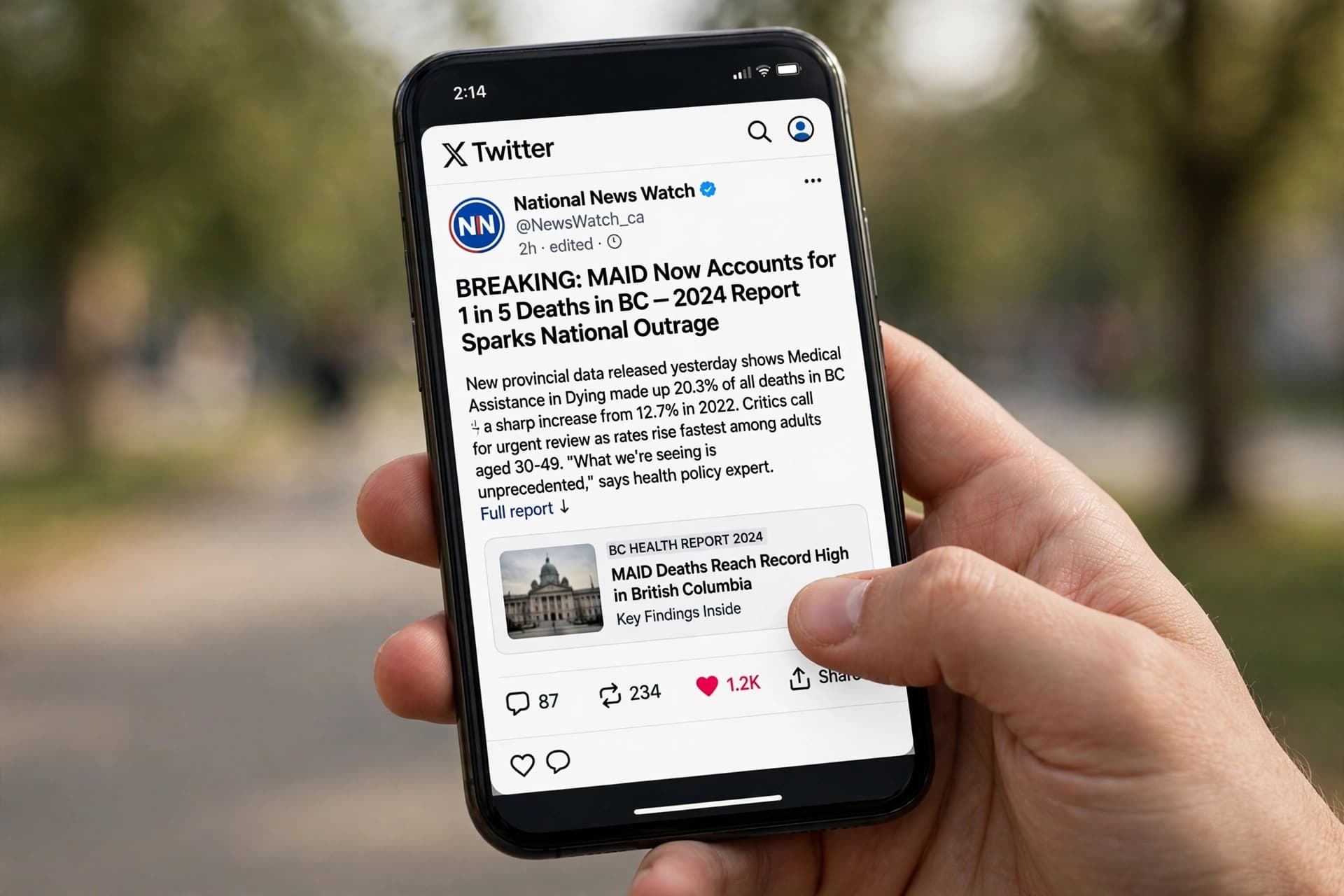
There is a particular danger in a headline that is not true—a danger made sharper by the speed with which it travels, by the way it confirms what readers already suspect, and by the difficulty of correcting a narrative once it has taken hold. In Canada, that danger has arrived in the form of a false claim about medical assistance in dying (MAID). The claim, which has circulated widely on social media and in some media outlets, states that a woman was approved for MAID because she could not cook. The story is not true. But the speed with which it spread, and the way it was used to argue against MAID, illustrates the challenge of correcting misinformation in a debate that is already deeply polarized.
The origin of the false claim appears to be a misrepresentation of a real case. A woman in Ontario had applied for MAID and had cited a number of factors in her suffering, including her inability to perform daily tasks like cooking due to a chronic illness. The "couldn't cook" detail was taken out of context and presented as the sole reason for her approval—a distortion that transformed a complex medical and ethical decision into a soundbite designed to shock. The woman's actual circumstances, including her medical condition and the process she went through, were ignored.
The false headline spread quickly. It was shared by opponents of MAID who argued that it proved the system was broken, that vulnerable people were being killed for trivial reasons, and that the safeguards were inadequate. It was also picked up by international outlets, where it reinforced existing concerns about Canada's MAID framework. The fact that the story was false did not stop it from being repeated, and the corrections that followed did not reach the same audience as the original claim.
What makes this case particularly instructive is what it reveals about the debate over MAID. The issue is genuinely contested, with reasonable people disagreeing about when and how it should be available. But the debate is also vulnerable to misinformation, because the stakes are high and the emotions are strong. A false story about a woman being approved for MAID because she couldn't cook is effective precisely because it feels plausible to those who already believe the system is dangerous. It does not need to be true to be believed.
The woman at the center of the story has not spoken publicly. Her privacy has been invaded by the circulation of her case, and the distortion of her experience has been used to advance an agenda she may not share. The misinformation about her case is a reminder that behind every statistic and every headline, there is a person whose life and death are being debated. And that the truth, however slowly it travels, is worth pursuing.
AI Image Disclaimer: The images accompanying this article were generated by artificial intelligence and are for illustrative purposes only.
Sources: Canadian Press, CBC News, Reuters Fact Check, AFP Fact Check
Published by Banx Network. This article is part of the Banx decentralized media programme, powered by the BXE token on the XRP Ledger.