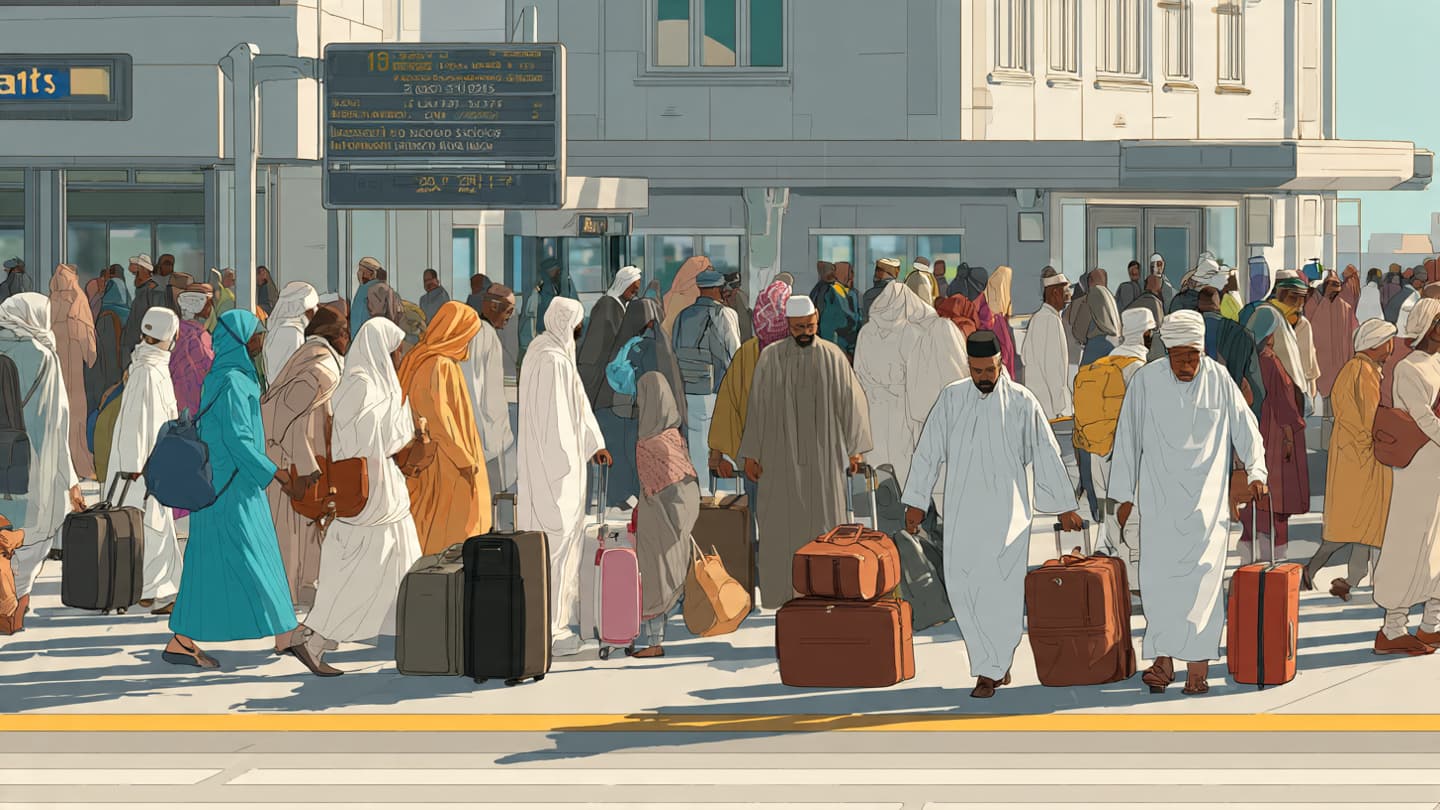
Pilgrimage has long carried a quiet power capable of crossing borders, languages, and moments of uncertainty. Even during periods when global headlines are filled with conflict and geopolitical tension, millions of believers continue moving toward places they consider spiritually essential. This atmosphere became visible once again as pilgrims from countries including the United States and the United Kingdom traveled to Makkah despite concerns surrounding regional instability.
Reports from international and Middle Eastern media indicated that large numbers of worshippers continued arriving in Saudi Arabia ahead of the Hajj season. Pilgrims interviewed by journalists expressed confidence in security arrangements and emphasized their spiritual commitment despite ongoing geopolitical tensions in the region.
Saudi authorities have reportedly intensified logistical and security preparations to support the arrival of international pilgrims. Transportation systems, health facilities, crowd management operations, and emergency services were expanded as part of annual efforts to accommodate millions of visitors.
For many Muslims, the pilgrimage to Makkah represents a once-in-a-lifetime spiritual obligation deeply rooted in faith and tradition. Global political uncertainty, while closely monitored, often becomes secondary to personal religious devotion during the journey.
Travel analysts note that religious tourism remains one of the most resilient forms of international movement, particularly when supported by strong institutional planning and coordinated security measures. Pilgrimage activity frequently continues even during periods of broader international uncertainty.
The arrival of worshippers from Western countries also reflected the increasingly global character of modern Islamic pilgrimage. Airports, hotels, and transportation hubs in Saudi Arabia have become gathering points for communities representing diverse cultural and national backgrounds.
Health officials and organizers reportedly continued monitoring regional developments carefully while assuring pilgrims that operational systems remained stable. Authorities emphasized preparedness and coordination with international delegations throughout the pilgrimage period.
Public conversations surrounding the pilgrimage also highlighted how faith communities often respond differently to geopolitical tension compared with financial or tourism sectors. Spiritual motivations can sustain movement and participation even during uncertain global conditions.
Saudi Arabia continued welcoming international pilgrims to Makkah as preparations for the Hajj season proceeded under heightened logistical and security coordination.
AI Image Disclaimer: Illustrative pilgrimage visuals featured in this article were partially generated using AI-assisted imagery.
Sources: Reuters Arab News BBC Al Jazeera
Published by Banx Network. This article is part of the Banx decentralized media programme, powered by the BXE token on the XRP Ledger.