
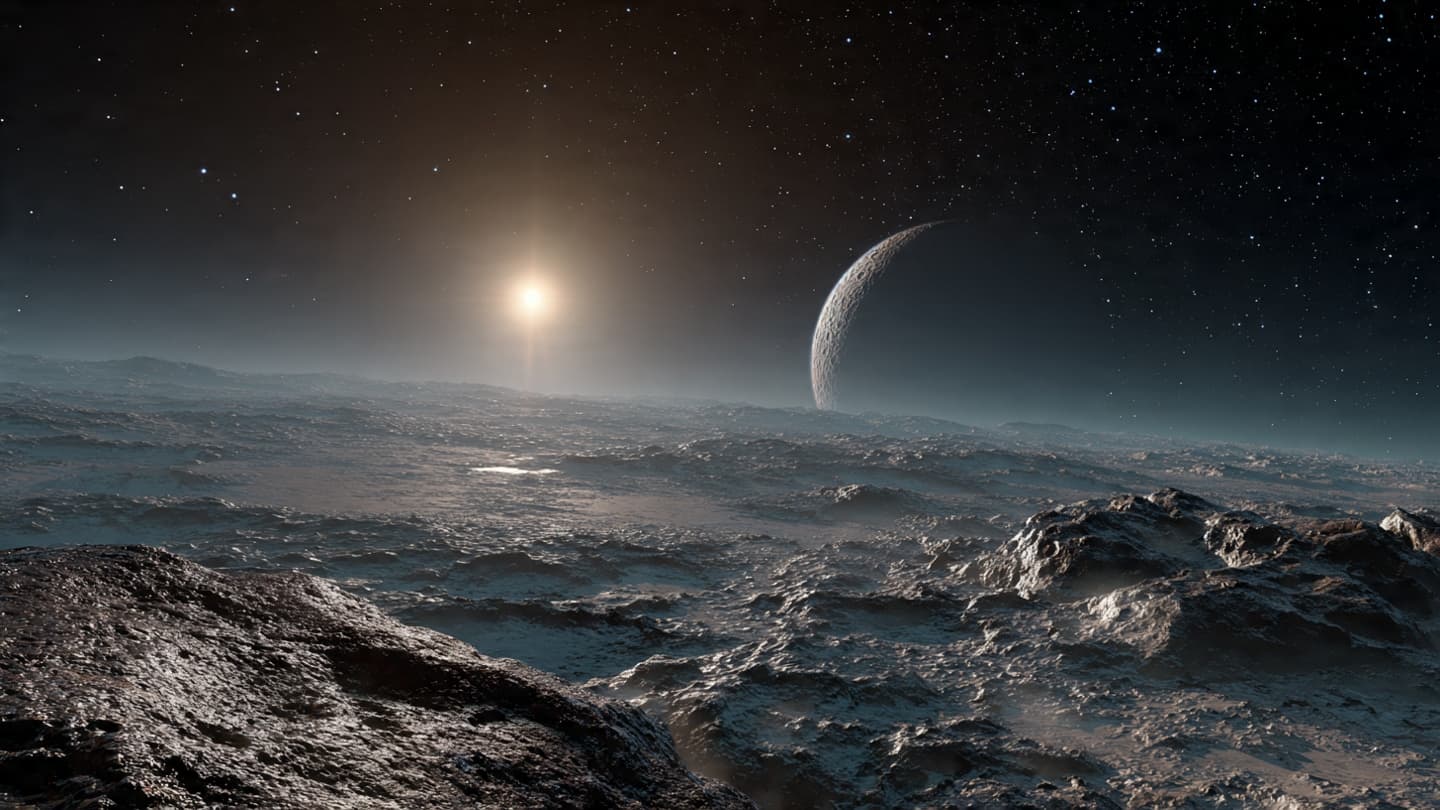
At the farthest edges of the solar system, where sunlight softens into a distant glow, even the smallest worlds can hold quiet surprises. These remote regions, often thought to be still and unchanging, continue to reveal layers of complexity that challenge long-held assumptions about what exists so far from the Sun.
Body: Astronomers have identified evidence of an atmosphere surrounding a small celestial body located beyond Pluto. The discovery adds to a growing body of knowledge about objects in the Kuiper Belt, a region filled with icy remnants from the early solar system.
The object, considered relatively small by planetary standards, was not previously expected to sustain an atmosphere. However, observations suggest that a thin layer of gas may be present, possibly generated by sublimation—where surface ice transitions directly into vapor under certain conditions.
Researchers used advanced telescopes and observational techniques to detect subtle changes in light as the object passed in front of distant stars. These variations can indicate the presence of an atmosphere, even if it is extremely tenuous.
The finding challenges assumptions about the conditions required for atmospheric formation and retention. In such cold and distant environments, atmospheres are typically thought to be unstable or nonexistent.
Scientists believe that understanding how this atmosphere forms and evolves could provide insights into the behavior of similar objects across the outer solar system. It may also shed light on processes that were more common during the early stages of planetary development.
The discovery highlights the importance of continued observation of distant celestial bodies, many of which remain only partially understood. Each new finding contributes to a more detailed picture of the solar system’s structure and history.
Further research is expected to refine measurements and explore the composition of the atmosphere, offering additional clues about the object’s origins and characteristics.
Closing: In the quiet reaches beyond Pluto, the presence of an atmosphere on a small world serves as a gentle reminder that even the most distant places can hold unexpected complexity.
AI Image Disclaimer: Some images accompanying this article may be AI-generated to illustrate distant celestial objects and space environments.
Sources: Nature, NASA, Reuters, BBC
Published by Banx Network. This article is part of the Banx decentralized media programme, powered by the BXE token on the XRP Ledger.



