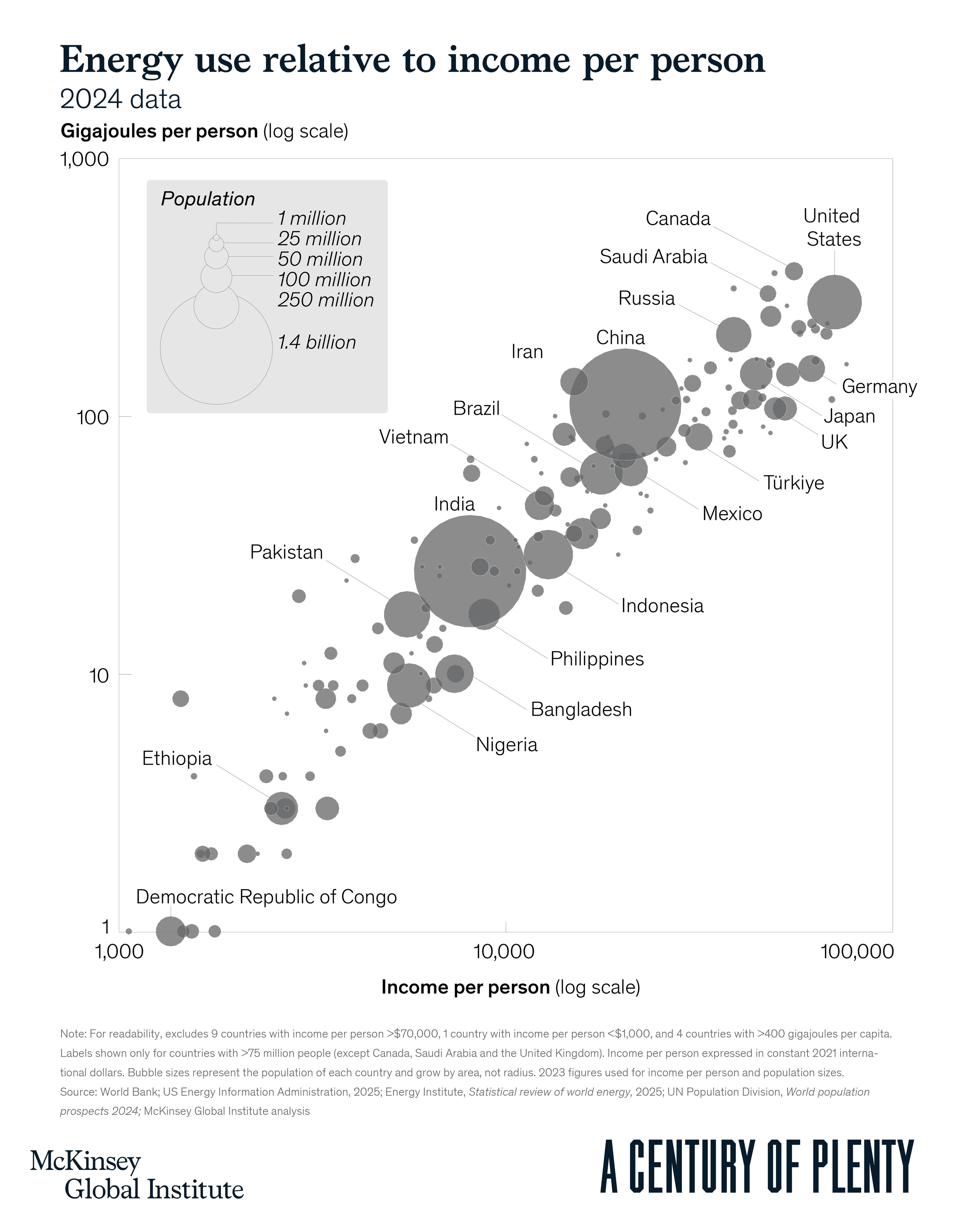
Energy has long been one of the foundational drivers of economic growth, and new research highlighted by the McKinsey Global Institute reinforces the connection between energy consumption and rising incomes. The findings show that countries with higher levels of energy use per person generally achieve greater productivity, stronger economic output, and higher standards of living. The relationship between energy and prosperity has shaped global development for decades. Access to reliable and affordable energy enables industrial production, transportation networks, healthcare systems, digital infrastructure, and modern manufacturing. As economies expand, demand for electricity and fuel typically rises alongside income levels. The latest data suggests that this pattern remains evident despite significant technological advances and improvements in energy efficiency. Developed economies continue to consume substantial amounts of energy, though many have become more efficient in how they use it. Technological innovation, automation, and cleaner energy systems have allowed some countries to generate greater economic value without proportionally increasing energy consumption. Nevertheless, energy remains a critical input for economic activity, particularly in industries such as manufacturing, mining, transportation, and construction. Emerging markets face a different challenge. Many developing nations are seeking to expand access to electricity while supporting industrial growth and improving living standards. Policymakers must balance economic development goals with environmental commitments, making energy strategy a central component of long-term planning. Investments in power generation, transmission infrastructure, and renewable technologies are increasingly viewed as essential for sustained growth. The discussion has become more important as countries pursue decarbonization initiatives. Governments are attempting to reduce emissions while maintaining reliable energy supplies capable of supporting economic expansion. Achieving this balance will require substantial investment in clean technologies, grid modernization, energy storage systems, and next-generation power solutions. Business leaders and economists increasingly view energy security as a competitive advantage. Nations capable of providing abundant, reliable, and affordable energy are often better positioned to attract investment and support industrial development. The transition toward cleaner energy sources does not eliminate the importance of energy itself; rather, it shifts attention toward how that energy is produced and distributed. As the global economy continues evolving, the connection between energy consumption and income remains a key factor in understanding development patterns. The latest research suggests that while technology may improve efficiency, energy continues to serve as one of the most important foundations of economic opportunity and rising living standards.
Published by Banx Network. This article is part of the Banx decentralized media programme, powered by the BXE token on the XRP Ledger.