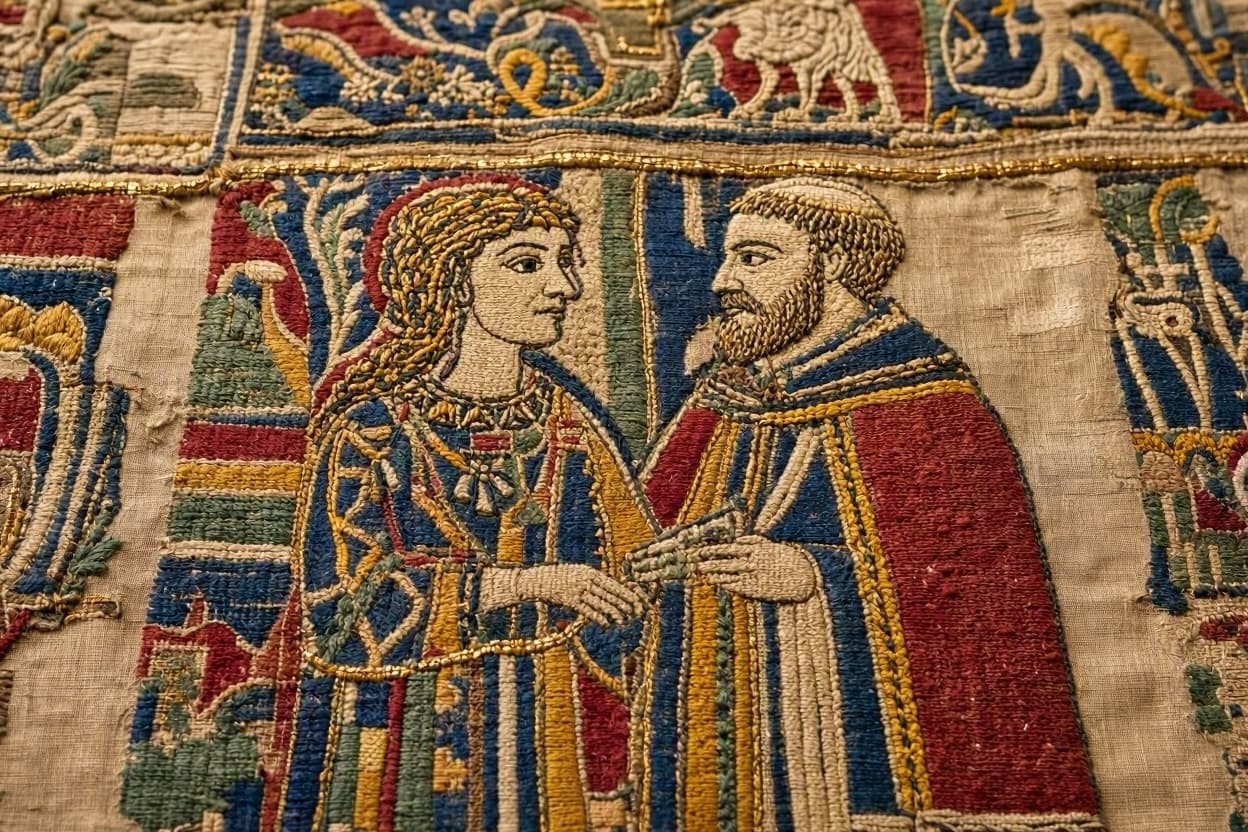
The Bayeux Tapestry is a monumental narrative of conquest and power, embroidered in the 11th century to chronicle the Norman victory at Hastings. Amidst the scenes of battle and political intrigue, three female figures appear, standing out in a predominantly male story. These women, though few in number, offer a rare glimpse into the lives and roles of women in medieval society, challenging the notion that they were merely peripheral to historical events.
The most famous of these figures is Ælfgyva, depicted alongside a cleric who appears to be touching her face. Her identity remains a subject of debate among historians, with theories ranging from her being a noblewoman involved in a scandal to a symbolic representation of a political alliance. The scene’s ambiguity invites interpretation, suggesting that women’s stories were often complex and intertwined with the political machinations of the time.
Another woman depicted is Queen Edith, shown mourning the death of her husband, King Edward the Confessor. Her presence highlights the emotional and ceremonial roles women played in royal courts. As a queen, Edith was a figure of influence and stability, and her depiction in the tapestry acknowledges her significance in the transition of power. Her grief is a humanizing element in a story dominated by martial prowess.
The third woman is less clearly identified but is shown in a domestic or supportive role. Her inclusion, however brief, suggests that women’s contributions to daily life and social structure were recognized, even if not always recorded in detail. These depictions provide a counter-narrative to the idea that medieval women were entirely invisible in historical records.
Scholars argue that the presence of these women in the tapestry serves multiple purposes. They may act as moral commentators, symbols of legitimacy, or reminders of the personal stakes involved in political conflicts. Their inclusion adds depth to the narrative, showing that history is not just about battles but also about the people affected by them.
The tapestry’s perspective is primarily Norman, yet it shows a degree of sympathy toward the English, including its female figures. This nuanced portrayal suggests that the creators understood the complexity of the events and the diverse roles played by different members of society. It offers a more holistic view of the period than many written sources.
Studying these figures helps modern audiences connect with the past on a human level. It reminds us that women have always been part of history, even when their voices are muted. The Bayeux Tapestry, therefore, is not just a record of war but also a testament to the enduring presence of women in the historical narrative.
Closing: The three women of the Bayeux Tapestry may be few, but their presence is significant. They offer a window into the medieval world, reminding us that history is woven from many threads, including those of women who lived, loved, and influenced their times.
AI Image Disclaimer: Any images used in conjunction with this article are AI-generated conceptualizations meant to illustrate the themes of media and justice.
Sources: The Conversation, History The Interesting Bits, British Museum, Wikipedia
Published by Banx Network. This article is part of the Banx decentralized media programme, powered by the BXE token on the XRP Ledger.