The universe often reveals its oldest memories in unexpected ways. Across billions of light-years, faint galaxies that would otherwise remain hidden occasionally appear brighter, stretched into luminous arcs or nearly perfect circles. These remarkable shapes are not optical illusions but natural consequences of gravity itself, transforming the cosmos into its own giant telescope.
The James Webb Space Telescope (JWST) is using this phenomenon, known as gravitational lensing, to study some of the most distant galaxies ever observed. The effect was predicted by Albert Einstein's theory of general relativity more than a century ago, which describes how massive objects bend the fabric of spacetime and redirect the path of light traveling through it.
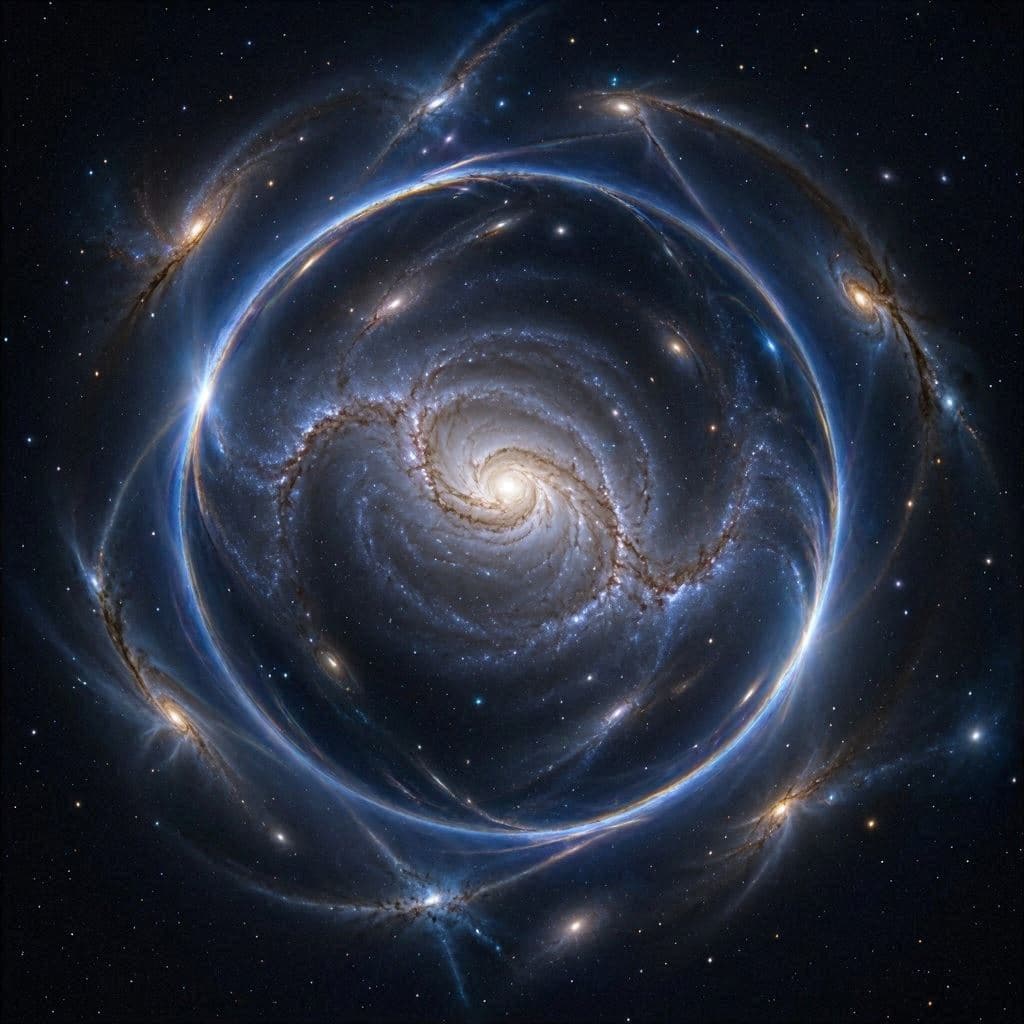
When a massive foreground galaxy aligns with a much more distant galaxy, the foreground object's gravity bends and magnifies the background light. Depending on the precision of the alignment, astronomers may observe elongated arcs or complete circles called Einstein rings. These natural cosmic lenses allow scientists to detect galaxies that would otherwise be too faint for direct observation.
Recent images highlighted by the COSMOS-Web observing program showcase eight striking examples of gravitational lenses. The project devoted approximately 255 hours of Webb observations to surveying more than 42,000 galaxies and has identified over 400 potential gravitational lens systems, providing researchers with an unprecedented collection for future study.
Among the most notable discoveries is an Einstein ring surrounding the galaxy designated COSJ100024+015334. The gravitational lens magnifies light from a galaxy that existed when the universe was roughly one billion years old, allowing astronomers to examine structures that formed during the universe's earliest stages.
Webb's infrared instruments offer significant advantages over previous space telescopes by detecting light that has been stretched to longer wavelengths as the universe expands. These observations reveal dusty and extremely distant galaxies that are difficult or impossible to detect with visible-light telescopes alone. The detailed images also help researchers investigate dark matter, galaxy evolution, and the growth of large-scale cosmic structures.
Scientists emphasize that gravitational lensing is more than a visually striking phenomenon. Because the amount of light bending depends on the mass of the foreground object, including invisible dark matter, these observations provide an important method for measuring the distribution of matter throughout the universe while simultaneously extending humanity's view farther into cosmic history.
As the James Webb Space Telescope continues its mission, Einstein's century-old prediction remains one of astronomy's most valuable tools. By combining the power of advanced infrared technology with nature's own gravitational lenses, researchers are steadily uncovering chapters of the universe's earliest history that have remained hidden for billions of years.
AI Image Disclaimer: The accompanying images are AI-generated artistic representations inspired by astronomical observations and are not actual James Webb Space Telescope photographs.
Sources: NASA, ESA/Webb, Live Science, Space.com
Published by Banx Network. This article is part of the Banx decentralized media programme, powered by the BXE token on the XRP Ledger.