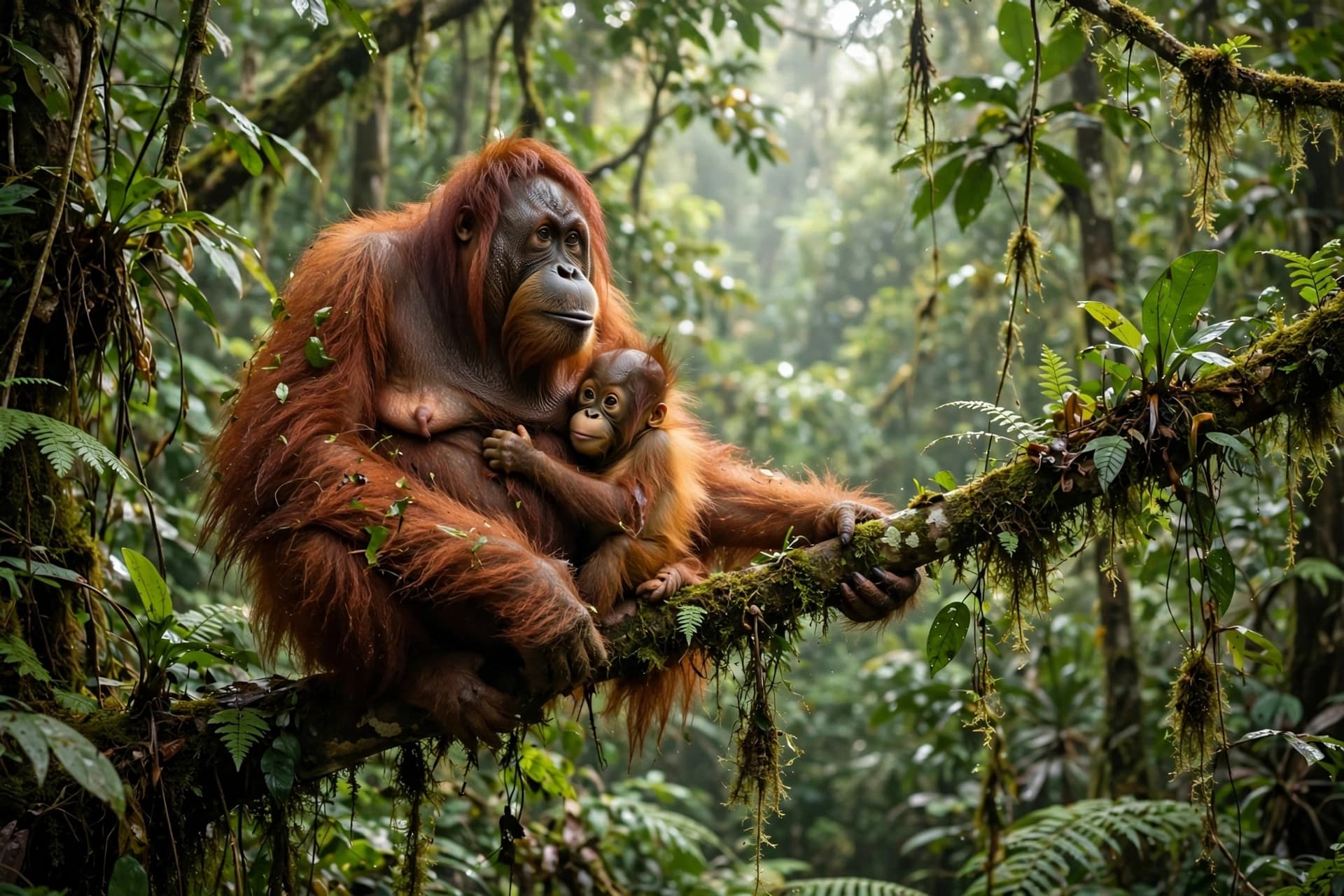
There is a particular tenderness in watching a creature return to a place it once fled—a forest that had burned, a canopy that had thinned to smoke and ash, now offering again the simple possibility of food and shelter. In West Kalimantan, on the Indonesian side of Borneo, that possibility was extended to eight orangutans on a Friday, when they were carried by land, boat, and foot to a protected forest and released back into the wild .
The eight apes—three mothers with their infants and two adolescent males—had been rescued between August and September as fires swept through Ketapang and North Kayong districts. Some were found surviving in coconut and rubber plantations, their forest homes burned and their routes to other wooded areas severed. One mother and her baby had been isolated on a patch of acacia trees just 400 square meters in size, surrounded by oil palm plantations . The fires, intensified by an El Niño weather pattern and land-clearing practices, had left them without access to food or safe passage .
The release site, Batu Nyambu Protected Forest, spans approximately 23,000 hectares and was selected for its ecological suitability: primary and secondary forest cover, available food and water, sufficient roaming space, and connectivity to other forested areas . Argitoe Ranting, operations director of the rehabilitation foundation YIARI, said the goal was to ensure that rescued orangutans “are not simply moved from one place to another, but actually have a chance to survive in their natural habitat” .
The broader numbers tell a story of escalating crisis. Between August and October 9, Indonesian authorities and YIARI rescued 46 orangutans from fire-threatened habitats . The International Union for Conservation of Nature warned in September that fires were burning in areas containing 52 percent of Borneo’s orangutan population . Roughly 104,000 orangutans remain in Borneo and Sumatra, down from more than 230,000 a century ago .
YIARI CEO Karmele Llano Sanchez described relocation as a “necessary step” when habitats become unsafe, while emphasizing that protection of forests must remain the priority . Some of the rescued orangutans are still receiving treatment for burns, malnutrition, and anemia; they will need time before they can be released .
For the eight released on Friday, the journey took six hours by land, one hour by boat, and two hours on foot, with the apes carried in turns to several points about 80 meters apart to minimize disturbance . They emerged into a forest that, for now, offers what they need: trees, water, and the quiet space to begin again.
AI Image Disclaimer: The imagery in this article was generated by artificial intelligence for illustrative purposes and does not depict the actual orangutans or locations described.
Sources: BBC, RRI.co.id, AFP, ANTARA News, RTM
Published by Banx Network. This article is part of the Banx decentralized media programme, powered by the BXE token on the XRP Ledger.