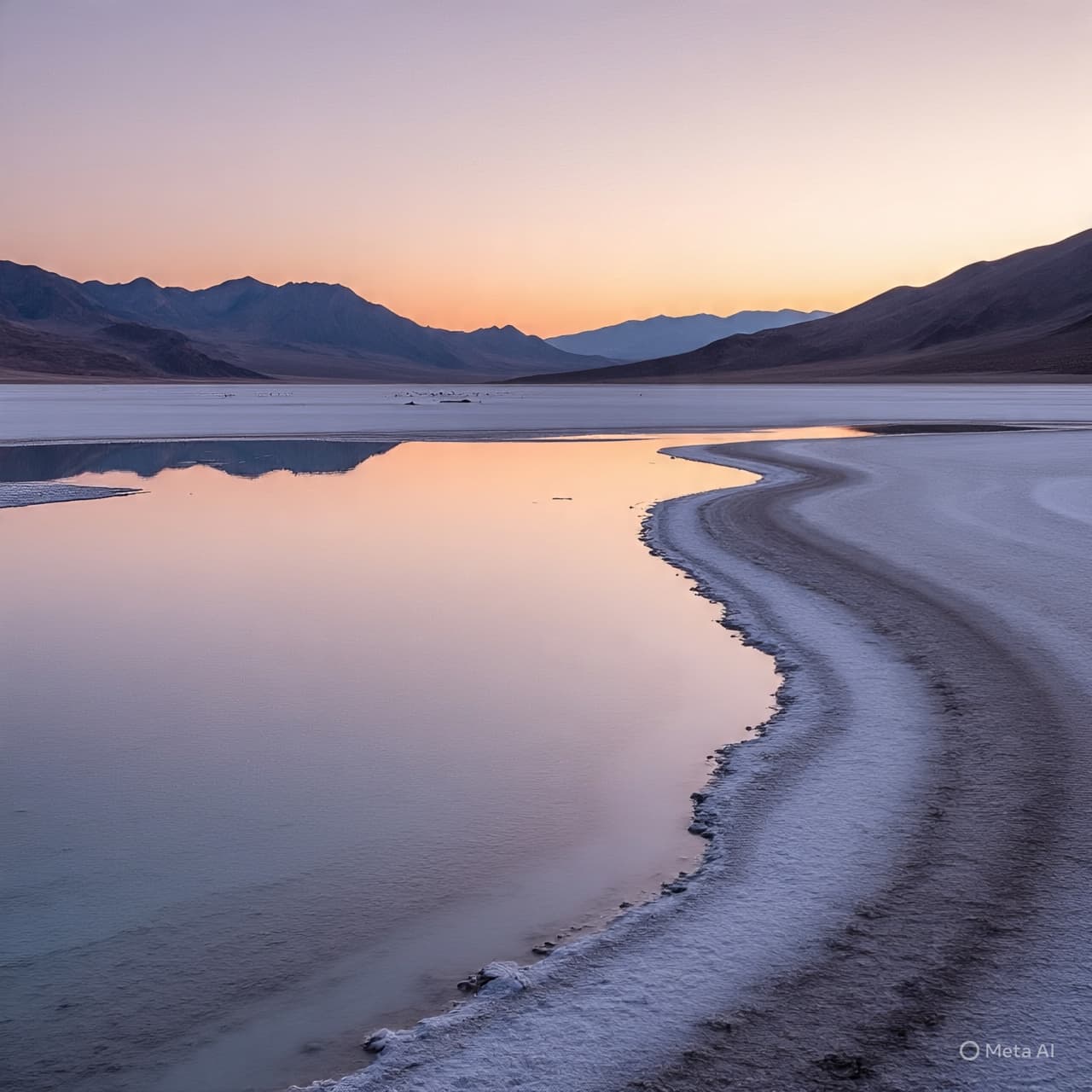
It was as though the desert had exhaled after centuries of silence — a ghost of water returning where once only salt and dust reigned. In the vast, sun-baked expanse of Death Valley National Park, a rare and fleeting mirror has emerged: waters pooling softly in the basin known as Badwater Basin, forming the elusive body once known as Lake Manly. The desert’s hush, usually absolute, now carries the gentle whisper of tides long gone — a hint of ancient times, resurrected by an extraordinary fall of rain.
For the first time in nearly two years, the desert floor has welcomed water again. Between September and November this year, storms brought 2.41 inches of rain — more than the valley typically receives in an entire year. November alone saw 1.76 inches, breaking a record that stood since 1923. Under the quiet of those storms, rain trickled down from surrounding mountains, converged into channels, and slipped into the basin far below — 282 feet beneath sea level, the lowest point in North America. In that hollow, the earth held water once more.
The lake that has formed today is modest in depth. Unlike the fuller, deeper returns of past years — high enough for kayaking and more expansive than many expected — this resurgence remains shallow, often not much above shoe-top height. Visitors who tread the mile walk from the basin’s parking lot can still glimpse the soft shimmering of water under the desert light.
Yet the shallowness does not dim its significance. This brief reawakening reminds us that the landscape holds memory — a memory of ice ages, of rivers coursing down from snow-capped peaks, feeding a lake that once stretched nearly 100 miles long and sank hundreds of feet deep. Under frigid climates many tens of thousands of years ago, water pooled here naturally; today’s rains are but a whisper of that ancient deluge, a reminder that the bones of a once-vast lake still rest beneath the salt and sand.
There is more at stake than the poetic return of water. The reemergence of Lake Manly may herald a subtle ecological renewal. Experts suggest that, should conditions hold, the moisture could nourish seeds laying dormantly in the desert soil — potentially triggering a bloom of wildflowers come spring. Such wildflower “superblooms,” though rare, have in the past transformed arid flats into fleeting carpets of color, a fragile contrast to the harsh backdrop.
Still, the reminder of contrast endures: this is a desert. The basin is sealed — the water has nowhere to flow out. The only escape is through evaporation, a slow, inexorable fading under relentless sun. Park officials advise any interested visitors: act soon, while the glassy surface remains. With every rising temperature, with every clear day, the water thins. The window is narrow.
In a land defined by dryness, by extremes, this temporary lake is nothing short of a wonder. It does not challenge — but reminds. It does not linger — but reflects. For a few days or perhaps weeks, the driest place on the continent has reclaimed a memory of water. In that glimmer, we glimpse the ancient rhythms of earth: how even deserts can hush themselves into sleep — and sometimes, if only by chance, wake again.
AI image disclaimer: Visuals are created with AI tools and are not real photographs — they serve as conceptual illustrations only.
Sources used: CBS News; ABC News; Newsweek; Las Vegas Review-Journal; NASA / historical Earth-observatory context.
Published by Banx Network. This article is part of the Banx decentralized media programme, powered by the BXE token on the XRP Ledger.