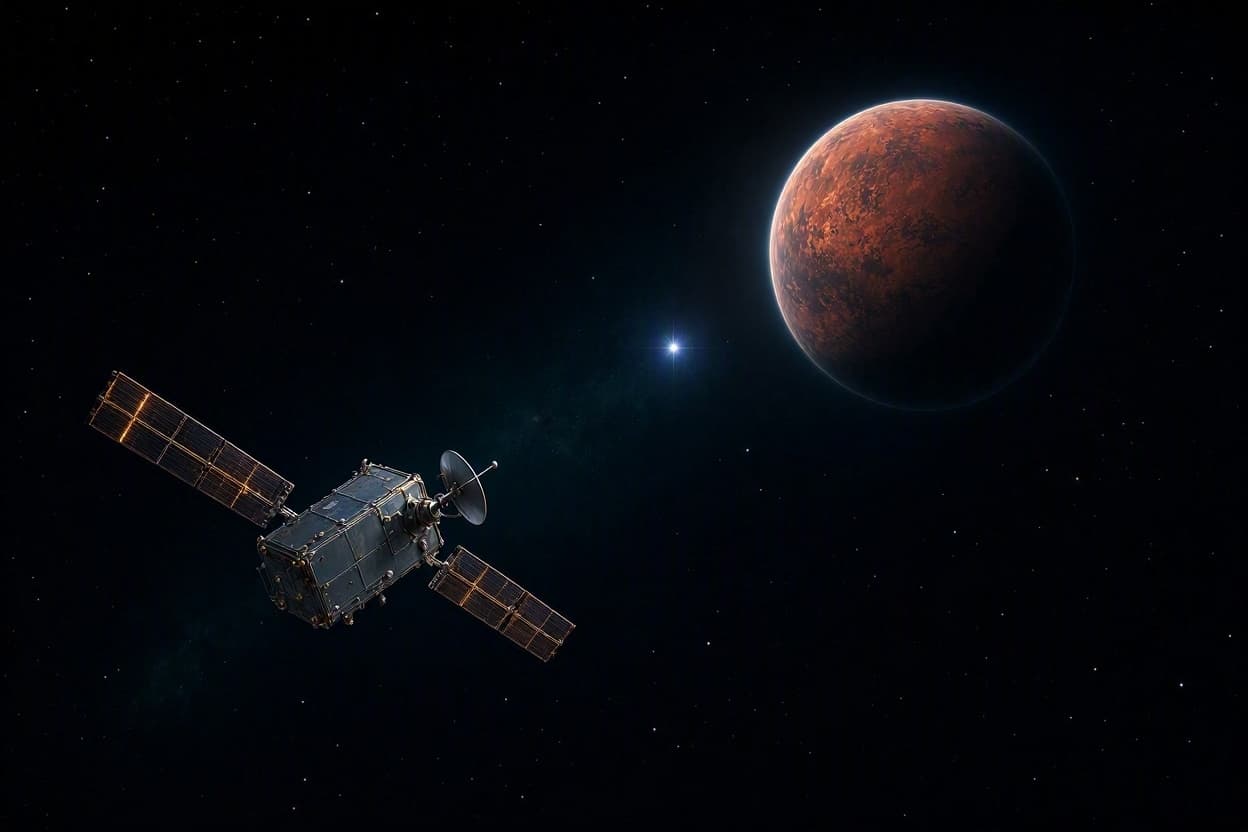
In the dark sea of space, where Jupiter’s mighty bands swirl like ribbons of time, there exists a world shaped by fire and rhythm. Io, one of Jupiter’s closest companions in the cosmic dance, has long been known as a place where heat and rock embrace in a ceaseless song of creation and release. Recently, scientists listening to this ancient celestial music detected a crescendo unlike any before — the most powerful volcanic eruption ever observed in our solar system beyond Earth’s fiery heart.
When NASA’s Juno spacecraft skimmed past Io on December 27, 2024, an instrument designed to see the invisible — the Jovian Infrared Auroral Mapper — sensed something extraordinary. A region in Io’s southern hemisphere lit up with an intensity that overwhelmed the detector, revealing dozens of volcanoes flaring in synchrony. Together, they formed a vast hotspot, stretching across tens of thousands of square miles, pouring out energy many times greater than all of Earth’s power plants combined. It was a moment when the hidden veins of a distant world seemed to pulse with a force that dwarfs familiar earthly storms.
Scientists describe this scene with a mix of wonder and curiosity. The eruption appears not as a single fountain but as a chorus of vents, perhaps linked beneath the surface by a network of molten rock channels. Like the gentle rush of invisible streams that feed a river, these subsurface flows may have synchronized, allowing this breathtaking release of heat and light to unfold across Io’s crust.
This discovery is rooted in the peculiar physics of Io itself. While most moons lie silent and cold, Io is gripped by Jupiter’s immense gravitational pull. As it swirls in its elliptical orbit, the moon is pulled and stretched, warming its interior like a forge at the hands of unseen smiths. That relentless flexing keeps magma stirred and ready, creating one of the most volcanically active landscapes known to humankind.
For researchers, the event offers more than a record to marvel at. It presents a lesson in how planetary bodies evolve under forces far stronger than those shaping Earth. It whispers of hidden chambers deep beneath the surface and challenges our ideas about how heat, pressure, and time interact across different worlds. In the quiet reading of infrared light, these ideas begin to take shape, like embers glowing in the night.
In the gentle stillness of scientific discovery, there is no judgment — only an invitation to look deeper. As Juno continues its journey, and as eyes on Earth and in space return again and again to Io, we are reminded that the solar system is not a static place, but a living one, breathing in heat and motion, unfolding stories older than our own.
🖼️ AI Image Disclaimer (Rotated Wording)
“Visuals are created with AI tools and are not real photographs; they are conceptual depictions.”
📰 Sources
NASA Jet Propulsion Laboratory news Space.com astronomy reporting Gizmodo science article Universe Magazine space science coverage Madhyamam Online science news
Published by Banx Network. This article is part of the Banx decentralized media programme, powered by the BXE token on the XRP Ledger.